
 Fr Joseph Esper
Back in 1980 a national magazine ran a story about a man who had a very unusual experience earlier that year. While out running some errands, he returned to his car, which was in the parking lot of a large shopping mall. As he opened the door, he saw a note lying on the front seat. It said: “Dear sir or madam, I fully intended to steal your car until I saw your bumper sticker which says ‘Peace be to you.’ It made me stop and think. I reasoned that if I did steal your car, you certainly would not be at peace, and on the other hand, I felt I would not be at peace, either, as this was to be my first car theft. So, ‘peace be to you’ and to me. Drive carefully, and next time lock your car.” The note was signed “A Would-Be Car Thief” (Mark Link, S.J., Illustrated Sunday Homilies, Year C, Series I, p. 79).
This is an example of how our efforts to promote peace—including something as simple as a bumper sticker—can make the world a better place. We know, of course, that it doesn’t always work this way, and that many times our efforts to influence others through our example of love and kindness seem to be wasted or have no effect. Nevertheless, Jesus calls us to demonstrate our faith and love to the world—and He offers us the Eucharist as a source of courage and strength as we attempt to do this. As Catholics, we’re expected to accept and experience Christ’s peace here at Mass, and then carry that peace with us as we leave here, so that we might share it with others.
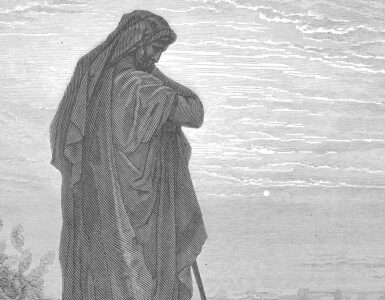
The Hebrew word for peace is “shalom.” This means more than just the absence of war and violence; it implies freedom from trouble, and the presence of health, security, and spiritual and material blessings. This is the image given us from the Book of the Prophet Isaiah (66:10-14). Jerusalem had been destroyed and her people carried off into exile. However, those who were mourning over Jerusalem’s misfortunes would have reason to rejoice. The Lord promised…
I will spread prosperity over Jerusalem like a river, and the wealth of the nations like an overflowing torrent. . . as a mother comforts her child, so will I comfort you; in Jerusalem you shall find your comfort.
Thus, God assured His people that after knowing only violence and affliction, they would finally be at peace.
In his Letter to the Galatians (6:14-18), St. Paul describes this wondrous peace in spiritual terms. He had suffered greatly as a servant of Christ, but these sufferings were as nothing to him because of the peace he had received. The apostle promises that all who follow Jesus can have this same inner peace. Jesus Himself speaks of this great gift in the Gospel of Luke (10:1-12, 17-20) and tells us that we must freely share it with others. When sending the seventy-two disciples out as missionaries, He instructed them not to worry about material things, and to offer their peace to everyone they met. The reason for this was simple: if the disciples were obviously preoccupied with money and other material concerns, they would not be at peace, and thus wouldn’t be effective or believable representatives of the King of Peace. This remains true today; genuine disciples of Jesus must ask the question, “What can I do for God’s glory and for the well-being of His people?,” rather than “What’s in it for me?”
It’s through our spiritual nourishment at Mass that we can become living signs of God’s peace and love for others. When the Virgin Mary appeared to the three shepherd children of Fatima in Portugal in 1917, she described the “Peace Plan from Heaven:” a request that we perform acts of penance and fasting, repent of our sins, and pray for the conversion of sinners. These are vitally important and necessary things that we can and should do on our own, and the message of Fatima is perhaps more important now than ever before—but when we think about it, the things Our Lady requested also occur most perfectly at Mass. For example, we fast for one hour before receiving Holy Communion, we greet and wish peace to those in the pews around us, we acknowledge our sins at the beginning of Mass and ask God to forgive us, we pray for the needs of the Church and of the world—including the conversion of sinners—and we participate in the sacrifice of Jesus, the greatest sacrifice of all. Thus, we should have an increased awareness of the responsibility the Mass places upon us. The grace and strength we receive here isn’t for our own benefit only; Jesus wants us to carry these gifts to others.
What can we do during this coming week to share the peace of Jesus? We could perform a favor for someone, especially when it’s inconvenient for us, or offer a sincere compliment to another person—particularly someone in our own family, or someone we tend to take for granted. We might try extra hard to avoid gossiping, and “hold our tongue” in a situation where we’d normally criticize. We could go out of our way to avoid arguing, and silently pray for those who offend us. We might make an extra effort to be courteous, friendly, and helpful. We can contribute to any worthwhile charity working to alleviate suffering in the world and to improve the lives of the downtrodden. And, as always, we can offer our prayers and sacrifices for peace, and place our lives completely in the hands of Christ.
Jesus doesn’t call us to be naïve or to throw caution to the winds; we should still lock our cars, take reasonable steps to defend ourselves and our families, support and defend our country, and continue to oppose evil in whatever form it appears. Above and beyond all this, however, we must be living signs of the peace, freedom, and love which only Christ can give. The Eucharist nourishes us, strengthens us, and challenges us to bring these gifts to the world.

 Fr Dino Vanin
 Fr Charles Irvin