

 Fr Dino Vanin
We have an existential problem. Sunday after Sunday, we risk failing to capitalize on what God’s words are meant to elicit in our minds and hearts. Too often, we forget that the Lord is present in our midst with all his awesome, boundless power, as well as in our hearts in such an intimate, personal way that there should be nothing to fear. The consequence is easily predictable: we feel anxious and worried even for reasons that are embarrassingly marginal.
But this is an experience which we have in common, across millennia, with the large portion of humanity suffering from weak faith. Elijah felt so frustrated by lack of results in his mission to keep the Israelites faithful to the Lord, that he felt drained of all energy. Had the Lord forsaken him? At that juncture, to him, it sure seemed that way! Even rootless queen Jezebel was after his life; so, panic-stricken, he wished to die. His depression lasted until he felt again the presence of the Lord. Thankfully, at times, the reassurance of God’s presence comes into our hearts in a very gentle and soothing manner, like the tiny whispering sound of the breeze on Elijah’s face.
In contrast, since his conversion, St. Paul’s trial of anguish for the salvation of his fellow Israelites continued for the rest of his life. He felt great sorrow and constant anguish in his heart. (Cf. Romans 9:2) The comfort that allowed him to go on came from the unshakable conviction that God is forever faithful to his promises and Christ Jesus, a Jew, is the ultimate pledge of God’s faithfulness to those promises. Hence, it appears that Paul rode a spiritual rollercoaster. At times, he was extremely elated because nothing could separate him from the love of God in Jesus Christ; while other times the anguish of wondering about the salvation of his fellow Jews became overwhelming. So, up and down he went.
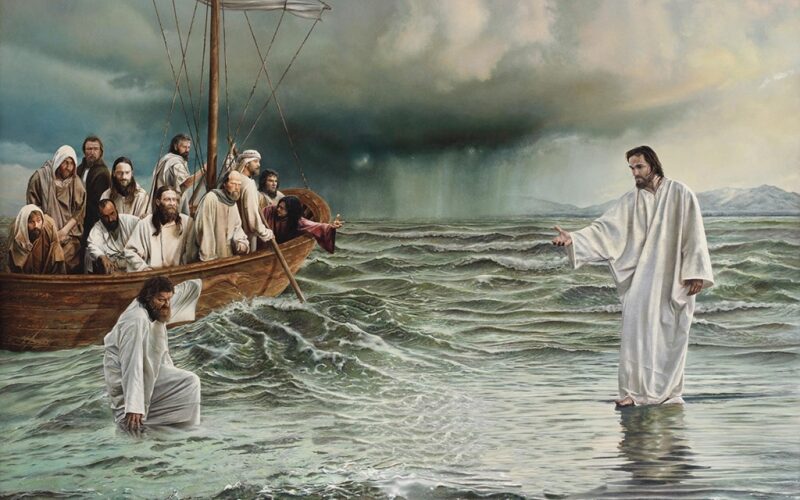
Like St. Paul, some of us ride the rollercoaster of spiritual elation and anguish, where the peaks are around the time we gather for the Eucharist on Sunday, the lows whenever, during the week, we let anguish and apprehension take over and rule our lives. The gospel passage (Mt. 14:22-33) offers us yet another form of fear and anxiety: The constant worrying that nags us most of our days, but that allows us to function from day to day, suddenly can throw us into panic.
In these extreme cases, we too get the “sinking feeling” Peter experienced as he was walking towards the Lord. We hear the Lord calling us to himself: “Come!” Yet, time after time, we are the victims of an error of our own making. We forget that Jesus is walking on water. That is something humanly impossible. The waters are dangerous by themselves, and then there is the strong wind, sweeping across the surface.
His invitation to go to him across an unwalkable element, under the most adverse circumstances, is an allegory we need to interpret and apply. It does not calm the storms of life; it does not provide us with a sudden solid road under our feet. Hence, as soon as we take our eyes away from the Lord; as soon as we look down at the water or feel the buffeting of the perilous wind, we begin to sink. We must keep in mind that Jesus’ Word to us is strictly a guarantee that he is there for us; it is not the magic removal of the adverse elements we are facing. Astonishingly, firm trust in the Lord allows us to tread on what is humanly impossible, in the dark, contrasted by the force of the strongest winds, amid daunting difficulties. The only surety is his presence. The only surety is his strong hand which will grab us tight as soon as we cry out to him.
Hence, the word “Come” doesn’t make us privileged people with a divine exemption from tears, pain and doubts; but if we keep reminding ourselves that the one calling us is the Lord, the sinking feeling will cease. However, we can be so weak in our trust in the presence of the Lord that we might engage in a feverish search for sensational events like miracles, apparitions, visions, and personalized divine messages.
But that is certainly the wrong way of preparing for future storms and menacing waves.
It is in the boat; it is in the Church as a community of faith, where we can capitalize fully on the presence of the Lord. In that seemingly fragile boat, there is a communality of frailty, doubt, fear—and little faith. But there is always, always, and forever the Lord. All of us so small, so frightened, yet big and bold, and courageous and daring from the moment in which we, as a group, do him homage and say: “Truly you are the Son of God. You will always be there to steady us with the strength of your almighty arm!


 Deacon Donald Cox
 Fr Joseph Esper