 James S. Anderson
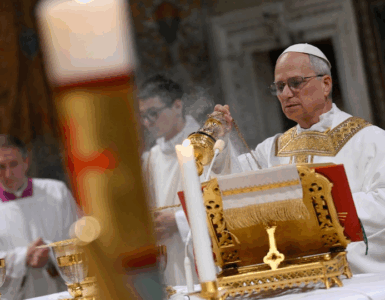
It was a great blessing to read the special interview of Father Rozo Palic entitled “The Wounded Healer” in the last issue of Shalom Tidings (March/April 2026). It served as a reminder for me as a Psychotherapist and Catholic of the healing power of the Eucharist. Indeed, as Fr. Palic explained, we carry wounds and it is Christ who is the ultimate source of healing. As Jesus is truly present — body, blood, soul and divinity — in the Eucharist, to Jesus in the Eucharist is where we are to go to heal our wounds and to find sustenance in this life. In fact, doing so provides us with Jesus’ very own life-force.
Father Palic touched on how often our physical ailments have spiritual maladies at their core. The Psychoanalyst Carl Jung said, “At bottom all psychological problems are spiritual problems.” Many of the clients I see present with physical ailments that are in all probability psychosomatic, as when their emotional and psychological issues subside, their physical issues do as well. Research continues to show that one’s level of spirituality and reliance on God directly correlates in a positive way with better healing outcomes and wellbeing. I have certainty seen this borne out in therapy. Those who rely most on God do make the most progress; those who surrender all to God have the best outcomes. The best way to surrender to God, as Father Palic reminds us, is to turn to Jesus in the Eucharist.
The article identified the differing deep wounds we carry and how healing “requires distinguishing between the wound itself, the sin it enables, and the Enemy who exploits both.” The article then immediately explains that the antidote for of this is: “Jesus, truly present in the Eucharist.” How true these words are! Working with clients, I have found sometimes we need to unpack how tangibly such a profound truth at this needs to look in practice, in large part so the client will know what steps to take and will try them out. About the antidote Fr. Palic points to and thus how one can tangly heal, the answer is simple: by partaking of the Blessed Sacrament worthily (see 1 Corinthians 11:27-29) at Mass and visiting Jesus at Adoration.
Indeed, the Eucharist is greatest, most inexhaustible mystery hiding in plain sight. To unpack it briefly from Scripture, it needs to be understood that for an ancient Hebrew mind, it was believed that the life-force (nephesh in Hebrew) of all beings is contained in their blood (dam in Hebrew). That is precisely why the Torah forbid eating blood. Leviticus 17:11-12 reads: “For the life of the flesh is in the blood; and I have given it to you for making atonement for your lives on the altar; for, as life, it is the blood that makes atonement. Therefore, I have said to the people of Israel: No person among you shall eat blood, nor shall any alien who resides among you eat blood.” Is it any wonder why today when we go to a doctor and do blood work, it usually can tell us what is going on with a person? Therefore, when we partake of the Eucharist, in a very real way we ingest and take in the life-force of Jesus from his dam.
No wonder why, then, some were scandalized by Jesus words in John 6 regarding the necessity of us eating his flesh and drinking his blood, words that actually made some leave Him when he uttered them:
So, Jesus said to them, “Very truly, I tell you, unless you eat the flesh of the Son of Man and drink his blood, you have no life in you. Those who eat my flesh and drink my blood have eternal life, and I will raise them up on the last day; for my flesh is true food and my blood is true drink. Those who eat my flesh and drink my blood abide in me, and I in them.
John 6:53-56
Tellingly, after many leave Jesus because this was too much for them to handle (see John 6:66). Jesus never says, “Oh, wait a second, come back as I only meant these words only in a symbolical sense,” to those who departed. Rather, he lets them walk away and his disciples comment on how, indeed, this is a hard teaching (6:60). Interesting, this teaching even today sadly causes much division in the body of Christ.
It is the case that only a god or a madman would make such a clam, as C.S. Lewis argued regarding Jesus and his claims in general, and we undoubtedly know Jesus was not the former. No doubt only a god, Jesus, could make such a pronouncement that superseded what previously was given by God in the Torah, specifically in Leviticus, as technically Jesus words ask one to violate Torah. Jesus is the only one who stood and stands above the Law or Torah. He gives us a New Torah at the Last Supper in the Eucharist.
It is indeed by God’s providence that Jesus was born in a city that in Hebrew literally means “house” or “temple of bread,” Bethlehem (beth lehem). Recall in John’s Gospel Jesus also states that he is the living bread of life come down from Heaven (6:51),which resonates with and calls to mind the manna that God provided in the book of Exodus that sustains the Israelites during their wilderness wonderings. The manna foreshadowed the bread of the New Covenant, Jesus, and how he sustains us in the Eucharist. In the book of Exodus, one needs recall that the Passover was not completed nor the Covenant at Sinai until a sacred meal was eaten, and so it is with the New Passover and New Covenant in the blood of Jesus. The sacred meal of the New Passover and New Covenant is the Eucharist Jesus instituted at the Last Supper. This meal ratifies the New Passover and New Covenant in Jesus blood every time we partake of it.
Shalom Tidings’ “The Wounded Healer” helpfully displayed how Father Rozo Palic’s ministry, insights regarding our wounds and explaining of the place we are to go for healing — Jesus in the Eucharist — could not be more timely and true for all times. Countless miracles surrounding the Eucharist and its healing effects throughout the ages abound. Numerous people have told me of profound encounters they have before the Blessed Sacrament and at Eucharistic Adoration. One should run to these for healing; that is how one tangibly takes steps to heal. There you will encounter Jesus and your life will change for the better. As the Real Presence of Christ exists in the Eucharist, it is the place to encounter Him. He is the ultimate Healer and thus the Eucharist is the place for true and lasting healing of our wounds, both psychological and physical. It is the place of communion with Him and other members of the body of Christ. Parking of Christ worthily at Mass and spending time with Him at Adoration is how one tangibly encounters a healing and where one undergoes a transformation. When we allow the nephesh of Jesus to enter us via partaking of His body and blood (dam) in the Eucharist, we cannot help but be transformed and healing will come.

 Fr Joseph Esper
 Fr Charles Irvin

 Deacon Steve Greco