

 Fr Joseph Esper
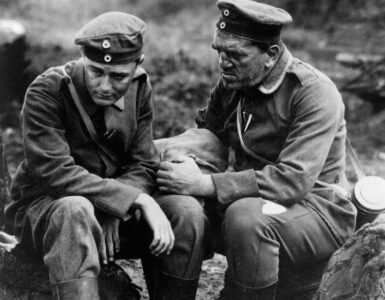
During World War II, a few months after the Germans had invaded and conquered France, a French priest was saying daily Mass in the little village to which he was assigned. Coming out of the sacristy, he noticed the church was empty, but that didn’t matter; he began Mass anyway, saying the prayers aloud in Latin. A few minutes later he heard a male voice saying the Latin responses. Even though the man had arrived late for Mass, the priest was pleased to have at least one person in attendance. Now, in the old days, the priest faced the altar up against the front wall, with his back to the congregation, and at a weekday Mass, there being no homily, he didn’t even see the people until it was time to distribute Holy Communion. When this priest turned around to give Communion to the one person present in church, he was shocked and upset to find that it was a German soldier. The French priest was offended; anger and national pride won out over his Christian duty, and he turned right around and put the Blessed Sacrament back in the tabernacle, without allowing the German to receive.
Old grievances and suspicions sometimes linger for many years. I once had the chance to tour the area around the city of Verdun in eastern France. A terrible battle was fought there in World War I; the French and the Germans each lost over 350,000 men killed or wounded in just a few months. The battlefield and the surrounding cemeteries are now a national shrine—and while there, I noticed something interesting. The cemeteries where French soldiers are buried have rows and rows of white crosses, as one would expect to see. However, in the German cemeteries, the crosses are brown—because the French government would not allow them to be painted white, as white is a color of innocence, and the Germans were the invaders. Old injuries take a long time to heal, especially when inflicted by foreigners—but such healing is possible. Near the city of Verdun there used to be a little village called Fleury. It was captured and recaptured, back and forth, eight times during the battle, and in the process was completely destroyed. Now the site is an historical monument, with little plaques mounted on posts at the sites where each of the buildings of the town once stood. There’s also a modern stone chapel in commemoration of all the dead—and here the French showed s true generosity of spirit, for the chapel is named not Our Lady of Fleury, nor Our Lady of France, but rather, Notre Dame de Europa—Our Lady of Europe. This is the spirit in which all Christians are called to live: a genuine concern not only for our own fellow citizens, but for the people of every land and nation. Jesus came to save everyone, and so we must place no limits on our love if we are to be citizens of His Kingdom.
The Jews were God’s chosen people; He revealed Himself to them in a way not granted to any of the other inhabitants of the earth. At first the Jews assumed this meant that they alone would share in the glory of His Kingdom; only gradually did they come to realize that it was the Lord’s plan for them to be a light to all the nations, teaching even foreigners to worship the one true God. In the Book of the Prophet Isaiah (56:1, 6-7), the Lord reveals that people of any nationality who pray to Him and serve Him with sincerity are pleasing to Him; as God says, “My house shall be called a house of prayer for all people.” In the Gospel of Matthew (15:21-28), Jesus demonstrated this truth in a practical way by healing the daughter of a Canaanite woman—a foreigner and a pagan, and thus someone whom the Jews considered unworthy of God’s notice and blessings. The apostles were greatly embarrassed by the scene she was making through her persistent begging, and wanted Jesus to grant her request just so she’d be quiet and leave them alone. By pretending to ignore her, Our Lord gave her the chance to demonstrate her faith in His power—and when she did, He happily granted her prayer. God hears the prayers of all His children, regardless of nationality, race, or social status. In his Letter to the Romans (11:13-15, 29-32), St. Paul reminds us that we can’t assume that just because we belong to the “in” group, we’re automatically pleasing to God. The Jews were God’s chosen people, but most of them rejected the Messiah Whom He sent; their disobedience provided an opportunity for the Gentiles to hear the Gospel, but Paul remained concerned for his fellow Israelites and looked forward to their eventual conversion. In the same way, we as Catholics must not become complacent in our faith; we must always experience our religion as an obligation, and opportunity, to serve others in Christ’s Name, without exception.
Sometimes we as Americans can get very upset with foreigners—often with good reason. It is true that the United States doesn’t get sufficient credit for its generosity, its good example, and for all the beneficial things it does. It’s also true that some other countries and peoples are greedy, violent, and corrupt, and act in a way that makes them our enemies. None of these truths, however, excuse us from our duty to love other people, foreigners included. There are wicked people in the world, such as terrorists and criminal regimes, who must be opposed—if necessary, by force; even so, we still have an obligation to desire and pray for their conversion. Jesus wants everyone to be saved—not only Catholics, and not only law-abiding, middle-class Americans. He loves non-Catholics and foreigners, churchgoers and non-churchgoers, religious believers and atheists; He even loves terrorist, dictators, white-collar criminals, gangsters, drug pushers, abortionists, pornographers, and everyone else whose values and lifestyle we rightly reject. This means that even as we refuse to support or associate with certain people, we must still love them—for it’s our Christian ideal that we should hate the sin, but love the sinner. We can and should offer daily prayers and sacrifices for people who are different from us, for people whom we dislike for any reason or no reason, and especially for all the wicked people in the world who have so far rejected God’s love; the Lord wants us to pray not only for the victims of evil throughout the world, but also for the conversion of all evildoers—including those who hate us or consider us their enemies.
In spite of our many faults, we as Americans are probably less prejudiced, less vengeful, and less likely to hold a grudge, than almost any other people on earth; during World War II, for instance, Germany and Japan were our mortal enemies, but afterwards we helped them rebuild, and now they’re our allies. That’s greatly to our credit, but God asks us to do even more—as individuals, and as a nation. The Lord always offers us opportunities to share His love and peace, and as long as our hearts are open, we’ll recognize them and be given the grace to make good use of them. In some still-incomplete but wonderful way, God’s Kingdom is already here among us—and our lives and example should point to it, and invite others to enter into it.


 Jennifer Borek

 Deacon Kurt Godfryd
 Deacon Donald Cox