

 Fr Joseph Esper
In 1896 a German immigrant to the United States, a man named Emmanuel Ninnger, paid for his purchases in a grocery store with a $20 bill. The sales clerk counted out the change, but after the customer left, noticed some smudges on her sweaty fingers. Looking at the $20 bill, she saw that it was smudged, too; she showed it to the store manager, who summoned the police. An officer confirmed it was counterfeit—in fact, he said, it was a masterful piece of counterfeiting, the best he had ever seen. The sales clerk happened to know the customer’s name, so the police were able to get a warrant to search Ninnger’s apartment. During the investigation, they found an artist’s easel, to which was clipped a genuine $20 bill. Incredible as it sounds, Emmanuel Ninnger hand-painted each separate counterfeit bill, one at a time—and he always produced near-perfect copies. Ninnger was arrested, convicted, and sent to prison—but that wasn’t the end of the story. The police also discovered three portraits Ninnger had painted; these were confiscated and sold at a police auction, bringing in a price of over $5000 each—an incredible amount of money in the late 19th century. Ironically, it took Ninnger about the same amount of time to paint a $5000 portrait as it did to paint a $20 bill. (Brian Cavanagh, Fresh Packet of Sower’s Seeds, #43)
Emmanuel Ninnger was a thief, and he might have gotten away with his counterfeiting had it not been for a sales clerk with sweaty hands. The question can be asked, however, from whom did Ninnger steal the most? The answer is none other than himself; not only did he misuse his incredible talent, but he actually could have earned much more money if he had made an honest living. In the same way, if we seek this world and its pleasures instead of Heaven, we are stealing from ourselves. God gives us life on earth as an opportunity to become eternally rich in His Kingdom.
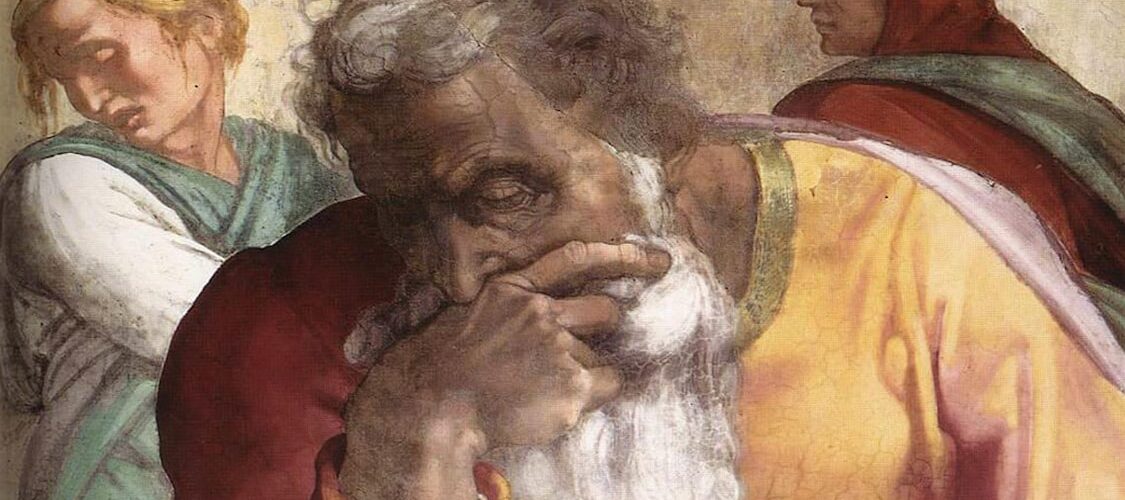
It’s often said that things are never quite as they seem, and this is most especially true in terms of life and death. The world fears death, and tells us we must live with gusto, grabbing as much for ourselves as we can, delaying and denying the inevitable while fleeing from every possible form of sacrifice and suffering. The values of the Kingdom of God are quite different. Many times we are called to suffer and make sacrifices; moreover, it quite often seems our sincere efforts to do good aren’t appreciated, but only get us into trouble. This was certainly the experience of the prophet Jeremiah (20:7-9). He faithfully proclaimed God’s message at great personal cost, but this only made him intensely unpopular. Jeremiah’s life was an unhappy one, but it’s safe to presume that he is now eternally happy and greatly honored in Heaven for his faithfulness. As St. Paul (Romans 12:1-2) tells us, we must not conform ourselves to this world and its values; instead, he says, we must “be transformed by the renewal of [our minds], so that [we] may discern what is the will of God, what is good and pleasing and perfect.” Living this way doesn’t come naturally, as the Gospel of Matthew (16:21-27) shows; Peter thought death was a tragedy that his Master had to avoid at all costs. Jesus sternly rebuked him, and then explained that the only way to be true to ourselves is to surrender to God’s will. If we gain the entire world at the cost of our souls, we lose everything. If instead we use our earthly lives as an opportunity to die to self by taking up our cross each day, we gain eternity. Placing God’s will ahead of our own brings a happiness and peace and value to life that simply can’t be obtained in any other way.
Each of us has a cross to bear; it may be painful, but it’s also very valuable, as it can be our way of following Jesus and thus preparing ourselves for Heaven. If we rebel against this, we hurt ourselves more than anyone else. This is perhaps the deepest tragedy involving all those people who’ve committed assisted suicide over the last few decades. Not only are there hospices and pain-management techniques available today to help such persons cope with pain, but in choosing death before their time, they rob themselves of the opportunity to make a valuable sacrifice pleasing to God; they’re following the false way of the world Peter suggested, not the way of Jesus Christ. Assisted suicide is against God’s will; even assuming a merciful judgment on His part, those who commit it certainly aren’t ready for Heaven when they die. They must be cleansed of their sins in purgatory—and purgatory does exist, and this always has been and always will be a teaching of the Church. In fact, there are numerous legends and private revelations of people claiming to have had visions or even spiritual experiences of purgatory. All of them state that suffering there is much more intense than it is here on earth—and yet our suffering here in this world is much more valuable, because we can freely choose to offer it up as a sacrifice for ourselves or others, and let it be an expression of our gratitude for all that Christ suffered for us.
God doesn’t ask us to seek out suffering, nor does He want us to neglect every reasonable effort to alleviate it, but if it comes, He desires us to offer it up as a sacrifice. If we don’t, we’re not cheating Him, but ourselves. Every time we experience something difficult, painful, or merely unpleasant or inconvenient, we can silently pray, “Lord, I offer this up for Your glory, or for the souls in purgatory, or in reparation for my sins,” or for whatever or whomever we wish. If, for instance, we’re suffering a bad headache, or stuck in traffic, or feeling miserable in the heat and humidity, we can either waste the opportunity or even let it become an occasion of sin by cursing or complaining—or we can try to get some benefit out of it by enduring it as patiently as possible, thereby making it an offering to God.
We can offer the Lord not only our sorrowful and painful experiences, but also our joyful and rewarding ones; this sort of offering is also pleasing to Him—and it stands to reason that if our automatic reaction is to praise and thank Him every time something good happens, He’ll send us even more blessings as a way of bringing us still closer to Him. God doesn’t want our lives to be unpleasant, but He does want them to be focused; He desires that we paint beautiful spiritual portraits of ourselves, not cheap counterfeits which only pretend to bring happiness. Jesus warns us that if we concentrate only on this world, we are in danger of wasting our lives, and if we seek only ourselves, we will bring ourselves to ruin. In all things, God’s will must come first. This was the path Jesus traveled to eternal glory, and He invites us to follow this path as well.


 Donald Wittmer
 Deacon Gregory Webster


 William Borst