

 Carolyn Humphreys, O.C.D.S.
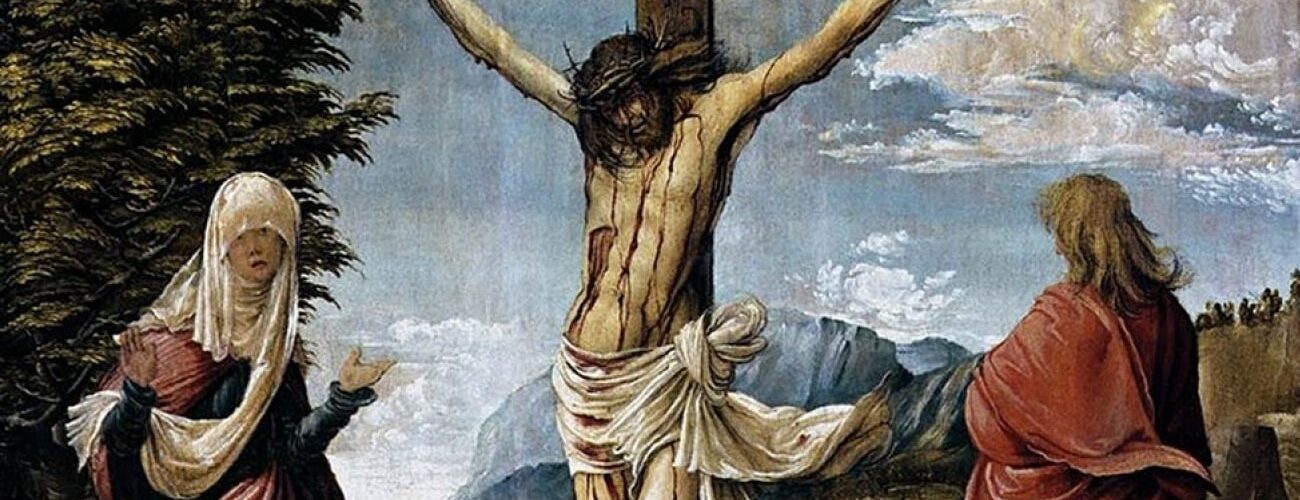
The bishop of Notre Dame Cathedral in Paris, many years ago, was a great preacher and evangelizer. He tried to reach out to unbelievers, scoffers, and cynics. He liked to tell the story about a young man who would stand outside the cathedral and shout hateful things at the people entering to worship. He would call them fools and all kinds of names. The people tried to ignore him but it was difficult. One day, the parish priest confronted the young man. The young man ranted and raved against everything the priest tried to say. Finally, he said to the young scoffer: “Look, let’s get this over with once and for all. I’m going to dare you to do something . . . .and I bet you can’t do it.” And, of course, the young man shot back: “I can do anything you propose.” “Fine,” said the priest. “All I ask you to do is to come into the sanctuary with me. I want you to look into the face of the figure of Jesus on the cross and I want you to scream as loudly as you can: “Christ died on the cross for me and I don’t care one bit.” So, the young man went into the sanctuary and screamed as loud as he could, looking at the face of Jesus on the cross—-”Christ died on the cross for me, and I don’t care one bit.” The priest said, “Very good. Now do it again.” And again, the young man screamed with a little more hesitancy—-“Christ died on the cross for me and I don’t care one bit.” “You’re almost done now,” said the priest. “Now, say it one more time.” The young man looked up at the crucifix, raised his fist in defiance, but the words just would not come! He just could not look at the face of Christ and say that anymore. After telling the story, the bishop said, “I was that young man. . . . That defiant young man was me! I thought I did not need God, but I found out that I did.”
This story, revealed to us by Father George Rink, illustrates how a bright lightning strike of grace can change the direction of our lives. The face of Jesus on the cross has changed the direction in the lives of innumerable people. Who, in their right mind, would not be moved by the face of the crucified Jesus? A crucifix has the power and strength to attract, draw and ravish us. Even if people have an adverse reaction to a crucifix, it is a symbol of Jesus’ sacrifice by death that resulted in his resurrection and the redemption of humankind. We are called to live the paschal mystery. John Paul II encourages us, “There is no evil to be faced that Christ does not face with us. There is no enemy that Christ has not already conquered. There is no cross to bear that Christ has not already borne for us, and does not now bear with us. And on the far side of every cross we find the newness of life in the Holy Spirit, that new life which will reach its fulfillment in the resurrection. This is our faith. This is our witness before the world.”
Our journey in faith can start slow, progress in fits and starts, or have times of dense fog, but as long as we keep moving ahead, it is the greatest and most captivating journey in our lives. Teresa of Avila said that we either go forward or backward on our faith journey. Keeping this in mind, we must persevere in faith formation. This is not an easy road, and we need guideposts to point us in the right direction. Our faith journey is rooted in, and radiates the incomprehensible love of, God. It is the only journey that does not end on this earth. Engrossing as they may be, all things pass on this earth, and as they pass, we see the value of that which lasts forever.
Prayer connects us with the eternal realm of heaven. There are guideposts with flashing red lights that tell us to stop and pray. When we see them, we rearrange some aspects of our day so that there is time to pray in a place where we are relatively free of distractions. These sacred times become a daily need, and we treasure them beyond measure. Time spent in prayer is well spent. Prayer inspires us to give small services to others such as kindness to the annoying telemarketer, or a few encouraging words to a down heartened person. Prayer teaches us to look for the Lord within others and ourselves. As pioneers who take Jesus and the gospel seriously, prayer supports us on our frontier path. We live as if Jesus were by our side and talk with him as if we would to a dear friend and sound guide. This sustains bypassing sinful detours and moving ahead.
Jesus said, “Blessed are the pure in heart for they shall see God” (Mt 5:8). Today, an important guidepost is purity of heart. This is not for lukewarm or complacent Christians because purity of heart is unsustainable by mediocrity. The more we understand purity of the heart, the more we comprehend the destructiveness of sin. Sin darkens the brilliance of purity by willful choices that turn us away from God’s love and goodness. A sin is anything that insults, affronts or diminishes human dignity or defiles or is destructive to human life. Dark elements within society label sin as unimportant, attractive, a topic for jokes or taken lightly. Evil is a strong motivator and can easily harm or destroy the life of the soul. John of the Cross imagined our soul to be surrounded by colorless, clean, unflawed glass. We can clearly see things inside and outside if we keep the glass spotlessly clean. However, our sins change the pristine glass to various shades of grey, or black, that blurs or blocks God’s wonder and magnificence from our eyes. Purity reveals how evil obscures accurate vision needed for the next good step. As a life long challenge, purity keeps us watchful and sober. Teresa of Avila wrote: “O Lord, how true that all harm comes to us from not keeping our eyes fixed on you.” Keeping our eyes on Jesus is based not on sweet feelings or fascinations of the moment, but on determination and hard choices over a lifetime. We strive to do this by attuning our will and intellect to God’s will, especially concerning the truths of faith. Augustine guides us, “Christians must believe the Creed so that by believing they may obey God, by obeying they may live well, and by living well they may purify their hearts. With pure hearts they can understand what they believe.”
The guardian of purity of the heart is prudence. Our Church provides doctrine, sacraments, opportunities for grace, discipline, guidance and spiritual growth, as well as cautions so that we avoid taking a wrong road. Prudence reveals that current or popular trends, behaviors, fashions, and ideations that are not spiritually healthy result in a seriously infected soul. Growing in the virtue of prudence is a great help in overcoming temptations aimed at deteriorating our spiritual well being. Prudence is a path and a prod. The path leads us to God. The prod keeps us on the path and moving ahead. Through Jesus’s cross and resurrection he has set us free and we strive to remain free from the clutches of anything that pulls us away from God and his love. Prudence fortifies our aim to be life long Christians and poses the question: What is life giving for my soul? Sound answers move us from violence to peace, despair to hope, indifference to love, sadness to joy, evil deeds to good actions, and selfishness to service. What are the prudential signs that protect us? To name a few: Avoid bawdy, noisy demoralizing places and people, and iniquitous entertainment. Keep company with good uplifting people. Practice modesty in speech, behavior, and dress. Prudence is like a wise elder mother who only wants the best for her children. She understands what the allurements the world has to offer us, but knows true treasures are found in God.
Prayer, purity of heart and prudence are only three of the many guideposts that direct us through our landscape of faith. Our Catholic faith is lived in everyday reality and if we keep our eyes open, we can find signs of God everywhere. Conor McCourt tells us a story: “A man who, in desperation, called out to God, ‘Let me see you.’ And a star shined brightly, but the man did not see. The man shouted, ‘God show me a miracle.’ And a baby was born, but the man did not notice. So, the man cried out in despair, ‘Touch me God and let me know you are here.’ Where upon God reached down and touched the man, but the man brushed the butterfly away from his shoulder and walked on. As time goes by in our spiritual journey we will intuitively realize there is no place where God is not. He is in the breeze that cools, in the sun that warms the body and gives needed nutrients. He calls through the sweet song from a morning bird. He is in the friend that advises and comforts; he is in the smile of recognition from a stranger’s eyes. St. Francis de Sales reminds us, ‘God is in all things and in all places.’ There is no place or thing in this world where God is not truly present. Just as where birds fly, they always encounter the air, we also wherever we go or wherever we are, we find ourselves in God’s presence.”
The more we travel forward, the deeper our friendship with Jesus grows. We follow Christ unreservedly, even when we do not fully understand his teachings. Words to guide us from post to post were written by Meister Eckhart a long time ago. “Be in all things a God seeker and at all times a God finder, among all kinds of people and in all kinds of circumstances. And make it a life habit to copy Jesus Christ. To do what he did and to avoid what he avoided. Always learn to love him as he loved us.”


 Fr Dino Vanin
 Deacon Steve Greco
 Fr Mario Attard OFM Cap
 Fr Charles Irvin