 James S. Anderson
As part of the process of liberating the Israelites from the bondage of Pharaoh, the book of Exodus demonstrates God’s mighty power by executing judgment on the God’s of Egypt (Exod 12:12). This is evidenced in how each of the ten plagues represents an attack on a specific deity of the Egyptian pantheon. In order to survive the final plague, the death of the firstborn sons of Egypt, which likely is in part a polemic against the Egyptian belief that Pharaoh is a god, God institutes one of the most famous events in Israelite memory, the Passover. Exodus then details Israel’s other monumental event, God’s covenant with the Israelites. These two pivotal events in Israel’s history serve as the interpretive matrix for understanding the pivotal events of Jesus actions and words at the Last Supper. Thus, the book of Exodus, perhaps surprisingly for many, contains the hermeneutical key for unlocking and understanding the Eucharist.
The Eucharist is an inexhaustible mystery we never truly fully grasp and one that is hiding in plain sight. Nothing is more important, for it is Christ himself — body, blood, soul and divinity. Hence, the Church declares it to be the “source and summit of the Christian life” (CCC §1324; Lumen Gentium, no. 11). When explaining the mystery of the Eucharist, Jesus makes use of the two salient themes of Exodus — Passover and Covenant. They can be found in Exodus 12 and Exodus 24, respectively, and both call to mind the Last Supper with the institution of the Eucharist recounted in the Gospels, as well as in Paul’s first letter to the Corinthians (11:23-27).
These central events for the life of Israel that are celebrated annually — the Passover and the Mosaic Covenant — are the interpretive keys for understanding Jesus and the Last Supper (The annual celebration of the giving of Torah by God at Mt. Sinai is known as Shavuot). After studying these stories anew, one will understand on a much deeper level how the central events of the Torah were used by Jesus to articulate his atoning work as well as the importance of the Eucharist. Most fascinating is the insight laying bare in Exodus; namely, that both the Passover and later the enactment of the Covenant at Mt. Sinai were completed with a sacred meal. (Contrary to some Evangelical Protestant streams of Christianity, Jabel al-Lawz in modern-day Saudi Arabia is not the Mt. Sinai of the Bible, not least because the biblical evidence precludes it and many of the claims surrounding the theory are untenable to say the least.) In fact, one learns from the text that the Passover was not even complete until the passover lamb was eaten after being slaughtered (Brant Pitre, Jesus and the Last Supper, 2015; The Jewish Roots of the Eucharist, 2011) and so neither was the covenant ceremony complete until a meal ratified it.
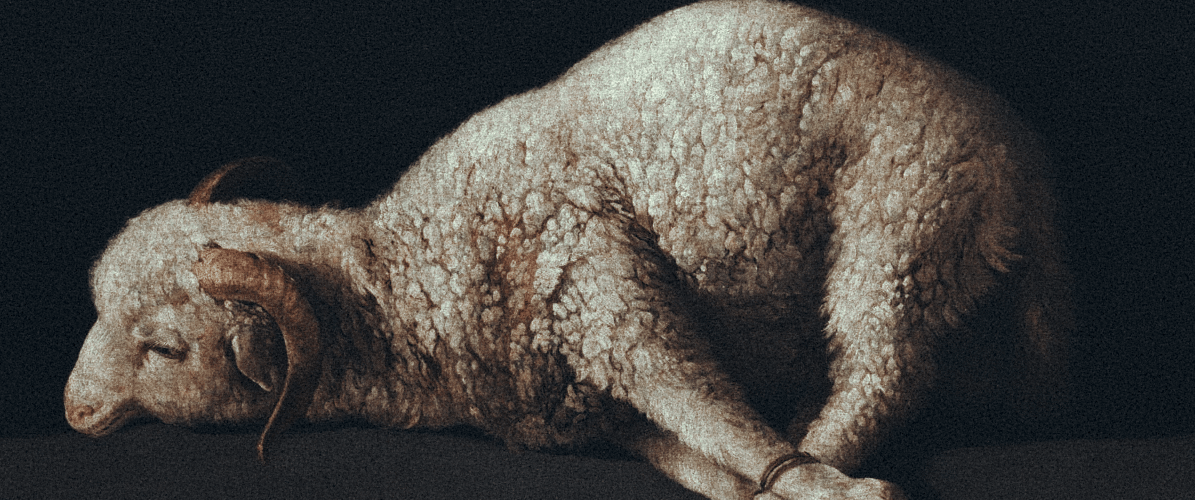
The choice of a lamb/ram in Exodus 12:3 (recall adult male sheep are called rams) is not without significance, lost to many of us today without knowledge of the ancient Egyptian context in which we find this story. In Exodus 12 the Israelites are commanded to slaughter for the Passover sacrifice an animal that was sacred to the Egyptians — a lamb. Archeologists have found temples in Egypt adorned with ram’s heads. The Israelites thus had to make a hard choice, essentially one between following God or the worldview of the Egyptians. They could find themselves in grave danger for killing an Egyptian sacred animal. In a way, God was asking them to make a very difficult decision, a choice between life and death. Who are you going to follow? This could cost them their lives and they knew it. God commanded this level of obedience, as he does with all of us.
That the Passover and the Mosaic Covenant were not complete until the sacrifices were eaten has huge implications for the sacrifice of the Last Supper, the first Eucharist, and all the Eucharistic meals that follow to this very day at every Mass. In the Synoptics and even in John’s chronology (Pitre, Last Supper, 2015), the Last Supper is a Passover meal in which Jesus is presented as the new passover lamb. At this meal he also institutes a New Covenant via his blood by explicitly stating it in his words over the Eucharist (Mk 14:24; Mt 26:28; Lk 22:20). Thus, as recounted in the New Testament, in a singular occurrence by his self-giving sacrifice on the cross, Jesus instituted a New Passover and a New Covenant, an event that amalgamated these Exodus stories in a new way. This New Covenant was previously prophesied about in Jeremiah 31:31-34. Interestingly, the only time “New Covenant,” which we also translate as “New Testament,” is mentioned in the corpus of texts of the New Testament, it is in a reference by Jesus to the Eucharist, and not the later twenty-seven books of the canon we call the New Testament. Indeed, profound! This New Passover/New Covenant involves a sacred meal, one that essentially ratifies it every time we partake of it. It is the Eucharist. In it Jesus’ sacrifice is represented across time and space and offered to us in an unbloody manner at the sacrifice of every Mass. It is a New Passover and a New Covenant in His blood. We affirm it and ratify it every time we partake of the Eucharist. Thus, this new offering is a beautiful amalgamation of a new passover and new covenant sacrifice.
The biblical text in its original languages reveals the above. One should recall that the New Testament was written in Greek, but Jesus spoke Aramaic, a sister language of Hebrew. The words of Jesus on the Eucharist at the Last Supper and us partaking of it explain that we are to do this “in remembrance” (anamnesis – Greek) of him. In his native language, Jesus would have used a variation of the Hebrew word “zakar” which means “to remember.” The Greek “anamnesis” is cultic, liturgical language calling to mind the memorial, grain offering of the Hebrews in the Jerusalem Temple in which the Mosaic Covenant was remembered and ratified each time it occurred. The Greek translation of the Hebrew Scriptures (the Septuagint) uses the term “anamnesis” for the “grain offering.” The Hebrew “zakar” carries a connotation of more than just remembering but also “making present.” Therefore, Jesus’ command to “do this in remembrance of me” means to make present again his sacrifice. We make him present again (zakar) at every Mass. This is significantly similar to how the Passover of the Jews is remembered or “made present again” (zakar) every year at their Passover celebration.
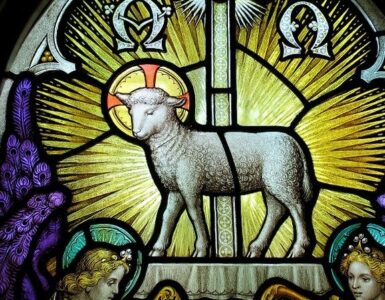
St. Augustine famously wrote regarding the Bible: “The new is in the old concealed; the old is in the new revealed.” Upon reading about the Covenant and Passover in Exodus through the lens of the New Testament, one can see clearly how Jesus is the Passover lamb of God, as the Gospel of John states explicitly (John 1:29). He institutes a new exodus and at the same time is the one who inaugurates a new covenant by his blood. The covenant ceremony in Exodus 24 foreshadowed a new covenant ceremony. The blood splashed on the altar and later the sacrifices offered to God as part of the ceremony, foreshadowed the blood of Christ which was offered and shed for us. Christ is already there in the Old Testament. The old is the “new revealed,” indeed, as Augustine tells us. What an illuminating revelation!
To elaborate a bit more on Christ’s free offering of himself on the cross to the Father, it should be noted that Christ’s sacrifice at Calvary profoundly pays the price for covenantal unfaithfulness to the Old Covenant while it simultaneously creates a new covenant between God and humanity. Only God could work out such details as this and in such a profound way with the concepts of covenant and passover that we find in Exodus. Scripture is indeed inspired by God, for it contains these profound messages of God with such depth and even mysticism. To some extent, our finite minds never completely grasp all of it, though faith illuminates aspects of it in our hearts. As the Holy Spirit is the author, Scripture is indeed a wonderful, inexhaustible mystery, as is the Eucharist. We are all called to immerse ourselves in it for our own edification and to learn God’s ways. The Gospels thus record how our Savior’s freewill offering to God on our behalf ushered in a new epoch of salvation history. Typologically speaking, it is the book of Exodus, in its telling of how the people were set free from the bondage of Egyptian slavery and encountered God at his holy mountain, that paved the way and foreshadowed the New Exodus and Passover of Jesus, the Lamb of God. He, like Moses before him, would in similar fashion enact a means of liberating humanity from death to life, that is, from bondage of sin to eternal life.
Perhaps, surprisingly, Exodus explains that the reason the Israelites were to be set free from the oppression of Pharaoh was so that they could go worship/sacrifice to the Lord after a three-day journey from Egypt (Exod 5:3). It is interesting to note that in the Bible, worship is always associated with a sacrifice. This has clear implications for the sacrifice of the Mass and the Eucharist, as opposed to other types of services. The three-day journey calls to mind Jesus’ three days between his death and resurrection. What has been argued here regarding Exodus also coheres with the observation that Jesus would later in the New Testament be presented as a new Moses, but greater to be sure; similarly, he is presented as a new Elijah but greater (James S. Anderson, Extolling Yeshua, 2019). He is thus patterned after these paradigmatic figures of ancient Israel but far surpasses them; it thus takes a plethora of images to begin to articulate who this Rabbi was that traversed first-century Palestine with a message of redemption and love — God incarnate. Undoubtedly, Jesus is also the “prophet like Moses” prophesied about in the Torah (Deut 18:15-19).
In conclusion, the book of Exodus narrates the institution of the Passover and the Mosaic Covenant, and these salient, pivotal events in Israel’s history foreshadow the figure and work of Jesus in multiple ways. As Jesus explicitly makes use of these events to articulate the offering of himself in the Eucharist at the Last Supper, the book should consequently be seen as one of the main hermeneutical or interpretive keys for understanding Jesus and unlocking his words and actions at the Last Supper. In combining the two concepts of Passover and Covenant, Jesus brilliantly uses them to explain his sacrificial offering — the Eucharist. Exodus then is the “new revealed” in the old. It points forward to how the Eucharist ratifies the New Passover and New Covenant instituted by Christ every time we partake of it. Exodus therefore unveils for us that the Last Supper is the institution of a new exodus.

 Fr Dino Vanin
 Br Matthew Marie, OSB
 Deacon Kurt Godfryd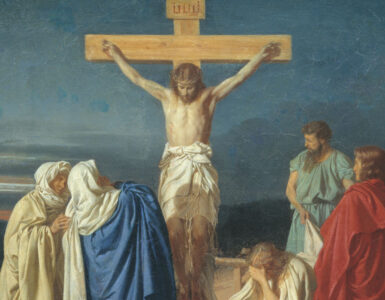

 Fr Joseph Esper