


 Fr Joseph Esper
Once upon a time there was a woman who was very proud of the fact that she greatly wanted peace in the world and an end to all warfare and violence, crime, family divisions, hunger, poverty, disease, and every other problem afflicting humanity. She herself wasn’t actively involved in working to solve any of these things, but she assumed that didn’t matter because her heart was in the right place. One night she had a dream in which she went into a little shop called the “Paradise on Earth Store.” To her amazement, she saw Jesus standing behind the counter—at least, it looked like Him. Getting up her nerve, she asked, “Lord, is it You?” “Yes,” He answered. “Do You work here, Lord?” she continued, and He said, “I don’t just work here; I own the store.” “Oh, well, what do You sell here?” she inquired, and He responded, “Anything a good and loving person could ever want. Feel free to look around.” Still in a state of shock, the woman began walking down the aisles, and was amazed at what she saw advertised there: peace on earth, loving families, crime-free neighborhoods, no more drugs, enough food for everyone, an end to poverty, clean air, wise use of natural resources, no more racial discrimination, morally uplifting TV shows and movies, fine schools, government leaders free of corruption and incompetence, churches without scandal, the spread of the Gospel throughout the world, and countless other wonderful things.
Overcome with delight, the woman began making a list, furiously writing down all these items and many others. Finally she brought the list to Jesus, Who skimmed it over quickly, smiled at her, and said, “No problem.” He then began reaching under the counter, picked out all sorts of small packets, put them in a box, and handed it to her. “What are these?’ asked the woman. Jesus explained, “Seed packets. This is a catalog store.” “What?” said the woman. “You mean I don’t get the finished product?” “Oh, no,” the Lord answered. “This is a place of dreams. You come in and see what the product looks like, and I give you the seeds. You plant them and nourish them and help them grow, and later someone else reaps the benefits.” “Oh,” said the woman, with great disappointment—and then she left the store without buying anything (Megan McKenna, Parables: The Arrows of God, p. 28). It’s easy for us to have noble and inspiring dreams, and to make our list of everything we’d change if only we had the power. As most of us know or eventually discover, life is a little bit more complicated than that. Change usually doesn’t come easily; worthwhile things take time, and even then there are no guarantees. This is an unavoidable fact of life, and patience is an essential part of Christian discipleship. God wants us to be laborers in His harvest, even if we don’t see immediate results.
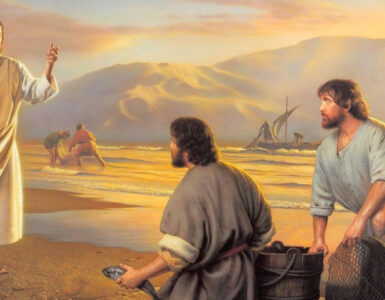
The Lord God offers us opportunities to share in His ongoing plan of salvation; what sort of response we make is entirely up to us. After freeing His people from slavery in Egypt, God told them, “If you harken to My voice and keep My covenant, you shall be My special possession . . . you shall be to Me a kingdom of priests, a holy nation.” However, more often than not, the Israelites did not keep their covenant, or sacred agreement, with God. Therefore God sent His Son to die for our salvation even though we were still sinners—or indeed, as St. Paul says, even though we were God’s enemies because of our sins. We are reconciled to God through the saving ministry of Jesus—and as we see in the Gospel, this is a gift He wants to share with all mankind. This mission requires our help and involvement, for as Our Lord says, “The harvest is abundant but the laborers are few.” As a result, each one of us has an important role to play in living out and proclaiming the Good News of salvation.
Once there was an idealistic young man, just about to graduate from college, who wrote to an uncle, “I think it’s up to young people like me to make a difference, so I’m going to go out into the world, work among the poor, be a peacemaker, fight for justice, and show people a better way to live. If after six months, however, I haven’t managed to change the world, then I’ll call it quits, find a good-paying job, and start taking care of myself.” Obviously this young man was soon disillusioned; it can take a lot longer than six months to change things, and some problems may never be completely solved—at least not by earthly standards. Jesus wants us to respond to this hard reality not with discouragement, but with hope.
For instance, we’re called to treat other people with compassion and respect. What if there’s someone who’s always in a cranky mood and never seems to appreciate our efforts on his or her behalf? We’re supposed to continue loving him or her, even if it seems a waste of time—for in a moment of personal crisis, that person may remember our unconditional love, take hope, and make a first tiny attempt to reach out in faith; when this happens, we will have played our role in aiding his or her conversion. We’re called to work for a better society, whether by being involved in the right-to-life movement, writing emails or letters to the editor or our elected representatives, boycotting the sponsors of certain TV shows, voting only for morally-acceptable candidates, and so on. It will often seem like we’re swimming against the tide—but once in a while, our additional effort may be just enough to swing things in a different, more favorable direction. We’re called to make a lifelong commitment to the most difficult reform of all: changing ourselves, using prayer, penance, the sacraments, and divine assistance to overcome our sins and faults. This can be very discouraging, especially as we grow older, but the Lord’s grace can accomplish miracles. God never gives up on us, and we will ultimately become truly holy, as long as we never give up on ourselves.
It’s easy to ask “Why are there so many problems in the world?” Jesus wants us to ask instead, “What can I do to help change things?” All of us can make a difference by being loving, faithful, and persistent. If we really want the world to change, we’ll show it by our Christian commitment; in particular, we’ll rely on daily prayer, the regular reception of the sacraments, occasional acts of penance and self-denial, a genuine concern for other people, and an ongoing thirst for God’s glory. These practices will help us recognize and use the opportunities we’re given to plant seeds of paradise here on earth. It’s easy for us, like the woman in the dream, to have wonderful and inspiring hopes for a better world, but if we’re not willing to get involved personally and make the necessary sacrifices, these noble desires count for nothing. If it’s true that the road to hell is paved with good intentions, we might also say that the road to Heaven is built of simple acts of love and faith, put into place again and again, one day after another. We may not be able to change the world in our lifetimes, but if we work faithfully in Christ’s Name, we will become part of the Kingdom of Heaven and we will help bring about a rich harvest.

 Fr Dino Vanin
 Deacon Donald Cox
 Fr Mario Attard OFM Cap