
 Paul Suski
On the 350th anniversary of the apparitions of the Sacred Heart to Saint Marguerite-Marie Alacoque in Paray-le-Monial, I offer this reflection on their broader significance and spiritual implications.
Devotion to the Sacred Heart did not begin with the private revelations to St. Margaret Mary. It is firmly rooted in Sacred Scripture and Tradition, going back to the early Church Fathers. Her visions, however, shed light on its true meaning and set it apart from other forms of piety by the distinctive character of its love — a love that truly gets to the important aspect.
In the Old Testament, the heart of God is mentioned twenty-six times. The most especially poignant reference appears in chapter 11 of Hosea, where God speaks from the depths of His being, torn by the unfaithfulness of Israel. On the one hand, divine justice demands punishment; on the other, love pleads for mercy and another chance. The Lord declares:
“My heart is overwhelmed, my pity is stirred. I will not give vent to my blazing anger, I will not destroy Ephraim again; For I am God and not a man, the Holy One present among you; I will not come in wrath.” (Hosea 11:8–9,)
The heart is the dwelling-place where I am, where I live; according to the Semitic or Biblical expression, the heart is the place “to which I withdraw.” The heart is our hidden center, beyond the grasp of our reason and of others; only the Spirit of God can fathom the human heart and know it fully. The heart is the place of decision, deeper than our psychic drives. It is the place of truth, where we choose life or death. It is the place of encounter, because as image of God we live in relation: it is the place of covenant. (CCC 2563)
Rev. Professor Józef Kudasiewicz teaches that the heart, in biblical theology, is the centre of a person’s religious life — the deepest core of their very humanity. In his seminal encyclical Haurietis Aquas (“You Shall Draw Water”), Pope Pius XII affirmed: “We do not hesitate to proclaim that devotion to the Sacred Heart of Jesus is the most powerful school of divine love—that love which must serve as the very foundation for building the Kingdom of God in the hearts of individuals, within families, and across nations” (no. 123). Likewise, Pope Pius XI described this devotion as “the very synthesis of our entire faith and the guiding norm of a more perfect Christian life.” And in 1984, on the Solemnity of the Sacred Heart, Pope John Paul II declared:
“Within the Sacred Heart is hidden every treasure of wisdom and knowledge. In that Divine Heart pulses God’s infinite love for all—each one of us, personally and unceasingly.”
Following the Second Vatican Council, a prevailing tendency emerged to question nearly everything associated with the “pre-conciliar” era. Devotion to the Sacred Heart of Jesus likewise fell victim to this sweeping reformist fervour, with certain self-styled reformers dismissing it as an outdated and overly sentimental form of piety, no longer suited to contemporary spiritual sensibilities. Similar views had already begun to surface earlier, particularly in countries where religious faith was on the wane.
According to available scholarship, the German Catholic theologian Richard Egenter—who published Kitsch und Christenleben in 1950 and revised it in 1958—offered a sharp critique of so‑called “religious kitsch.” Chief among his concerns was the portrayal of the Sacred Heart, which he regarded as overly sentimental and incapable of striking a balance between realism and Christian symbolism. Egenter rejected the fusion of these elements in Christian iconography and dismissed the sentiment expressed in the well-known hymn: “O Jesus, meek and humble of heart, make my heart like unto Thine.” He argued that such popular devotions risked reducing profound theological truths to mere sentimentality.
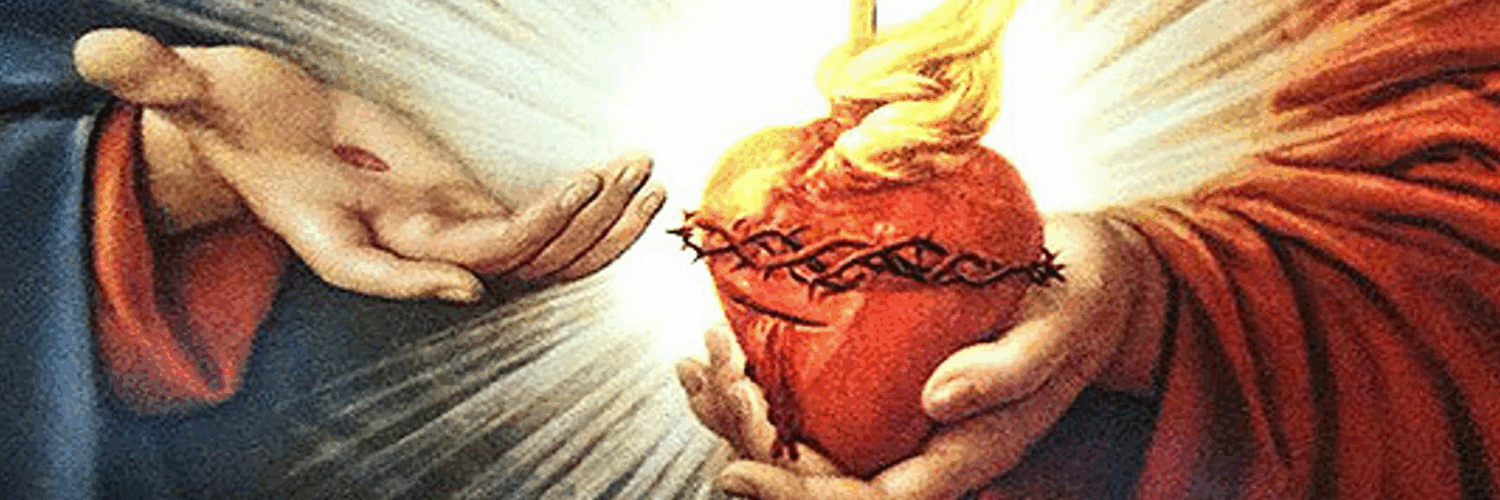
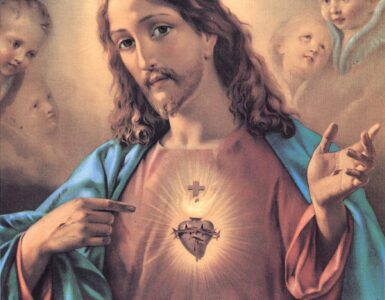
It turns out that Our Lord Jesus Christ never requested Saint Margaret Mary Alacoque to have His likeness portrayed. Rather, He asked that His Sacred Heart be depicted and that it alone be the object of veneration.Saint Margaret herself crafted, by her own hand and in accordance with her visions, the first depiction of the Sacred Heart of Jesus. The Heart is encircled by a crown of thorns and surmounted by a cross, all enveloped in flames. Within the wound of the Heart is inscribed the word Caritas—that is, Divine Love. It was only in subsequent years that various artists, inspired by this sacred emblem, began to render the full figure of Our Lord, incorporating the Heart into His portrayal. Though numerous variations have emerged over time, the central and unchanging motif remains ever the Most Sacred Heart of Jesus.
All four of the momentous apparitions experienced by St. Margaret Mary Alacoque focused on the Eucharist. She perceived the Heart of Christ in the consecrated Host—either during Holy Communion or while adoring the Blessed Sacrament. In one vision during Mass, Christ revealed His flaming, thorn‑crowned Heart and, symbolically, exchanged it with her own.
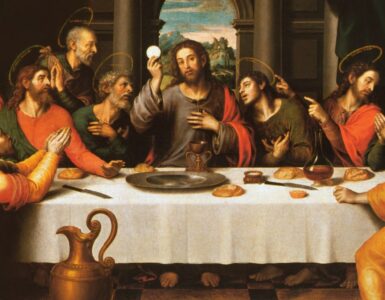
St. John the Apostle is regarded as the first devotee of the Sacred Heart of Jesus, for during the Last Supper he inclined his head upon the Lord’s breast, attentively listening to the heartbeat of the Divine Master. In a mystical vision recorded by St. Gertrude of Helfta, St. John the Apostle revealed that while he heard the heartbeat of Christ at the Last Supper, its full meaning was reserved for later generations. “To these latter times,” he said, “is reserved the grace of hearing the eloquent voice of the Heart of Jesus.” This striking prophecy suggests that devotion to the Sacred Heart was divinely destined to awaken a weary world to the fire of Divine Love. As the Church faces modern trials, the Sacred Heart emerges as heaven’s response to rekindle faith in the end times. – St. Gertrude’s Herald of Divine Love (Legatus Divinæ Pietatis) As one priest put it: “Perhaps God waited until we had the means to recognize His presence more clearly.”
Could it be that the foretold time has already come? In March 2004, to dispel any lingering doubts regarding the Eucharistic miracle of Buenos Aires, two Australians—journalist Mike Willesee and lawyer Ron Tesoriero—sought the expertise of Professor Frederick Zugibe, a renowned specialist in cardiac pathology and forensic medicine at Columbia University. Notably, the professor was not informed that the sample he was examining originated from a Consecrated Host. After conducting his analysis, he remarked:
“The sample you brought me is a heart muscle, a myocardium, more precisely the left ventricle.” With growing astonishment, he later asked, “You have to explain one thing to me, if this sample came from a person who was dead, then how could it be that as I was examining it the cells of the sample were moving and beating? If this heart comes from someone who died in 1996, how can it still be alive?”
This revelation underscores a deep mystery of faith: in receiving the Consecrated Host, we encounter the living Heart of Jesus Himself. Similarly, sites such as Tixla (2006), Sokołka (2008) and Legnica (2013) have undergone histological and microscopic analysis, revealing heart muscle tissue in a state of agony—specifically myocardial fibres—and blood of the AB group.
In all contemporary Eucharistic miracles, microscopic analysis has consistently evidenced the presence of cardiac muscle tissue in a state of agony. It is as if Christ Himself declares: HERE IS MY HEART! Scientists have also examined much older cases, and remarkably, the findings remain identical to those of recent events.
Dr. Edoardo Linoli analysed the Eucharistic miracle of Lanciano and confirmed the relics were of human origin: the blood was type AB and the flesh definitively cardiac. He stated:
“as regards the flesh, I had in my hand the endocardium. Therefore, there is no doubt at all that it is cardiac tissue.”
The blood group, he added, matches that of the man of the “Turyn” Shroud and reflects Middle Eastern origin. I am confident that this case will be followed by further discoveries confirming the presence of cardiac muscle in Eucharistic miracles that have occurred throughout the centuries.
In the Sacred Host dwells the God-Man, Jesus; within His Person beats His Heart, through which we are loved with the full perfection of His humanity.
Since the Host is, in truth, nothing less than the Living Heart of God—whom we receive at every Mass. Our own hearts (by which is meant not the anatomical organ, but the spiritual center of the person) gradually begin to conform to the very qualities of Christ’s Sacred Heart. The Eucharistic Lord is the remedy for every malady of soul and body.
As the Divine Presence lies hidden beneath the appearance of bread in the Blessed Sacrament, so too are the supernatural effects of His grace within the human soul largely concealed from our view—realities that will only be fully unveiled once we have passed beyond the veil of death.
The same principle holds true in Eucharistic adoration: to remain in the presence of the Living God—Our Eucharistic Lord, enthroned on the altar in the monstrance—is to place oneself beneath divine irradiation. Slowly, imperceptibly, the soul is refined, the heart is reshaped in the likeness of the Heart of Christ. An hour spent in silent adoration before the Most Sacred Heart of Jesus is time of inestimable spiritual value. And the ramifications of that divine encounter, though hidden to our temporal senses, will be made manifest in eternity. As the old saying goes, we become like the company we keep.
Consider the Litany of the Sacred Heart of Jesus, with its beautiful invocations. Here are but a few:
Heart of Jesus, obedient unto death, have mercy on us
Heart of Jesus, pierced with a lance, have mercy on us
Heart of Jesus, source of all consolation, have mercy on us
Heart of Jesus, our life and resurrection, have mercy on us
Heart of Jesus, our peace and reconciliation, have mercy on us…
It is also worthwhile to contemplate the devotion to the Sacred Heart within a particular framework—namely, that of Divine Love. Three liturgical Solemnities—Divine Mercy, Corpus Christi, and the Sacred Heart—are united by a single mystery: the Heart of God as the wellspring of Divine Mercy, encountered most intimately in the Holy Eucharist.
Reparation forms a central part of devotion to the Sacred Heart. It entails offering atonement for sins that offend God’s love, as Jesus requested of St. Margaret Mary. This may pertain to one’s own sins as well as those committed by others.
Shockingly, in 2023, Archbishop Geremias Steinmetz administered Holy Communion to a Muslim sheik during the funeral Mass of a cardinal. O Tempora, O Mores! It is only the tip of the iceberg of transgressions today that cry out for apostolic reparation.
In summary, God wants to shower us with grace and peace, but He is now left alone most of the time; locked up in tabernacles throughout the world. Though so often forgotten and alone, He is there. Let`s pray for the entire world to love Jesus Eucharistic.
In a world marked by declining reverence at Mass and growing materialism and secularism, we are all the more called to become living monstrances. The Blessed Virgin Mary was the first, most perfect, and most fitting Tabernacle, having carried the Incarnate Word beneath her Immaculate Heart for nine months.
May Our Eucharistic Lord be praised everywhere by everyone!

 Michael Vacca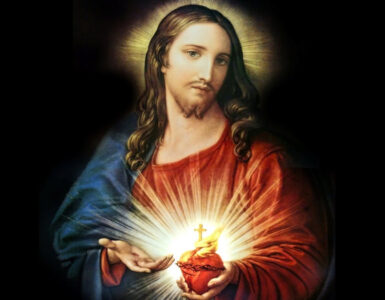
 Fr Mario Attard OFM Cap
 Carolyn Humphreys, O.C.D.S.