
 Fr Joseph Esper
A religion teacher in a Catholic high school had been talking to her students about the Holy Trinity, and at the end of the class period she gave them an assignment. They had to write their answers to the question, “Which Person of the Trinity do you relate to best at this time of your life?” The next day her students had some interesting responses. One boy wrote, “My father and I have a zero relationship. I need a father right now, and since I can’t turn to my dad, I turn to my Father in Heaven. I sometimes talk to Him about my problems, the way I would like to talk to my dad about them.” A girl in the class wrote, “My brother lives with my father out of state, and I live with my mother. Ever since my parents’ divorce two years ago, we hardly ever see each other anymore. I never thought I’d miss my brother, but I do. So now I’ve kind of adopted Jesus as my brother.” Another student wrote, “Just recently I began praying to the Holy Spirit. I’m going to college in a year, and I have no idea what I want to take up. I hope the Holy Spirit will enlighten me. Anyway, I’m praying to the Spirit for guidance” (Mark Link, S.J., Illustrated Sunday Homilies, Year A, Series II, p. 65).
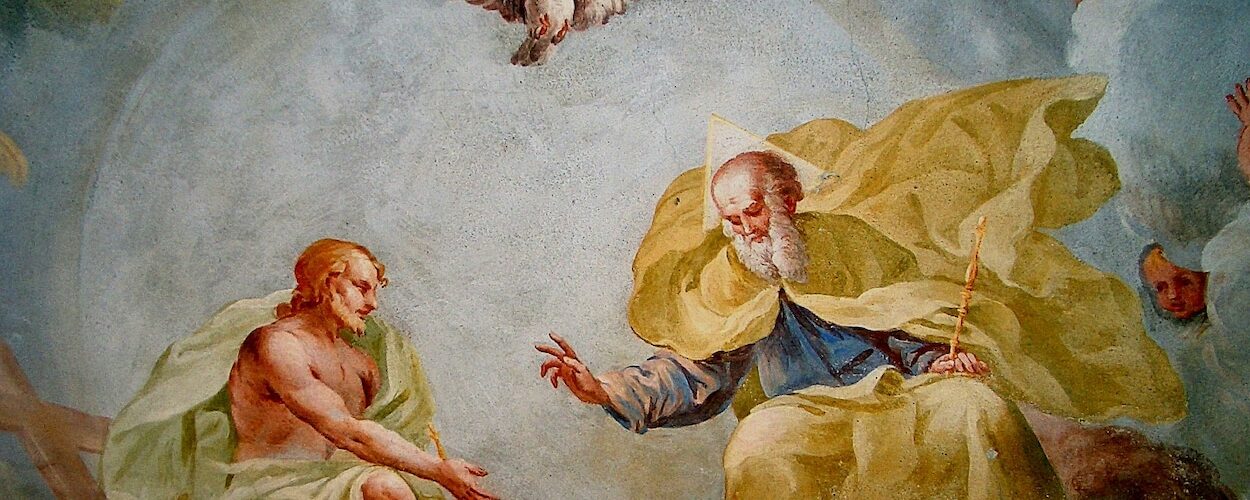
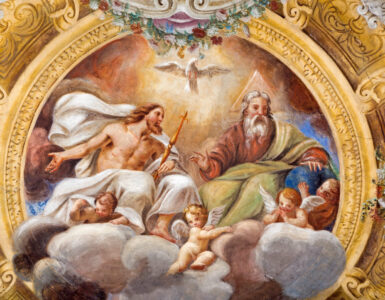
These are three very different answers, and the students who wrote them were seeking three different things: acceptance, companionship, and guidance. However, these three needs all come under the heading of love, and it’s love which helps us believe in something that will always be a mystery. The Holy Trinity consists of Three Persons in One God: Father, Son, and Holy Spirit. This mystery is beyond our understanding, but not beyond our experience; if we live in love, we will share in Their life.
Love is the most dynamic force in all creation, and the Source of all that exists. The effects of this powerful force are easily seen in our own lives: when we truly love others, we become capable of rising above ourselves, making great sacrifices, living life more deeply, and even—if we fall in love with others—almost becoming new persons. These very human experiences are not only good and spiritually healthy; they also help us begin to understand how God lovingly created us, and why He seeks our love in return. In the Book of Exodus (34:4-6, 8-9), God describes Himself in these terms: “The Lord, the Lord, a merciful and gracious God, slow to anger and rich in kindness and fidelity.” God established a series of covenants, or sacred agreements, with His people, but human sinfulness prevented them from fully achieving their purpose. Therefore, the Lord took the radical and inconceivable step of directly involving Himself in the life of the world by becoming one of us.
As Jesus states in the Gospel of John (3:16-18), “God so loved the world that He gave His only Son, so that everyone who believes in Him might not perish but might have eternal life.” Jesus announced this Good News, and after His resurrection and ascension into Heaven, He sent the Holy Spirit to live in the Church and to guide each individual believer. This should make a difference in our lives. As St. Paul says in his Second Letter to the Corinthians (13:11-13), “Live in peace, and the God of love and peace will be with you.” The Father, the Son, and the Holy Spirit are perfectly united in love, and we can choose, by the way we live, to begin sharing in this union.
The English mathematician and physicist Sir Isaac Newton, who died in 1727, almost three hundred years ago, is considered by many to be the greatest scientist in history. Among other things, he discovered the law of gravity, began to develop the study of calculus, and invented the telescope. Near the end of his life, when Newton was asked “What do you consider your greatest discovery?,” he humbly responded, “I have made two important discoveries in life: one, that I am a very great sinner; and two, I know that Jesus is an ever greater Savior” (David Burgess, Encyclopedia of Sermon Illustrations, p. 122).
Knowledge, no matter how vast and impressive, is ultimately useless—unless it helps us come closer to God and fulfill the mission in life He gives us. None of us is capable of truly understanding and explaining the mystery of the Holy Trinity, but all of us are, or should be, capable of receiving and returning love—and this is what matters. The pagans in the ancient Roman Empire had a famous saying about the followers of Christ: “Look at these Christians—see how they love one another.” It wasn’t mainly the early Christians’ religious beliefs that caught everyone’s attention and led to many conversions, but the way they lived out these beliefs—and this remains true today.
When it comes to putting our faith into practice and fulfilling our Christian responsibilities, love is more important than knowledge. We might know the Ten Commandments and the teachings of Jesus by heart—but if we don’t act upon them, this knowledge achieves nothing. We might be experts in psychology and in explaining why people feel and act as they do—but if we can’t lovingly relate with our own families and friends, what good is our expertise? You or I might spend a lifetime pondering the mystery of the Holy Trinity, trying to figure out what it means to say there are Three Persons in One God—but even if we miraculously come to understand more of this mystery than anyone else who ever lived, this knowledge would be useless to us if we failed to have love in our own hearts.
We’re called to live in God’s Kingdom and forever rejoice in His Presence. Even then we won’t completely understand the Holy Trinity, but in Heaven things will be much clearer to us. What truly matters right now, however, is the way we live on earth. The Father, the Son, and the Holy Spirit are a community of love, marked by perfect openness, sharing, and acceptance. These are virtues we can and should try to imitate, and the more we do so, the more we share in God’s life. The fullness of truth and love await us in the future, but—with the help of the Holy Trinity—we must prepare for them here and now.

 Fr Dino Vanin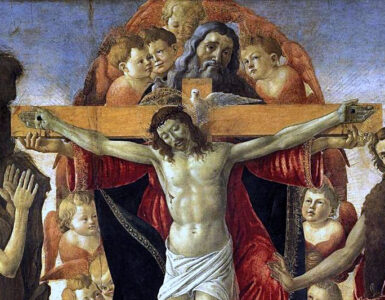
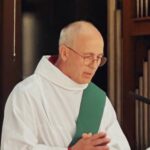 Deacon Kurt Godfryd