

 Michael Baglino
Oh, St. Anthony look around; something is lost and cannot be found. Or is it ‘someone’ is lost? Ever think about where you fit in a sociological sense or belong within the body of Christ? What role do we play in the coming of Thy Kingdom? Or, ever considered the structure of our society and the big picture of how we should view it from a Christian perspective?
Some may float around, flounder around, plug away, yet still persevere without function or purpose. Traditional sociology and 1 Corinthians 12:1-27 have the view, the answer, and the explanation. Traditional sociology is not today’s sociology. The current perspective of sociology is postmodernism and Marxism: an activist, anti-Christian assessment of our lives. Post-Modernism focuses on individualism and global diversity. Marxism focuses on our material conditions, inequalities, and class conflict. These are worthy views to a certain extent; however, both leave out the spiritual component. Is it any wonder everything is deteriorating? Traditional sociology, on the other hand, aligns itself with 1 Corinthians 12 and I believe the theoretical founder of this secular perspective to be the19th-century French sociologist, Emile Durkheim.
Emile Durkheim was a Jewish French sociologist who laid the foundation for what is referred to as functionalism. After the onset of the Industrial Revolution, as Europe was urbanizing at such a fast rate, here was a gentleman trying to make sense of all this social change, and he did so with God in mind. He probably read the Torah, probably not the New Testament, but nevertheless founded a theory that aligns with 1 Corinthians 12 leading to the functionalist perspective. I say “probably” because his father and grandfather were both rabbis, and there was certainly a religious upbringing and influence on his thinking. He himself eventually thought he knew better than they did.
All societies are structured and organized, but in different manners. Each society, usually in the form of nations, is composed of five institutions, perhaps seven, depending on varying interpretations within nations with large-scale organization. They are the institutions of family, politics, economics, education and religion. Health and sport may be viewed as institutions, although most sociologists view them as part of the economy. Society is organized for the purpose of serving and functioning for and through its individual members. Admittedly, some societies are organized more effectively than others. Thus, economic systems, political systems, family organization, education both public and private, and religious institutions serve members of society accordingly. They function to serve the sick and dying, to teach and train, create and distribute wealth, to employ the public, to lead in worship and cultural constraints, entertain, to maintain order, etc. We all have our part in it. We often hear from certain sectors that the United States is the best country in the world. Well, evaluate its institutions alongside other nations, and we probably could determine that.
According to the functionalist perspective in sociology, the smooth functioning of an institution would have a positive effect on each other institution. Should one falter, others would do likewise, creating an imbalance. And so, society moves on, either progressing or regressing. Imbalances and corrections are needed, as imperfections among institutions affect each other. For example, schools need to train citizens for the economy. Should schools fail to adequately train or fail to train at all the appropriate skills needed, our economy suffers. If families fail to remain stable, culture is damaged, or social disorder may emerge, crime may increase, straining our economy and/or negatively influencing the body politic. To Christians, family structure is the most important institution. If it falters, so do other institutions, and we need patching up here and there. Some social critics point to the breakup of the family for our political and cultural degeneration. When social citizens fall away from religious institutions or the religion itself is compromised, immorality and its social repercussions emerge.
Now, with regard to the Body of Christ as in 1 Corinthians 12:1-27, we can interpret it as a sociologist through the lens of this functionalist perspective. We all have so many different gifts, so many different personalities through which to contribute those gifts. There are so many ways of service. Each contributes wisdom, knowledge, prophecy, manners of all skills and talents, and all are important. Rather than the 5 social institutions, we have biological systems to serve our bodies, yet there is one body. The organs and parts of the vascular, respiratory, digestive, endocrine, skeletal, neurological, and circulatory systems are our body’s institutions. Yet there is one Lord and one body in Christ, just as there is one individual body. The foot, the hand, the ear, and the eye are all important, but each has its own function, and all are necessary for one body. The heart, the kidney, the muscles, the spine, and the spinal cord each contribute in a certain way, and certainly significant contributors to one body, I would say. If one part suffers, all suffer with it. When it all functions properly, all in the body are joyful. We can see how organs within the various systems in our body can affect each other positively or negatively. So, each society with its own institutions and components grows, as each biological body grows, and as the Body of Christ grows.
Yet One Body
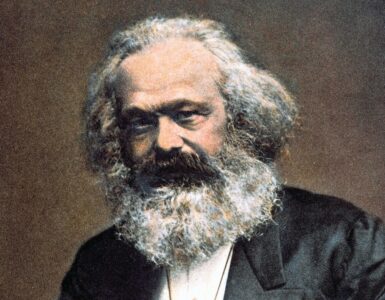
So how are Marxism and postmodernism in contradiction with the Christian perspective? They are monolithic ideologies fostering a global reset. These ideologies oppose nationhood for global control. In fostering equity, they eliminate equality. Equity is a leveler; all things are the same. To the left, that makes for equality. In not accepting our different body parts and institutional contributions to the whole, these ideologies insist upon a leveling of purpose and a centralization of control. Central control exists to make all and everything the same. It is not equality. Let the government control it all, nationally and globally. They will replace God and his ways. As mentioned above, the spiritual component is eliminated. God’s ways are different in that we each contribute according to others’ needs. Isn’t it interesting that Karl Marx used this phrase in ‘The Communist Manifesto’, and it means the opposite? With centralized authoritarian control, the state will determine needs and contribute as it designs. The devil is devious. Let us return, or shall I say, continue to move forward to Thy Kingdom Come, a Christian view of society in which God’s truth marches on without such an organizational restructuring to satisfy a man-made ideology. This writer prefers to ask who am I in Christ rather than what am I within the state.
+++
Sources:
Baglino, Michael J. The Dr. B. Reader on the Ologies: Psychology, Sociology, Anthroplology. 2023.
New American Bible (NAB). World Catholic Press. 2010.

 Vincent Ryan Ruggiero
 William Borst
 Fr Dino Vanin