
 Carolyn Humphreys, O.C.D.S.
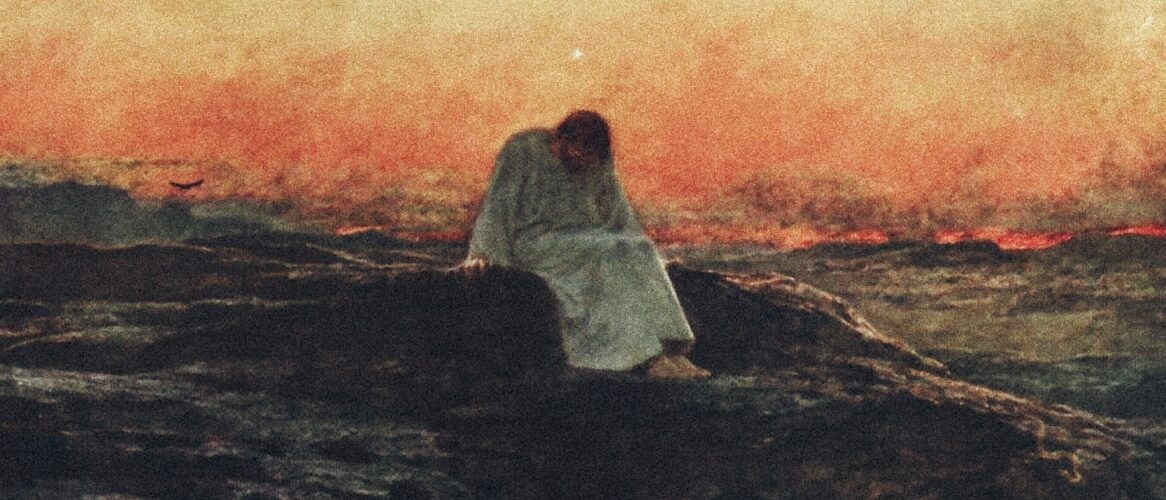
A desert has an atmosphere of impending death. This can be seen most vividly in the arid terrain below sea level known as Death Valley in California. The valley is located largely in Inyo County. In 1849 thirty pioneers attempted to find a shortcut to the California gold fields by going through it. There were eighteen survivors. The valley was named by one of the women who found much comfort in the twenty-third psalm. Verse four was particularly consoling:
Even though I walk through the valley of the shadow of death, I will fear no evil, for you are with me.
This was a phrase that became excruciating real. The valley is marked by death’s stark presence. Formidable places such as Furnace Creek, the Devil’s Golf Course, Funeral Mountain, Last Chance Range, the Black Mountains, and Coffin Canyon dot the landscape. The desolate ravaging properties of this desert are second only to the Sahara.
The external signs of a desert can reflect what is taking place within us when unexpected difficulties in life mirror back an interior spiritual desert. At times we may feel as if we are wandering in a wasteland. The joy and pleasantries of a faith we knew now appear to be dry, brittle and sun bleached. Consolations, delights, or God related experiences are memories of long ago. We live by a bleak faith that stands alone. All that seemed spiritually important has been taken away. There is dryness and a void ahead. If we are on a road it is replete with distress and discord. If we are on a trackless waste we have no idea where we are going. In the time ahead we join with the passion and death of Jesus in a way we never knew.
We do not choose an interior desert experience, know how long it will last, or how many desert experiences there will be in a lifetime. The interior desert may come without warning like a flash of lightening or a sudden earthquake. There appears to be no reason why it began but a desert experience can also be initiated by an occurrence in life that cause a pause or a complete stop along our life’s journey. Life seems suspended for a time until the disturbance has been diminished or worked through. Examples of disturbances that may trigger an interior desert could be termination from work, a recent failure, a collapsed relationship, unmet goal, shattered dream, fatigue, sudden and prolonged physical or mental problems, diagnosis of a terminal or incurable disease, or the death of a loved one.
The interior desert is demanding spiritually. With the disappearance of all usual paths the spiritual journey seems to be at a standstill. Our loving and giving capacity seems drained. We are alone and remain so without comfort or sweet distractions.
Although our heart feels like it has turned to stone, the desire to pray remains. Empty feelings make us realize we are helpless and no longer in control. So we learn to wait. And in the waiting we are slowly purged from that which draws us away from God. We confront a sterile faith, prayer without appeal, plus our sinful nature. And slowly God begins to reveal himself and his will as he meets us in his place and in his time. We realize more deeply and more intensely that God has sovereignty over all. As he reveals himself in the desert, we begin to see things as they are from his vision. Faith may be saturated with the sands of doubt and hope may be inundated with the sands of fear. However, the desert is a location where we can grow in authentic faith and hope, as God speaks in the secret places of our heart. The words of Hosea ring loud and clear “So I will allure her. I will lead her into the desert and speak to her heart.” (2:16)
The most daunting landscape is the desert. Prayer in the desert is without frills or consolations. However, it is like the intimate prayer of Jesus when he went out to a place of solitude to pray in secret. The desert is a place of patience and of being put to the test. Teresa of Avila offers encouragement,
Courage, courage, my daughters. Remember that God does not give anyone more trials than can be suffered and that his Majesty is with the afflicted. For this is certain, there is no reason to fear but to hope in his mercy. He will reveal the whole truth; and some machinations, which the devil kept hidden so as to create a disturbance, will be made known.
After some time the interior desert can evolve into a rich place. If we are very quiet we may feel God gently pulling us back together. Like Humpty Dumpty after the fall, God can do what all the king’s horses and all the king’s men could not do. God puts the fragmented pieces of our broken and shattered lives back together again, and we are left feeling better than ever. Yes, the desert is a dear teacher as shards of its wisdom are uncovered.
The interior desert can become a proving ground when challenges are presented in rapid succession. Therefore it is not a place for people who are mediocre, complacent, or unable to be accountable or responsible for themselves. Because there is no ordinary routine to fall back on, it is a day to day spiritual challenge. We stand face to face with an incomprehensible God, are totally exposed before him, and do not babble. We are only mute to know God as God.
But Where are the Flowers?
The most beautiful desert flowers are the mystical blossoms of faith and hope. Faith is believing in, without fully understanding, God. Hope is the conviction that God is loving, trustworthy, and faithful. At times we may not be able to see those flowers, and at other times their blooms are in the strangest of places or seen at unusual times. A new awakening of, or deeper appreciation for, these flowers can be found in the desert. John of the Cross gives good advice, “Live in faith and hope, though it be in darkness, for in this darkness God protects the soul.”
At times faith is like a cactus flower. Pretty, but with sharp stickers all around it. The stickers represent various kinds of suffering. Christians who suffer can have a faith that shows the beauty of Christ in a way that is perplexing to others who simply do not understand how a person could be joyful, patient, and kind in the midst of pain. Ongoing suffering can open us, and others, to the beauty of Christ by demonstrating that there is something greater than what this world offers. We have Jesus, and can proclaim with the psalmist, “You make known to me the path of life; in your presence there is fullness of joy; at your right hand are pleasures forevermore.” (Psalm 16:11)
Hope can be like a desert marigold flower covered with the sands of a desert windstorm. The flower is oh so hidden. All seems bleak and fruitless. G.K. Chesterton lifts our spirits. “It is only when everything is hopeless that hope begins to be a strength at all. Like all the Christian virtues, it is as unreasonable as it is indispensable.”
The delicate desert sunflower of silence is unappreciated and rarely enjoyed in contemporary society. Teresa of Calcutta sets us on the right path. “The beginning of prayer is silence. If we really want to pray we must first learn to listen, for in the silence of the heart God speaks. And to be able to see that silence, to be able to hear God we need a clean heart; for a clean heart can see God, can hear God, can listen to God; and then only from the fullness of our heart can we speak to God. But we cannot speak unless we have listened, unless we have made that connection with God in the silence of our heart.”
Special desert flowers just for us are out there on the barren land, we just need to look for them. They could be camouflaged or concealed. One day we will find that the spiritual desert has drawn us to a new vision of life through spiritual realities that are neither measurable nor expressible. We learn that with God all things work together for good. Soft rains quench the parched dryness within. We are distinctly refreshed and revitalized. During, or after, our inner desert experience there is no need to be different, or set apart from the human family. We quietly bring the interior desert to humanity and gently release it where it is needed without fanfare. In other words we bring the peace of Christ to a battered world by manifesting hope to the hopeless, compassion to the hateful and hurting, and sunbeams of life in the shadows of death.
+++
A Desert Memory (by Bertrand N.O. Walker)
Lonely, open, vast and free, the dark’ning desert lies;
The wind sweeps o’er it fiercely, and the yellow sand flies.
The tortuous trail is hidden, ere the sand storm has passed
With all its wild, mad shriekings, borne shrilly on its blast.
Are they fiends or are they demons that wail weirdly as they go,
Those hoarse and dismal cadences, from out their depths of woe?
Will they linger and enfold the lone trav’ler in their spell,
Weave ‘round him incantations, brewed and bro’t forth from their hell?
Bewilder him and turn him from the rugged, hidden trail,
Make him wander far and falter, and tremblingly quail
At the desert and the loneliness so fearful and so grim,
That to his fervid fancy, wraps in darkness only him?
The wind has spent its fierce wild wail, the dark storm pall has shifted,
Forth on his sight the stars gleam pale in the purpling haze uplifted.
And down the steep trail, as he lists, he hears soft music stealing;
It trembling falls through filmy mists, from rock walls faint echoes pealing.
Whence comes this mystic night song with its rhythm wild and free,
With is pleading and entreaty pouring forth upon the sea
Of darkness, vast and silent, like a tiny ray of hope
That oft times comes to comfort when in sorrow’s depths we grope?
’Tis the An-gu, the Kat-ci-na, ’Tis the Hopi’s song of prayer,
That in darkness wards off danger, when ’tis breathed in the air;
Over desert, butte, and mesa, it is borne out on the night,
Dispelling fear and danger, driving evil swift a flight.

 Deacon Steve Greco
 Msgr Joseph Pellegrino
 Fr Dino Vanin