

 Fr Joseph Esper
Almost twenty years ago a man in New York State named Michael Gill wrote a memoir or book called How Starbucks Saved My Life. His story is interesting and timely not so much because of the events that occurred in his life, but because of how he responded to them, and what he learned from them. At age 53 Michael seemed to be on top of the world: he had a lovely wife, an expensive home, and a high-level and prestigious advertising job with a leading firm that paid $160,000 a year. Ten years later, however, his perfect life had collapsed: he was divorced, unemployed, and practically broke; to make things worse, his doctor informed him he had a slow-growing brain tumor. Michael was close to despair, and had no idea what he was going to do—until a chance encounter changed everything. While nursing a cup of coffee at the local Starbucks, the store manager approached him and asked if he needed a job; it happened that the shop was holding a “Hiring Open House” that day. In the past, Michael would never have considered a job pouring coffee—that menial work seemed beneath him—but he was desperate to get medical coverage, and Starbucks had a generous insurance plan, so he accepted an entry-level position paying just $10.50 an hour.
Four years later, Michael’s life had improved: his tumor wasn’t growing, and he was old enough to qualify for Medicare, so he no longer needed to work at Starbucks for the insurance benefits. However, he didn’t quit making and serving coffee, because he discovered he actually loved the work—even the less-enjoyable parts, such as washing the counters, taking out the garbage, and cleaning the toilets in the bathroom. As he explained,
“When I accepted the job at Starbucks, it struck me that I probably would never again have money, titles or expensive possessions—yet one evening at Starbucks, I realized that I was as happy as I had ever been in my life. This ‘low level’ job gave me supportive bosses and co-workers, lots of human interaction, and enough money to live a simple life. These were my real priorities, and I had never even known it. Instead, I had wasted most of my life pursuing other people’s goals” [namely, bigger paychecks, loftier job titles, and flashier possessions].
In an interview for a newsletter article about his life, Michael shared some of the lessons he had learned, including the fact that any task can be worthwhile, if it involves serving others; that getting caught up in the desire for more money only leads to a desire for still more money; that while it’s necessary to learn from the past and plan for the future, it’s more important to live in the present; that the only job truly beneath you is the one you don’t give your full effort; and that we find our happiness by responding to our true calling in life, rather than settling for society’s values and expectations or struggling to go in a different direction not really meant for us (Botton Line Personal, January 15, 2008).
These are very valuable life lessons, especially the need to seek our true purpose in life, regardless of our age or circumstances. God has a plan for each one of us, and honestly trying to discover and fulfill it is the best way to experience true happiness on earth, and to prepare ourselves for everlasting joy in Heaven.
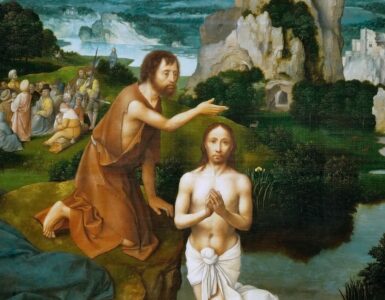
The Church uses the feast of the Baptism of the Lord as an opportunity not only to promote vocations to the priesthood and religious life, but also to remind all her members of the need to hear and answer God’s call. Jesus was baptized in the Jordan River by His cousin John; He submitted to this baptism, though free of all sin, as a sign of His commitment to doing the will of His heavenly Father. Our Lord thereby fulfilled Isaiah’s (42:1-4, 6-7) beautiful prophecy: Jesus was God’s chosen servant, one called to be a light for the nations, while setting prisoners free from spiritual slavery. As St. Peter (Acts 10:34-38) says, Jesus “went about doing good and healing all those oppressed by the devil, for God was with Him.” This is the most wonderful epitaph any of us could ever have: for people to say of us after our deaths, “God was with him,” or “God was with her.” Our mission in life, of course, cannot begin to compare with Christ’s—but we are called to follow in His footsteps, making a difference in the world through our example and our fidelity to His teachings and commandments.
When I was attending my parish grade school while growing up, I remember my class being taught the value of saying one Our Father, one Hail Mary, and one Glory Be every day so that we would be able to discover our vocations when the time came. That’s still a good idea, and not just for young people, and not only for persons called to a priestly or religious life. Everyone has important decisions to make in responding to God’s call—for instance, “Is now a good time for me to change my career? For a better position, should I Iook in a different area of the country? Should I accept this job offer that will pay me a bigger salary, but at the cost of having much less time for my family? If I choose lesser-paying but more satisfying employment, will my finances be okay? Is the Lord calling me to something different—something that will both challenge me, and allow me to serve Him more effectively? Should I stick with this job I hate because it at least pays a decent wage, and has great medical insurance? What should I do to keep myself busy once I retire? If God truly wants me at the job I now have, how can I do more to share my faith and make this a better world by working there? In addition to my work and my family responsibilities, is the Lord calling me to be involved in something else—perhaps parish ministry, or sharing my time and abilities with a local charity or volunteer group? Are my work priorities truly in line with God’s plan for me?”
These are all important questions, and we can’t reasonably hope to answer them correctly entirely on our own. We need to pray for ourselves, and for others, that we’ll all be able to discover and accomplish the Lord’s plan for us—whether that involves the priesthood, diaconate, religious life, marriage, parenthood, or the single life, and whether it means changing our careers or continuing what we’re doing, and whether it means working as a doctor or lawyer, a teacher or nurse, a farmer or truck driver, a computer programmer or salesperson, or even at the local McDonalds or Starbucks. Because we’re baptized, each of us has a God-given mission in life—and our eternal destiny will be determined in large part by whether or not we remain true to this calling.

 Fr Dino Vanin
 Deacon Donald Cox