
 Sarah Greydanus
Three and a half years have passed since the overturning of Roe v. Wade, a milestone that, as many noted, took place on the Solemnity of the Sacred Heart. Yet in those years, the rate of abortions has not significantly decreased. Aside from the surgical methods continuing in many states, most abortions are now procured with pills that can be obtained over the counter. (See Selena Simmons-Duffin, “Despite bans in some states, more than a million abortions were provided in 2023,” NPR, March 19, 2024.)
With access to abortifacients so easy and widespread, what is the most effective pro-life approach? One could make a case for passing more laws, seeking to ban the currently available methods of abortion. Yet, even if such laws were to be passed—unlikely to take place in all fifty states—the means of ending a pregnancy would still exist, and those who felt they needed them would still get them.
This, crucially, is how abortion is perceived by those who support it: as meeting an urgent need of struggling women. The above-referenced article quotes an OB-GYN who says that the increase in abortions reflects “a lot of people working really, really, really hard in order to make sure that abortion is still accessible to people who need it.” In fact, a research report from 2023 indicated that about two-thirds of women who have had abortions would have preferred not to. Of the 226 women surveyed who have had abortions, 33% responded that they wanted it; 24% reported that it was unwanted, somehow forced on them; and 43% had accepted it reluctantly. (PubMed, May 11, 2023)
“Sixty percent reported they would have preferred to give birth if they had received more support from others or had more financial security,” asserts the study. Here, then, is what drives most abortions: fear, maybe even desperation, a sense of being alone and without options. If this is what is at the root of the problem, the answer is not to pass more laws but to provide more help, to be the ones to say, “You are not alone. We are here for you; we love you.”
It should come as no surprise, then, that those in the front lines of pro-life service find that what is most necessary is love—active, concrete, personal love—for these women.
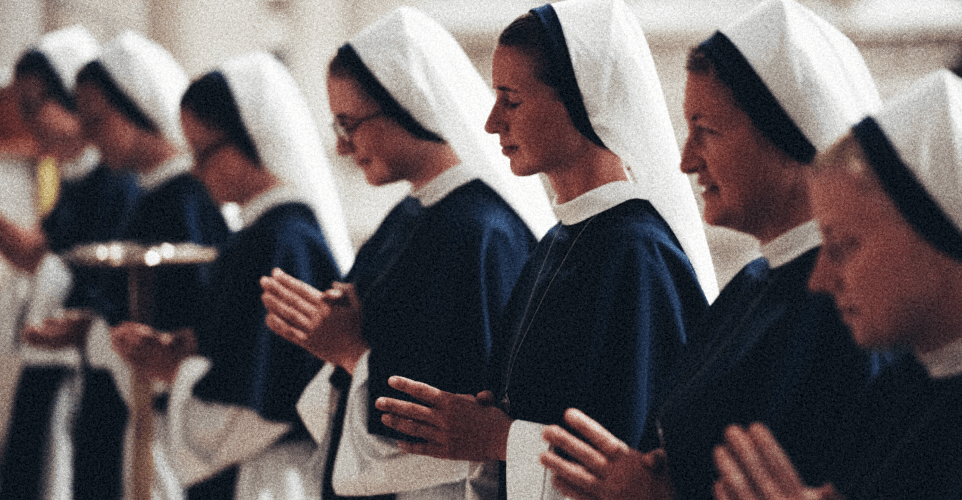
That love defines the charism of the Sisters of Life, serving with great devotion and remarkable success in cities across the United States and in Toronto, Canada. These Sisters support women in difficult pregnancies in whatever way and for as long as they need, hosting them at the convent, providing them with supplies and resources, and perhaps most importantly, listening to their stories. They offer to women in crisis pregnancies, who often lack support from family and friends, an open ear and heart, a safe place to open their hearts and consider what they truly want.
The fruits of this approach of caring presence can be seen at the congregation’s website, where one can find stories of women (anonymous for privacy) who chose to have their children with the Sisters’ help. The emphasis in their writing is strikingly different from almost all other pro-life literature: Nowhere is any mention made of the evil of abortion or the need to fight abortion. Instead, everything focuses on recognizing the profound goodness intrinsic to each person; as the homepage proclaims, “You are an image of God, irreplaceable.”
What does this have to do with pro-life work? Everything. As the Sisters have found, what the women they support really crave is to be loved, seen, cherished; this, in turn, gives them strength to hope and to make a choice in that hope. “Once people experience that they are loved, they can begin to give that same experience to others,” explains an article in the Spring 2019 issue of Imprint, the Sisters’ magazine. “Cardinal O’Connor [the founder] … would tell the Sisters that we were to ‘mother the mothers of the unborn so that they could mother their children.’”
The Sisters of Life are an especially prominent and successful instance of the apostolate of love, but not the only one. Shortly after Roe was overturned, two young Catholic mothers felt inspired to start a group to provide support for mothers in need. One of the two described their journey in a December 2024 article in Homiletic & Pastoral Review, “Meeting at the Well.” They ultimately discovered that the greatest need was for friendship, for a strong community. The article determined that anonymous material support, while helpful, is not enough on the level of the heart:
“True love and charity abide not in tidy boxes of donations stored for when they will be needed, but rather in tearful conversations and the consistent toil of presence which is a gift that no money can buy, no organization can manufacture.”
Brett Attebery, CEO of Her First Women’s Health, believes that the various pro-life organizations across the country could reach far more women with improved structure and public image. “The image [of Planned Parenthood] is clear, consistent, and recognizable,” he says in a recent email posting. “This allows them to win the ‘future decision’ long before a support-dependent pregnant woman ever faces an unexpected pregnancy. … Most young women don’t know life-affirming support exists. So, we start with brand. … But awareness alone is not enough. Once she contacts us, she must receive help immediately.”
These important practical questions warrant articles of their own. A good starting point, however, in pursuing these goals would be for each pro-life Catholic to recognize and be concerned about the need and pray to know how he or she might contribute to the solution. If every Catholic in the country did that, the transformation would be dramatic. What began on the Solemnity of the Sacred Heart would—and may yet—bear fruit in the love of His Heart working in His members.


 Fr Dino Vanin

 Thomas Addis
 Deacon Donald Cox
 Deacon Gregory Webster