
 William Borst
I am afraid that in these times of free-thinking apostasy and moral crisis, ideas of Heaven and eternal salvation have wavered between myth and fantasy, on the one hand, and moral certainty on the other.
Salvation is none of these. It is an individual promise from God that if we keep his commandments, especially His two great commandments to love the Lord with our whole being and to love our neighbors as ourselves for Him, we will be destined to be with Him for all eternity.
Since the beginning of the late 20th century, the narrative of Eden has experienced a decline in its appeal, with the aura of deliberate indifference. People now perceive Heaven as if it were not a bit relevant for the 21st century. some pursue fulfillment, while others opt for immediate rewards. Many others try to bargain with God when their ends appear on the immediate horizon.
The most notorious of the wager stories was that of Dr. Faust, who traded his immortal soul for a lifelong of pleasure, mostly sexual in nature. When thinking about these words, a modern example, immediately comes to mind in Hugh Heffner, the late scion of Playboy Enterprises.
The story of Dr. Faust dates to a German legend, which was based on the historical Johann Georg Faust (c.1480-1540). He was an erudite and successful itinerant alchemist, astrologer, and magician of the German Renaissance. He also had the reputation of being a conman and a heretic.
Dr. Faust became the subject of folk legends in the years after his death. His story was notably adapted by playwrite Christopher Marlowe as a tragic heretic, the eponymous Tragical History of the Life and Death of Doctor Faustus (1588-1592).
The Faustbuch tradition survived well into the modern period when German playwright, Johann Wolfgang von Goethe’s debuted his closet drama Faust. I first learned of the German masterpiece and Dr. Faust when my German class at Xavier High School studied Goethe in the early sixties.
It was Johann Werner Goethe, a 19th century German playwrite, who scored with his adaptation of Faust in two Parts, simply referred to as Part I and Part II. They proved to be the magnum opus of his career. His audiences were reported to be the largest for any rendition of the life of Faust. Many scholars regard it as the greatest work in German literature.
Faust, Part One takes place in many locations. The first scene is in Heaven. Faust is approached by Mephistopheles, one of the Devil’s many aliases. He makes a bet with God that he can lure one of his servants… in this case Faust, a faithful follower of God…away from his pious pursuits.
The next scene takes place in Faust’s study where the aging scholar is struggling with his vanity, the usefulness of scientific humanism and religious learning. But in his frustrations, the scholar turns to magic for the showering of the infinite knowledge he seeks. Frustrated at his failure to achieve this, he contemplates suicide. But Faust rejects this when he hears the Easter celebration emanating from the streets.
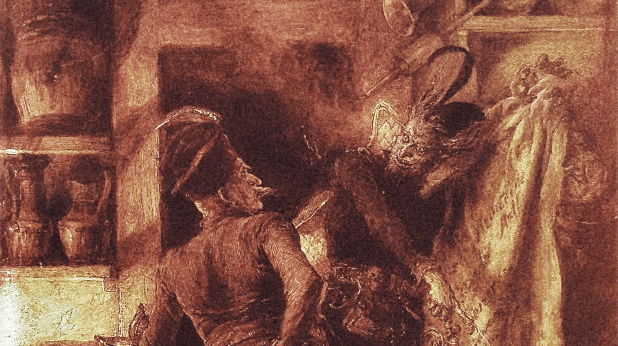
Dr. Faust then proceeds to take a walk with Wagner, his assistant. During their walk he is followed home by a stray poodle who transforms into Mephistopheles. After a night of sinister machinations, Mephistopheles returns with an offer that Faust cannot refuse. He signs his Faustian Bargain with a drop of his own blood.
The devil says he will grant Faust, a lifetime of pleasure so blissful that he will want it to never end. In return, Faust must promise to serve Mephistopheles in Hell throughout all eternity. This is the classic example of the Faustian Bargain, the sacrificing of one’s soul for some transit pleasure for unlimited knowledge and power.
It has come down to history as a Faustian Bargain with the Devil, which is a trading of one immortal soul for some earthly diabolical favors. There are some lesser-known phrases that talk of pacts with the devil, such as the Devil’s Bridges and the crossroads myth.
In truth this is really a dramatic portrayal of a sinful act. Anytime we seriously sin we are in effect jeopardizing our immortal souls for some fleeting sinful favor that in the long term will be very harmful to us and our immortal souls.
Mephistopheles arranges for Faust to have an affair with the beautiful peasant girl Gretchen. With Mephistopheles’ assistance Faust draws Gretchen into his arms. So, they could have privacy in their lovemaking, Gretchen poisons her mother with a sleeping potion she administered to her. When Gretchen becomes pregnant, she drowns her newborn, which causes her to be charged with infanticide. Faust helps her escape punishment while a chorus of heavenly voices proclaim that Gretchen shall be saved.
Part II is rich in classical allusion, while the romantic story of the first part is put on hold. Faust wakes up in a field of fairies, who initiate his new cycle of pursuits. Dr. Faust is irrevocably damned because he preferred human knowledge over divine knowledge. As Hugh Chrisholm, an editor for the Encyclopedia Britannica put it, He laid the Holy Scriptures behind the door and under the bench, refused to be called Doctor of Theology but preferred Doctor of Medicine. The play ends with the words: He who strives on and lives to strive/Can earn redemption still.
In addition to Goethe, many of the luminaries of German literary history, such as Franz Liszt, Hector Berlioz, Robert Schuman, Ludwig van Beethoven, Franz Schubert, and Peter Gorski have added to the Faust literary and musical canon.
My favorite adaptation is a 20th century play that has seen many revivals. I am talking about Damn Yankees, a musical comedy, which debuted on Broadway in 1955. Based on the book, The Year the Yankees Lost the Pennant, by George Abbott and Douglas Wallop, the play is the Faustian legend brought to the American stage. It was correctly set in New York City during the 1950’s when the New York Yankees dominated the baseball world. A film featuring Gwen Verdon, Ray Walston and Tab Hunter debuted in 1958.
The protagonist is a middle-aged real estate agent, named Joe Boyd, who was a long-suffering fan of the lowly Washington Senator’s team who spent an inordinate time in the American league basement. His wife laments their plight in the song, Six Months Out of Every Year. After she has gone to bed, he sits grumbling about if the Senators just had a long ball hitter…they could beat those damn Yankees…Suddenly a smooth talking, subtly demonic Mr. Applegate appears out of nowhere with an offer that no Senators fan could refuse.
Applegate offers Joe the once-in-a-life chance to become Joe Hardy, a young slugger the Senators desperately needed. He readily accepts even though he would have to leave Meg. But he does have the presence of mind to have an Escape Clause in his agreement, which would free him to leave the team before 9:00 on the night of the last game and return to his normal life.
Just before Joe Hardy enters the team’s locker-room the players have all pledged to do their best with the wonderful verse You gotta have heart…miles and miles of heart… It goes without saying that Hardy saves the day and the lowly Senators quickly become front runners in the pennant race. But it is understandable that Hardy misses Meg, his wife.
To evaluate Joe’s resolve, Applegate sends one of his devils’ assistants to lure him back to the job at hand. Lola had sold her soul for eternal youth and was the best homewrecker on his staff. Her job was to seduce Joe and ensure he loses the bet.
The play nearly gets lost in a series of detours, which almost makes Joe forget the job at hand. Despite Lola’s evil spells, Joe leads the Senators to a resurrection that finds them in the league pennant race with the Yankees.
When Lola realizes that Joe still loves his wife, she helps to send into the final game by delaying Applegate. Applegate confesses that wives have caused me more trouble than the Methodist Church!
Joe is at bat as the clock nears nine o’clock, his bewitching hour. Applegate makes sure he gets two quick strikes. As the clock strikes nine Applegate declares he has won Joe’s soul, but Joe shouts the deal in broken and even though he has reverted to his middle age body, he summons the moral and physical strength to literally will a home run and win the pennant for his team.
Joe reunites with his wife Meg, but Applegate continues to seize his soul by promising a world series victory. With Meg and even Lola on his side the audience has no doubt he can win over the devil.
While it is quite possible that the clarity of this message is lost or even erased in the choreography, the acting and the magnitude of the whole thing, I think the message is clear. Even though the devil does have some powerful temptations, his character, dutiful wife, prayer, courage, and some other virtues can always knock him off his Satanic path.
Though some people may relegate this scenario to that of an old wives’ tale, I believe its truth is relevant. As baseball players are wont to say, keep your eye on the ball, your mind in the game and the ball will find a safe place to fall. I think this baseball morality tale has a great lesson for all of us.
While both the play and the film were professionally produced with excellent casts, visual beauty, and fantastic music, we should never forget that the business of salvation is not a play nor a performance but at the very core of what is important in life.
It is up to us to be vigilant at all times with regards to attacks on our souls and our devotion to God. The devil has many tricks, and many can hide within the pageantry of a game with nine men on a side.



 Deacon Gregory Webster
 Fr Dino Vanin