

 Donald Wittmer
The year was 1952. Our family had just come from Mass and a small celebration at the local parish, St. Martin De Porres in Detroit. It was a Mass in honor of the celebration of my grandparent’s 68th wedding anniversary. I was 11 years old and I sat across my grandmother, Matilda Gentner, who was at that time 82 years old. My grandfather sat in the other room smoking his pipe. Stephen was 83 years old. I was curious so I asked her, “Grandma what was it like back then?”
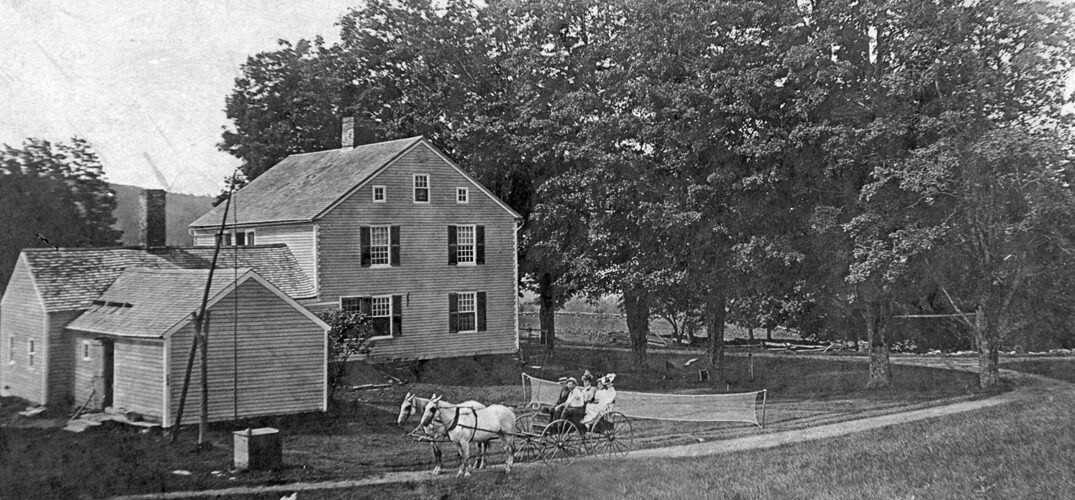
My grandmother was born in the year 1870, five years after the Civil War. She was born in Bremen, Germany and had taken a barge, after processing on Ellis Island, through the Erie Canal and a flatbed boat across Lake Erie and up the eastern Michigan shore to an area in the Michigan thumb near where her family settled in a town called Ruth, Michigan arriving around 1876. “Things were so simple back then,” she said. “So much of our time was spent in the fields and then canning and storing food to survive the winter.” “We had very little idle time. I went to school until I was 12 and then worked at home learning to sew, churn butter, and help around the farm. At harvest time, everyone worked from dawn to dusk to make sure the crops were brought in. I fed the chickens in the morning and collected eggs and then helped my mother and sisters bake bread taking time out twice a day to milk the cows.”
I kept asking more questions as I was fascinated. “When did you and Grandpa get married?” “Oh, he grew up on a neighboring farm and I saw him at church and in town. He was very nice and showed an interest in me. We started courting as it was called back then about a year before we married in 1884. Your grandpa was 15 years old and very strong” she said. “Ruth was a small town and everyone knew and helped each other out if you had problems or fell on hard times.” “Wasn’t that awful early to get married Grandma?” I asked. “Well by today’s standards I suppose,” she said, “but farming was hard work and if there wasn’t enough people to run the farm you were in trouble.” I knew that Grandma had lost two children in childbirth but four had survived. Childbearing and child mortality remained two of the most serious health issues for women and their families during the late 19th century. On average, women gave birth to seven live babies. One third to one half would not survive to age 5.
“Medical care was not available on the farm. Children were born at home and there was a lot of typhus and diphtheria. A lot of home remedies worked and some didn’t work,” she said. To make matters worse, there was a “price depression” in the United States from 1882 to 1885 mostly resulting from the decline in railroad construction. From 1879 to 1882 there had been a boom in railroad construction. In 1882 this trend reversed itself, resulting in a decline in related industries, particularly iron and steel. Eventually it affected everyone.
“Is there anything that you would change in the past sixty-eight years of marriage, grandma,” I asked. “No,” she said, “God has been good to us. There were times when we didn’t have enough to eat but we always made it through. Grandpa and I have been together a long time and they have all been good years.” My grandfather worked until he was in his 80s as the courthouse in Ruth burned to the ground in 1910 and with it all the records so his employer had to take his word for his age. My grandfather died in 1962 and will always be missed. My grandmother died in 1970 and will also never be forgotten. This conversation will always be remembered by me.

 Jennifer Borek
 Sr Angelita Fenker
 Fr Dino Vanin
 Gracjan Anthony Kraszewski
 Thomas Addis