
 Paul Suski
Since Russia’s invasion in February 2022, more than 11,400 Ukrainians have sought refuge in Australia. All in all, Ukrainian refugees have largely been met with empathy. The Labor government expedited humanitarian visas, affording access to work, education, and healthcare, as thousands of Australians extended open arms—and open homes. According to the 2021 Census, some 53,000 Australians claimed Ukrainian ancestry, with over 14,000 born in Ukraine, most residing in metropolitan hubs such as Melbourne and Sydney.
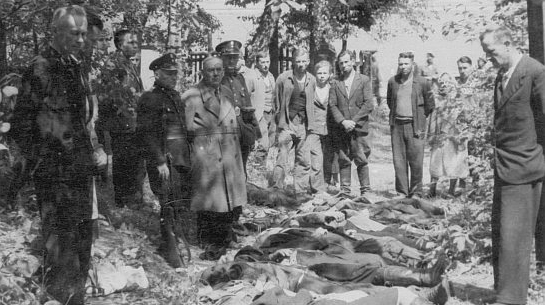
Regrettably, only a scant few—if any, and then only in fragments—are aware that many cities and backwaters of the South-Eastern Borderlands of the Second Polish Republic, with their cobblestones and roadside fences, were drenched in blood in the years 1942-1945: Polish, Czech, Roma, Russian, and Jewish.
As documented in the 2023 publication of the Institute of National Remembrance, Survivors of Genocide, the sheer scale and ferocity of the crimes committed give us every reason to affirm that “between 1939 and 1948, what unfolded constitutes the third genocide suffered by the Polish nation—following those perpetrated by the Germans and Soviets.” At the hands of Ukrainian nationalists—who often recruited ordinary peasants of both sexes—approximately 130,000 Poles were murdered. Retaliatory actions claimed the lives of between 10,000 and 13,000 Ukrainians.
As the report further states, the modus operandi of the atrocities committed by the OUN and UPA was marked by its immediacy and ubiquity—traits which, in most cases, distinguished it from the other two totalitarian systems, whose agents often employed indirect means of extermination, such as concentration camps and gulags.
This reflection would amount to little more than a routine media statement were it not for the moral imperative that every action undertaken by a Christian must, in some measure, bear fruit in goodness.
It is therefore fitting to turn to the Scriptures and to the authoritative voice of one of the Church’s greatest spiritual leaders, Saint John Paul II.
“And all this is from God, who has reconciled us to himself through Christ and given us the ministry of reconciliation, namely, God was reconciling the world to himself in Christ, not counting their trespasses against them and entrusting to us the message of reconciliation.” (2 Cor 5. 18-19)
“The only path to peace is forgiveness.” – emphasised the Holy Pontiff in his 2001 Lenten Message. “Forgiveness given and received enables a new kind of relationship among people, breaking the spiral of hatred and revenge and shattering the chains of evil which bind the hearts of those in conflict with one another.”
A year later, on the occasion of the World Day of Peace, he likewise recalled:
“Forgiveness may seem like an unacceptable weakness, even when the conflict is our own fault. If the blame lies with others, it may appear as an unjust humiliation.”
Referring to the process of Polish-German reconciliation, Saint John Paul II declared in 1997:
“Forgiveness, far from precluding the search for truth, actually requires it. The evil which has been done must be acknowledged and as far as possible corrected.” Of particular significance is the assertion made here that forgiveness does not imply forgetfulness. Thus, the pursuit of historical truth possesses intrinsic value and serves the cause of reconciliation.
“The truth is that one cannot remain a prisoner of the past, for individuals and peoples need a sort of ‘healing of memories,’ so that past evils will not come back again. This does not mean forgetting past events; it means re-examining them with a new attitude and learning precisely from the experience of suffering that only love can build up, whereas hatred produces devastation and ruin. The deadly cycle of revenge must be replaced by the new-found liberty of forgiveness.” – continued the Holy Father pointing to the path by which one might be delivered from the demons of the past.
The truth of genocide must not be buried in silence. The victims—together with the surviving relatives of those bestially slain—deserve remembrance; history itself demands it of us. It is unfortunate, however, that not a single Catholic online platform in the Antipodes has made even the slightest mention of those events.
As my fellow countryman, Blessed Father Jerzy Popieluszko, once uttered: “Truth bears the mark of endurance and of ultimately coming into the light, even when one attempts to conceal it with the utmost diligence and deliberation.”
Although hushed up during the communist era to preserve cordial Polish-Soviet relations, the Volhynia Slaughter has since the 1989–91 re-establishment of democratic governance been the subject of scholarly inquiry and ongoing public discourse.
Nevertheless, Polish victim advocacy groups have reproached Ukrainian authorities for venerating Stepan Bandera (1909–1959)—a figure partially accountable for the atrocities. In turn, Ukraine has raised grievances that its own citizens were subjected to ill-treatment in post-war Poland, particularly through coerced relocations.
Those in power have a duty to act in accordance with their nation’s best interests—understood not as narrow self-interest, but as a well-considered raison d’état. At the same time, they must work to eliminate the roots of mutual hostility and mistrust, thereby fostering understanding, reconciliation, and sincere dialogue between nations—dialogue grounded in truth.
We are bound together by the deep affinity of the Slavic family of nations. Despite the deliberate and systematic attempts at atheisation, we share profound and enduring Christian roots.
In conclusion, until the perpetrators of these crimes are explicitly identified and condemned, and the victims of the genocide are afforded proper exhumation, dignified burial, and at least symbolic commemoration, it will remain difficult to speak of genuine reconciliation. All the more regrettable is the fact that Poland’s reception of over a million Ukrainians has not been acknowledged as a milestone in that direction — one that calls for a reciprocal gesture on the part of the Ukrainian state.
The original account by Władysława Kamińska has been significantly shortened and stylistically adapted for an English-speaking audience. The events remain in chronological order as in the original. (Source: AIPN Gd, audio/video recording – 28.11.2016/29.12.2016)
Relations between Poles and Ukrainians in the settlement of Jaminiec, in the Derażne – rural municipality, Kostopol county, were remarkably cordial. Wiesława Kamińska paints a vivid picture of a peaceful, cooperative society in interwar Poland, particularly in the ethnically mixed community of Jaminiec. Her family shared warm and neighbourly ties with the Ukrainian Żuk family, with children doing homework together and even sharing meals. Ukrainians were fully integrated into civic life, holding positions such as village mayor and working as doctors and teachers – evidence that they were not marginalized. Therefore it is clear that Ukrainians weren’t treated as second-class citizens or serfs; on the contrary, they were integrated into many professional roles.
At school, children from various ethnic backgrounds – Poles, Ukrainians, Jews, Germans, and Czechs – learned side by side. Though religious instruction was separate according to faith, the atmosphere was open and respectful, without segregation or favouritism. Polish was the official language of instruction, but pupils were free to speak their native tongues among themselves.
This multicultural harmony persisted until the Soviet invasion on 17 September 1939, which marked the end of that relatively idyllic coexistence. Kamińska’s recollection suggests a deep sense of loss, as the arrival of the Soviets brought an abrupt and irreversible change to their way of life.
When the Germans arrived in June 1941, things were relatively calm. But in 1942, they handed control over to the Ukrainians.
On our estate, there was woodland, and beyond that lay the state forest. It was there that the Ukrainians committed the first massacres—against the Jews. The Germans had armed them. Where else could they have obtained such modern weapons? The Jews from the entire surrounding area were rounded up and brought there—no more than two kilometers from us. To this day, I can still hear the sounds—the cries, the shots. It was horrific.
They were forced to dig a pit and then stand inside it. Shot in the back of the head. Whether dead or just wounded, they all fell into that pit. Then the bodies were covered with lime. Some were still breathing—buried alive. A Ukrainian man who lived nearby told my parents that when he passed by the next day, the ground was still moving.
The Germans must have promised them something. “Wipe out the Poles, and you’ll have an independent, free Ukraine.” And so they began. Whole families, entire communities—wiped out without mercy. They murdered the Roma too, somewhere in those woods, though I don’t remember exactly where. There weren’t many of them—just a few travelling groups. Maybe twenty or thirty souls, no more.
On the 21st of March 1943, a kind-hearted Ukrainian came to our home. Not all of them belonged to the gangs—this man was around forty, a lifelong bachelor, and he said to my father: “Mr. Sewruk, if you truly won’t leave your land—as you say, you’d rather die here than abandon it—then at least send your wife and the young ladies,” meaning my sister and me, “to the large Polish village—Pendyki. They’ve got some weapons there now. Your sons can stay—meaning with you and your wife—or go with the women. But it will be very bad here soon.“
He had overheard the whispers among the Ukrainians—an attack on us was being prepared. He came on a Monday. By Tuesday, Father said to my brother:
“Staszek, ready the wagon. Load it with grain, flour, provisions, and bedding—you’ll take them to Pendyki. Your mother, Ziutka, and Władzia will go. I’ll stay behind. This is my land.”
The wagon was packed—bedding, clothes, food—everything ready. We were to have lunch and then set off. My brother stepped out into the yard to water the horses and the cows. As he looked up, he saw a large hay cart coming down the road with just one person sitting on it. Odd, he thought—and then, suddenly, the cart veered into the roadside ditch. Before he could react, men burst out from under the hay. Bandits. Four, maybe five of them. And they were right on our land—no more than 300 or 400 meters from the house.
My brother shouted: “It’s an ambush!” And we all bolted in the direction of Pendyki.
So we ran—my mother, my brother, my sister, my father, and I. Also with us was Mrs. Drohomirecka and her son. My sister and I ran together as fast as we could. At some point, we lost sight of everyone—Mummy, Daddy, our brothers, even Mrs. Drohomirecka. We ran until the gunshots finally stopped. We reached a small stream, and then beyond it, bushes—we’d managed to disappear from their view. That’s how we arrived in Pendyki—panting, terrified, but alive.
Later, I learned that Mummy and Mrs. Drohomirecka had only been stunned by the bullets—they’d fallen unconscious for a time. And that may well have saved their lives. Had those murderers found them, they would’ve been tortured to death.
When they came to, they ran across the road and hid with a Russian family—the Majors.
It was already the 23rd of March. The three of us were in Pendyki. That morning, my sister—just 22 at the time—turned to me and said, and my brother Stanisław was 18: “Listen, you’ve got to go and fetch Mummy. She won’t make it here on her own.“
They led me to the outskirts of the village. I was a mere twelve-year-old child, had never in my life set foot in Pendyki. I didn’t know the way; they simply pointed in the direction of some tall trees and told me to cut across the fields at a slant. They popped a cap on my head—a leather aviator-style one—and I was already wearing a coat. “Go on then, bring Mummy back. She’s staying with the Majors.” And off I went, just as I was told.
No sooner had I set foot on the main track than I heard the thunder of hooves behind me. My heart nearly stopped—my first thought was the Ukrainians. They always rode on horseback.
Three of them came galloping up. I had on a pair of boys’ trousers and that pilot cap—I must’ve looked just like a lad. Each of them was armed. One called out,
“Malý, kudy ty idesh?” And I answered him in Ukrainian, saying I was off to visit my uncle—the Majors. The one holding a pistol looked me over and said, “Maš ty szczastie, szczo ty ne laszka, bo tut tobi buła b mohyła.” – “You’re lucky you’re not Polish, or this spot would’ve been your grave.”
My heart was pounding like mad, but they left me be and rode off into the distance.
I reached the Majors’ homestead pale as a ghost. They asked whether I’d seen anyone on the way. I told them—three men on horseback. They only asked where I was headed. I’d said I was visiting my uncle, the Major. “Good girl,” they said, “If they come asking, we’ll say a relative dropped in.” They were frightened for their lives too—you could see it in their eyes.
I gathered Mummy—she could hardly stand, worn to the bone. They gave us a loaf of bread and a thick slice of salt pork.
We barely made it back to Pendyki with Mummy that same day. It was Thursday—the Feast of the Annunciation of the Blessed Virgin Mary. The bells had been tolling since dawn, but this wasn’t for prayer. It was an alarm.
We dressed in a flash—it was an attack on Pendyki. No sooner had I stepped onto the road than I saw them again, advancing from the east. We bolted westward, toward the Cumań Forest. Those woods stretched endlessly—vast, ancient forests once belonging to Prince Janusz Radziwił himself.
For a moment I glanced back—the sunrise was heartbreakingly beautiful, so bright and golden—but what I saw chilled me to the bone. It looked like the earth itself was crawling, like a swarm of ants. But it was a mass of Ukrainians coming for us.
Men and women alike, wielding saws, axes, flails, knives—whatever they could find. There were no firearms, not really. So again, we ran for our lives.
My brother had managed to get hold of some little popgun of a weapon and stayed behind with a self-defense group. He didn’t flee with us—only Mummy, my sister, and I kept running. They had a few of those little shooters between them, and made a brave attempt to hold them off.
Eventually, we plunged into the forest, deeper and deeper, trying to put distance between us and the horror behind. The attack began at six in the morning. We spent the entire day wandering through that forest, searching for a way out—but there was none.
If only we’d known the path—it was perhaps 8 to 10 kilometers to Cumań, which was a railway hub. Instead, we fled from one enemy straight into the arms of another. From the Ukrainians, we ran straight under the wing of the Germans.(The Poles were typically deported to Germany for forced labour.)
We got lost. Utterly lost. We wandered through that forest all of Thursday, and when night fell—it was dreadful. Wild beasts howled in the dark, wolves among them. The underbrush stirred with hidden life. Here and there, glowing eyes blinked from the shadows. We gathered what damp branches we could, just to have something to sit on—we were beyond exhausted, starving and parched. We wet our lips with snow, just to carry on.
When dawn finally broke, the three of us rose again and kept searching for a path.
Now it was down to this—either death by hunger or torn apart by beasts. We truly didn’t know which would come first.
Our second night in the forest. Once again, we gathered branches, huddled together—just the three of us—curled up to survive those long, black hours till dawn. The darkness felt endless.
Then my sister began to pray—really plead—with our murdered father. “Daddy, you were such a good father. You always gave us the best advice. Please, help us now—get us out of this forest. If not, wild animals will tear us apart, or we’ll starve to death.”
As soon as it started to get light, barely a whisper of dawn, she shook me awake, eyes wide. “Get up,” she said, “Daddy was here—he came and showed me the way out.”
I told her, “Ziutka, you must’ve been dreaming… maybe it was a vision.” But she swore—until the day she died—that she had seen our father, and he had spoken to her.
“When the sun rises,” he’d told her, “go right. You’ll reach a clearing in the forest. There’ll be one single pine tree there, with a tuft of branches at the top, like a feathered crown. That’s your first landmark. Pass that clearing and keep going straight. On your right, you’ll see rusty, abandoned railroad tracks. Don’t follow them—they’ll expose you. Stay in the woods, but keep the tracks in sight. They’ll guide you. Eventually, you’ll spot a water-filled hollow—a small forest pond, probably snow-covered now. Once you pass that, you’ll come to a road. That road will take you to Cumań.”
And just like she said—everything happened exactly the way our father allegedly had described.
Then we ended up on a proper road—paved, cobbled—the main route leading to Cumań. We were dragging ourselves along, helping Mum walk, and finally reached the little church. My parents were well-known in our area since Dad had been a councilman in the local municipality. In front of the church, there was a crowd from Pendyki. They spotted Mum right away and started shouting, “Mrs. Sewruk with her daughters is coming!”
There was a Mass going on inside, and my brother Staszek happened to be there. One of the men who recognized us said, “They’re already holding a service for your souls—it’s been two days since the attack, so folks thought your mother and sister had been killed.” He dashed inside and yelled, “Staszek, your family’s here!” And just like that, we were reunited with our brother. But our father and our other brother had been killed in Jaminiec.
And my godfather—God rest his soul—was returning from the nearby town of Derażne when the attack began. That’s when they caught him.
They gouged out his eyes. They sliced off his nose. They cut out his tongue and lopped off his ears. Then, with barbed wire, they bound his hands tight and tied him to a rope, which was fastened to the horse of one of those murderers. And then—that devil of a man spurred the horse with all his might. The beast galloped forward, dragging my godfather’s body along the road, tearing it to shreds as it went. He died in agony—my godfather, a good man, met a death too cruel for words.
As for my father—he suffered from asthma, had trouble breathing even on a good day. There was no chance he could run. So he stopped, leaning against a fence, too weak to go on. This was seen by Wołoszyn’s daughter—she’d hidden herself up in a tree and watched it all unfold.
One of the attackers ran up to him. It was our neighbour, Saszka Żuk. And my father, said to him: “Saszka, why do you want to kill me? What have I done to deserve this?” And Saszka replied: “Nothing. You were a good neighbour. But I have to kill you because you’re Polish. Still, because you were a good neighbour, I’ll spare you the suffering.”
And with that, he shot my father in the head. The bullet—an expanding one, as the older folks would later explain—ripped through him like fire through paper. It didn’t just kill him. It destroyed him.
When I returned the next day—back then, when I was still in the settlement of Pendyki—the locals showed me where it had happened.
My father was lying on his back by the fence, still wrapped in his old sheepskin coat. His arms were outstretched, eerily peaceful, as if someone had prepared him for burial. But half of his head was gone. Just… gone. One eye remained, staring.
May God forgive the perpetrators, receive their victims into His Kingdom, and grant humanity peace and protect from World War. Amen.

 Deacon Gregory Webster
 Vincent Ryan Ruggiero
 Fr Dino Vanin
 Fr Joseph Esper