

 William Borst
My title should evoke at least two valid questions. The first is just who in the world is David Mamet? The second question flows from the first.Why should I read anything about him? First of all, David Mamet is a renowned author and playwright. He is best known for his theater presentations, Glengarry Glen Ross and American Buffalo.
The son of Jewish immigrants, Mamet was born in Chicago in 1947. His conversion to a conservative did not occur until later in his life. He candidly admits that he did not speak to his first conservative until he was 60 years old. He attributes his conservative education, mainly to author and radio host, Glenn Beck.
I was introduced to his work in the film adaptation of The House of Games which appeared in 1987. Starring actor Joe Mantegna, its theme revolved around psychiatrist Margaret Ford, played relentlessly by Lindsay Crouse (Mamet’s first wife), who falls victim to a con-game that cheated her out of her life savings of $80,000. Like HOG, Mamet’s plots have many turns, twists and surprises but in the end, Ford achieved her bloody revenge.
My favorite Mamet film is The Spanish Prisoner, which introduced me to his second and current wife, the relatively unknown actress, Rebecca Pidgeon. Her performances have mesmerized me over several years as she has become a steady presence in virtually all of her husband’s plays and films. I think both playwright and actress owe a great deal to Mamet’s stylistic dialogue, where virtually every word is recited in a staccato monotone, with constant repetitions that attracts because of its unique cadence.
Mamet has also published two books where he distills his way of thinking. He earned both his conservative wings and the fury of his many liberal friends with his first book, The Secret Knowledge On the Dismantling of American Culture, published in 2011.
One reviewer for ABC News noted that Mamet wrote of Secret Knowledge that it was…likely to enflame the liberal audience that has embraced him since his rise to fame with 1984’s Glengarry Glen Ross. In this book, Mamet laid bare the extent of his rejection of liberalism and the origins of his apostasy, which he had revealed in Recessional, an essay for the Village Voice.
A home grown liberal most of his life, Mamet finally saw the light. Secret Knowledge was a book designed to jolt his friends and colleagues out of their complaisant seats of self-respect. The book is funny, belligerent, unapologetic Jewish and Zionist and adamantly conservative from a writer who had been once a self-described brain-dead liberal.
Mamet was a late bloomer with regard to political issues. When he started wondering about the world around him and often did not like what he saw. After decades of working with Hollywood liberals, who shared the same way of thinking, he was figuratively knocked from his horse during the early years of this century. Due to his conversion, Mamet is extremely harsh on Hollywood where he had contributed to the dazzling and confused syntax of the times. He directs his newfound ideas against the artificial world that he and Hollywood had helped to create.
As he writes, we here delight in indicting our sunset homes as Sodom and Gomorrah without the charm. Mamet is not worried about alienating his audiences anymore. My job is to entertain them…not manipulate them. Despite his new way of thinking, most of his creative friends are sticking with him…They simply don’t talk politics.
The former left-wing stalwart has reset his politics and with that his direction. In his latest book, The Disenlightenment: Politics, Horror and Entertainment, Mamet addresses his full attention to America and the cultural malaise, which liberals have created. His focus is fully on exploring how cultural elites have twisted our moral and political institutions into tools of manipulation.
Mamet attributes his great transition from playwright and film-maker to polemicist to the fact that people are seldom influenced by a play or a film. After making several movies and plays, Mamet felt frustrated by a truism of his craft. No one has ever had his mind changed by a play or a movie. With books like Disenlightenment, he has found a more straightforward way to direct his energies to the political realities of American life in the 21st century.
According to Civitas Outlook’s Emina Melonic, Disenlightenment takes several paths, which seem to be an intricate part of Mamet’s writing style. To properly understand him requires a dedicated patience to fathom what exactly he is saying. While the author meanders through the cultural edifices of America, he always returns to the central idea and origin of his thought.
Another reviewer, Tunku Varadarajan, commented on this book in an essay, The Rules According to Mamet, which appeared in the Wall Street Journal. Disenlightenment… is his latest assemblage of heat-seeking thought, comprised of 44 short and razor-sharp essays…
The reviewer adds that Mamet has been known as much for his political essays as for his drama. Among the broad spectrum of topics he explores, are war, peace, success, and ultimately death. In doing so Mamet’s astute analysis offers a fresh perspective on the cultural milieu which had produced his artistic talent.
In his inimitable style of wit, the playwright dissects the modern world with enthusiasm, wisdom and a plethora of movie references that tickles the cords of memory. His essays are not an unending stream of invective and political diatribe but of deliberate, concentrated reasoning, distilled into conclusions of almost rabbinical finality. Even his chapter titles are soddened with his clever wit, especially, his Lesbians and Whaling, Come Smoke a Coca-Cola, Armageddon, and Falling Up and Down.
With his off-the-wall humor, Mamet exposes the intricate dance between power and myth. His observations are free ranging from the carnival-like nature of politics to the special power of the English language to reflect a society where traditional values have been under siege for decades.
Unsurprisingly, Mamet is not shy about his devotion to President Donald J. Trump, which dates back to 2008. He believes the president’s heirs will, God willing, increase the longevity of the American Experiment. To his former associates, this is a broad slap across their collective faces, which in more chivalric ages would have been an invitation to a duel.
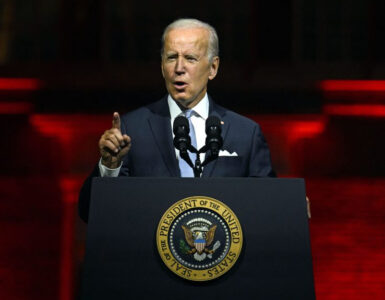
I think the playwright regards the president as a St. Bernard, sent by God to rescue America from the frozen tundra of liberalism. Mamet loathes former presidents Barack Obama and Joe Biden with an undisguised venom. In his view Obama was a Marxist and Islamist opportunist while Biden embodied all that was moribund in America.
Varadarajan says Mamet’s style is caustic writing of the thrilling kind. He offers the reader some short takes from his eloquent tirades. America is the first civilization, obsessed with over-eating instead of starvation and since we no longer need, laud or cultivate strength in order to survive, we squander it in a frenzy to allay fear and confusion over a terrifying overabundance.
Mamet also spanks former teenage world leader Greta Thunberg, whom he calls a professional truant. He underscores her arrogant thinking that she had the power to change the world by staying home from school. This would have been risible, had she not been so confused as to believe her own delusions.
Not all reviews were favorable to Disenlightenment. David Skinner’s review for the Washington Free Beacon, entitled The Mamet Theory of Everything, took issue with the author’s wide-ranging variety that made it an unsettling read. He should have immediately engaged his readers’ attention! But instead, Mamet launched into an elaborate comparison of our current anxieties about sex, race and the environment to the feelings that gave rise to the Salem Witch trials was to Skinner, an exercise in convoluted writing.
Skinner also blanched at Mamet’s recognizing the influence of Rebecca West, George Orwell, and Samuel Johnson on his thinking. He felt the playwright’s forays into the dark side of human nature congered more the influence of H.L. Menchen, Friedrich Nietzsche and B.F. Skinner. I also think that the reviewer believes that Mamet should have saved his ideas for his theatrical work in plays and films, instead of wasting them in a book.
Skinner did, however, recognize the fact that Mamet’s purpose was to present his essays as a united answer to the unsettling political and social dramas of the last two decades. It is apparent his goal was, not only to survey the damage liberalism has done to American culture but also offer a unified theory to explain just what happened. In other words, Mamet states he wanted to identify a seemingly unconnected set of symptoms as a single disease.
Mamet greatest fear is for the America’s nuclear family, which has been eviscerated by technology, contraception, penicillin, travel and so on. The champions of its demise have been humanism, globalism and atheism. Their concerted efforts to restructure the family appear to be more akin to life in an urban gang.
Lastly, Mamet and his plays tout manliness and masculinity against the cultural claptrap of Big Government, which wishes to deify feminism as the essence of Americanism. According to the author, Government, like Circe, turns men into Swine. Mamet’s name for America’s psychodrama is the prescient Wokelahoma, which perfectly identifies our dire situation. These words may in the long run resonate more deeply than any of his dialogues for American Buffalo.

 Vincent Ryan Ruggiero