
 Paul Suski
“I beg the Blessed Mother to touch the hearts of all parish Priests that they may have Perpetual Eucharistic Adoration in their parishes, and that it may spread throughout the entire world.” – St. Mother Teresa of Calcutta
The other day, my thoughts turned to remote Poland. On 31 August, the Benedictine Nuns solemnly commemorated the eighty-first anniversary of the tragic death of their fellow sisters in wartime Warsaw. Bound by a fourth vow — that of Perpetual Adoration — the Benedictines remained steadfast. In the very heart of the Warsaw Uprising of 1944, on that fateful day, a German aircraft unleashed their bombs upon the convent. The sisters refused to abandon the four priests as well as almost a thousand civilians who had all sought shelter in the convent’s basement — offering their own death together with them as a sacrifice in order to obtain mercy for their Country. As one of them expressed: “So that when Poland is reborn, it will neither be white nor red, but Christlike!
A Brief History of Eucharistic Adoration
In the earliest Church, the Blessed Sacrament was preserved following Mass so as to bring Holy Communion to the sick or imprisoned and thereby help to bolster their faith. Accounts such as those of St. Tarcisius tell of Christians risking their own lives in order to carry the Sacrament to wherever it was needed. Records from the late 4th century show that in some dioceses new converts were invited to adore the Blessed Sacrament for eight days after Baptism.
However, the practice of Eucharistic Adoration, whereby individuals pray with love before the consecrated Host, did not develop until later.
Public Adoration formally originated in Avignon, France, on 11 September 1226. To give thanks for the victory over the Albigensians, King Louis VII requested that the Blessed Sacrament be exposed in the Chapel of the Holy Cross. The adoring crowds were so numerous that the Bishop decreed a continuous day-and-night Adoration which, sometime later, was ratified by the Pope. The devotion persisted without interruption right up until the French Revolution in 1792 and then was once again restored in 1829.
Throughout the Middle Ages, the faithful increasingly adored the Blessed Sacrament, aside from their attendance at Mass. Initially, the Host was venerated within the Tabernacle; later with the doors open; and eventually in solemn exposition in a monstrance. Catherine Mectilde de Bar, founder of the Benedictines of Perpetual Adoration, notably emphasized Adoration of the presence of Jesus in the Host during this period.
In 14th-century England, the mystic Richard Rolle (1300–49) urged pilgrims to visit a nearby Church as frequently as possible. He wrote: “In the Church … there is God upon the altar to hear those who pray to Him and to grant them what they ask and what is best for them.”
The Council of Trent (1545–63) reaffirmed the Eucharist as truly the Body and Blood of Christ. In 1551, it decreed that Our Lord must be adored in the Blessed Sacrament, honored with festal celebrations, carried in solemn processions, and publicly exposed for Adoration — thereby ushering in a renewed era of Eucharistic devotion.
St. Alphonsus Maria de Liguori once wrote: “Of all devotions, that of adoring Jesus in the Blessed Sacrament is the greatest after the Sacraments, the one dearest to God and the one most helpful to us.”
Across Europe and later in the Americas, new religious orders continued to dedicate themselves to Perpetual Adoration. One example is the Congregation of the Sacred Hearts of Jesus and Mary and of the Perpetual Adoration of the Blessed Sacrament of the Altar, which was approved in 1817.
Although the practice declined somewhat after the Second Vatican Council, it flourished again under the encouragement of Pope John Paul II. Pope Benedict XVI likewise urged clergy, religious, and lay faithful to “take time, in the course of the week, in passing, to go in and spend a moment with the Lord who is so near…”
The Best Location and Form of Exposition
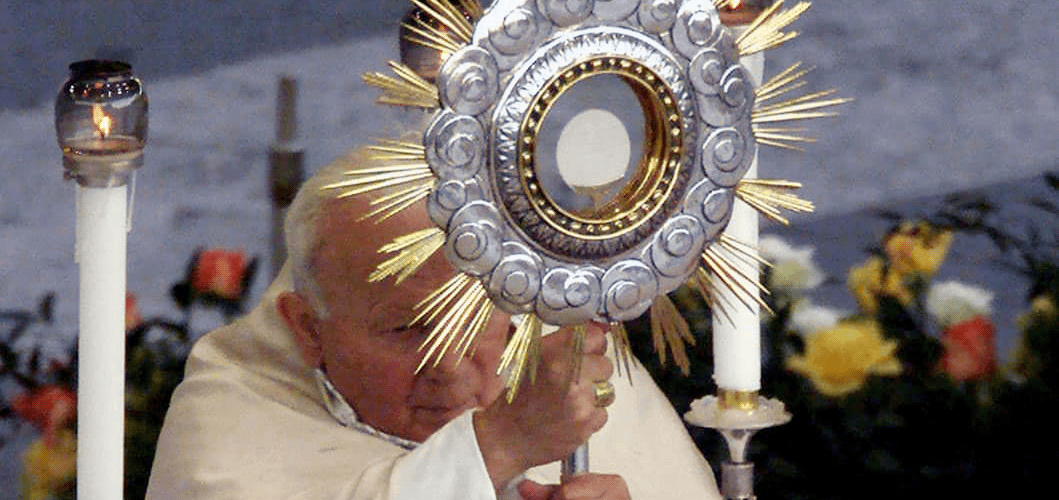
The ideal setting for Perpetual Eucharistic Adoration is a small, dedicated Chapel, where warmth and a sense of closeness foster recollection and reflection before the Lord. If such a Chapel is unavailable, a modest space—such as a sacristy, crying room, or a room in the rectory, convent, or parish centre—may be reverently adapted, with safeguards to honour and protect the Blessed Sacrament. Exposition in the monstrance, where Jesus is visibly present in the Eucharist under the appearance of the white Host, draws adorers into a deeper intimacy than when He is hidden in the Tabernacle. It also calls for a certain level of faithful commitment since at least two adorers must be present at all times to ensure that Our Eucharistic Lord is never left unattended.
PEA in Poland
Perpetual Eucharistic Adoration at the Parish of St. Joseph, Spouse of the Blessed Virgin Mary, in Warsaw has, in fact, continued without interruption since 1987. Around 300 members of the Confraternity of the Blessed Sacrament keep watch before the Eucharistic Jesus in scheduled shifts. It was the first church in Poland to introduce PEA — an idea brought from the United States by Fr. Krzysztof Małachowski who had come to preach a Retreat. At that time, the parish priest, Fr. Dr. Jan Sikorski, together with his parishioners in Wola—a district so grievously marked by the tragedies of the past—first came to learn that this devotion was already being practiced in many churches across America and beyond.”
Years later, Fr Sikorski remarked in an interview: “For fifteen years I haven’t seen the key to the church — nor have I looked for it — since it is always open. Adoration has never faltered, even though the area around the church is far from safe.” During the 2020 lockdown, the church remained open and the faithful continued to come.
“Sometimes young people turn up in the early hours of the morning after parties. Every day hundreds come, in their thirst for an encounter with Our Eucharistic Lord. Many receive special graces or intercede for them. The church is open round the clock and attendances are made up of the old and the young, of children and teenagers, either from the parish or elsewhere in the city or even further away. Pupils arrive before tests, students before exams. Ensuring that adoration is covered 24/7 is no easy task; it is, in a way, a miracle. It requires sacrifice and perseverance and therefore represents a considerable challenge to the whole community of adorers,” says the current Chaplain of the Confraternity, Fr. Dr Bolesław Szewc.
Drawing upon the inspiration and counsel of Fr. Justo Antonio Lofeudo MSS, the Adoramus Te Christe Foundation was inaugurated in 2022. In November 2024, Bishop Artur Ważny issued a pastoral letter supporting the Adoramus Te Christe mission.
At the time, Fr. Lofeudo, a charismatic Priest of Argentine origin, had already played a direct role in bringing to life six Perpetual Adoration chapels. Since then, the foundation has established thirty-three more. Its leaders dream that by 2033, each of Poland’s thousand-plus deaneries will be graced with at least one such Chapel. Many acknowledge that these houses of prayer are springing up like mushrooms after a summer rain. There are currently 61 Perpetual Adoration Chapels open to the public, with more to be established soon. Some Catholics also believe that the conservative candidate’s victory in the June 2025 presidential election was borne on a powerful wave of prayer flowing from these Chapels.
What a blessing it would be to welcome Fr. Lofeudo to Australia one day!
The Call to Nocturnal Adoration
Among the most precious hours are those in the deep of the night. Parents sacrifice much to feed, shelter, and educate their children. Without sacrifice, there is no love. The Christian life is marked by sacrifice—and those who choose one of these most difficult hours will bring divine blessings to earth, like rain from heaven. By giving just one hour weekly during the night, we can drive away evil from our land and flood humanity with merciful love!
Thanks to Christ’s sacrifice on the Cross, we have the gift of the Blessed Eucharist—His Passion reveals all that He endured so that we might have immortal life. Do not fear to attend Adoration during the night. There is no safer place than before Jesus in the Blessed Sacrament. He is the Light that drives away all darkness.
Countless people have died in wars, yet how few will make the smallest sacrifice for peace. Evil advances because those against God are often more active than those FOR Him. This spiritual combat—between good and evil—is the greatest war in history, deciding the fate of the Church and the world. It is a spiritual “red alert.” Who will answer Christ’s call: “Simon, are you asleep? Could you not keep watch for one hour?” (Mk 14:37)
Your presence during the night hours brings comfort to His Heart which is continually wounded by ingratitude and indifference. Your presence at any time consoles Him, just as Veronica consoled Him on the way to Calvary, but Jesus is especially moved by those who keep Him company in the silence of the night. Free from the rush of the day, our hearts can hear the whisper of His voice. In Gethsemane, He endured loneliness; your vigil repairs that moment. You may not know on earth whom your prayer has touched, but in eternity you will see the fruits!
Night adoration is not only of personal benefit — it is also an act of missionary zeal. By interceding before the Blessed Sacrament, you join the Church’s mission to bring Christ to the world. Many adorers find their night hour to be the most grace-filled time of the week. Even if they arrive tired, they leave renewed: “They that hope in the LORD will renew their strength, they will soar on eagles’ wings” (Is 40:31).
Jesus promised: “Ask and it will be given to you; seek and you will find; knock and the door will be opened to you.” (Mt 7:7). Those who come before Him—especially during the night — open wide the door for His grace to act. Every visit unleashes miracles of love—sometimes seen, sometimes hidden, but always real. Therefore, the adversary spares no effort to discourage potential night adorers.
(Based on “L’adoration nocturne – La valeur du sacrifice,” Missionnaires de l’Eucharistie)
Cardinal Robert Sarah writes that “The men and women who pray in silence, in the night, and in solitude are the supporting pillars of Christ’s Church.”
St. Pope John Paul II spent hours every week in nocturnal Adoration before the Blessed Sacrament, from which he received all the help he needed to accomplish so much good.
Fr. Dominik Chmielewski SDB recommends 30 minutes of night Adoration lying prostrate on the floor of a Church, claiming that nocturnal prayer gains a special privilege before the Lord.
On a personal note, a couple of years ago my wife and I had been battling for over five years with a court case concerning a property. We had prayed many times for God to sort it out— but nothing happened. One day, while scrolling through YouTube, I came across a sermon by Fr. Dominik. Moved by his words, for the first time in my life I fell prostrate, begging Jesus for help. To my astonishment, just fifteen minutes later I received a phone call informing me that legal proceedings had begun and everything would be resolved favourably. Since that day, whenever something truly serious arises, I prostrate myself before Our Eucharistic Lord, caring little about whatever others might think…
Fruits and Benefits of PEA
Just as the sun’s rays melt the ice, the gentle yet powerful grace of Christ in the Blessed Sacrament softens hearts which in turn leads to conversions and stronger faith. Pastors report a steady stream of RCIA candidates, as well as clear spiritual growth among those parishioners who spend time before the Eucharist Lord. Wherever PEA takes root, remarkable transformations follow. Bishops and pastors note a significant increase in Mass attendance—on Sundays as well as weekdays—as many return to the Sacraments. In some communities, Adoration has been credited with restoring peace, preventing violence, and shielding against political or ideological harm. Beyond individual conversions, PEA renews family life, inspires vocations, emboldens Gospel witness, and strengthens parish unity while centering the very heart of the community upon the abiding presence of the Eucharistic Lord.
God’s Special Work of Grace
Metz, France — On 14 June 1865, “Mlle Anne de Cléry” was suddenly and completely cured while praying before the Blessed Sacrament during the third day of Perpetual Eucharistic Adoration at Saint-Martin’s parish. An anonymous parish Priest recorded the event, and the Bishop of Metz approved its publication, calling the healing a divine sign of God’s favour for this devotion.
“We had prostitution and drugs being sold in front of our Church. When we took on Perpetual Adoration of the Blessed Sacrament, this all stopped. When our Lord in the Blessed Sacrament is exposed on the altar, crime leaves the area. I am convinced of that.” (Fr. James Swenson, pastor of St. Bridget Catholic Church, Las Vegas, NV).
From childhood, I was immersed in an environment that was steeped in atheist ideology, one that actively opposed every expression of religious belief. I myself did not believe in God. One day, while waiting for a friend, I happened to pass a Chapel where Eucharistic Adoration was taking place. I was suddenly touched by a radiant light. In the space of a few minutes, my entire life was transformed — I became a Catholic and began to adore the Blessed Sacrament regularly. — André Frossard
Bishop John Magee of Cloyne in Eire, (Ireland) reports that vocations to the Priesthood in his diocese have tripled since he started Perpetual Eucharistic Adoration. In 1990 there were 16 seminarians and by 1993 the number had risen to 45.
The Parroquia Expiatorio del Santísimo Sacramento is likely the oldest site in Guadalajara, Mexico. This monumental neo-Gothic Church is striking in its austere beauty. The parish Priest notes that the blood of martyrs is the seed of vocations and that many vocations also spring from Eucharistic devotion. In the Archdiocese of Guadalajara, more than 900 candidates are preparing for the Priesthood, and even contemplative religious orders are facing no shortage. The Priest himself is not the only one in his family to dedicate his life to God — his sister is a nun. […]. (Piotr Ewertowski, 2024-10-06, misyjne.pl)
“Between 2008 and 2010, Ciudad Juárez, situated in northern Mexico, was ranked among the most dangerous cities in the world. Every day numerous lives were lost as a result of conflicts between drug cartels and the like. Following the establishment of a Chapel of Perpetual Adoration – in fact, several such Chapels – the cartels vanished from the city and peace was restored.” – Fr. Justo Antonio Lofeudo MSS
St. Mother Teresa of Calcutta said: “It was not until 1973 when we began a daily Holy Hour, that our community began to grow and flourish.”
Fr. Mirosław Kopczewski OFMConv entered the Province of the Immaculate Mother of God in Poland (Warsaw) in 1988. Before that, on his way to work each day, he would stop at the Church for 30–40 minutes, spending this time before the Tabernacle for many weeks on end. He recalls:
“It was just Him and me. When my thoughts began to wander, I would say: ‘I am here and You are here. Do with me what You will.’ I called this the prayer of presence.”
In his third year at the seminary, he experienced doubts about his vocation and sought help in Adoration.
“I set out to spend an hour in the Chapel from 8 to 9 p.m. I missed not a single day, nor shortened it by even a minute. It was hard to stay put. Something seemed to push me out: intrusive thoughts like ‘You’re wasting your time,’ or ‘Think how many interesting things you could be doing.’ But I didn’t give in; I sat there as I had promised, sometimes clinging to the pew.”
He continues:
“When my mind wandered, I returned to my pre-seminary prayer: ‘I am here and You are here. Do with me what You will.’ After a few days, I noticed I left the Chapel somehow lighter.”
Two or three months later, the young Friar realised:
“The Lord Jesus had taken away all my doubts—and I hadn’t even noticed when.”
Today, the Franciscan serves as a Priest in Niepokalanów, where the Chapel of Perpetual Adoration was established in September 2018.
“Adoration of the Blessed Sacrament has saved—and continues to save—my life,” says Dominika, a medical doctor who wished to share her experience with the reader:
“After enduring five miscarriages, along with the ensuing depression and anxiety, I sought help through psychotherapy. While it provided some support, the results were far from satisfying. Determined to find something that would truly help, I began exploring other options and so came across the practice of mindfulness. Curious, I asked my psychotherapist for his opinion. To my surprise, he responded:
“Why not? But since I know you’re a person of faith, perhaps you might first try spending half an hour each day in Adoration. If that doesn’t help, then you can turn to mindfulness techniques. In Adoration, you don’t have to do anything—you simply sit and look at Jesus.”
My first thought was: How on earth am I going to find the time for that? Yet my inner suffering was so intense that it compelled me to make the time. Thankfully, living in a large city meant I had ample opportunities for Adoration. So I began.
The peace, joy, clarity of mind and heart, and the profound sense of closeness and love from Jesus that I experienced were extraordinary—and deeply healing.
It has now been almost three years since that first “half-hour” before the Eucharistic Lord, and in that time I have gone to Adoration nearly every single day.”
Conclusion
The fruit of persevering in the stillness of Adoration, while it quietly works upon us, is a deep and lasting peace—not merely a transitory feeling, but a steady spiritual disposition, untouched by shifting emotions or external stimuli. A soul nourished by the Presence of the Eucharistic Heart is transformed, much like someone who has yielded to the life-giving power of being in love. A powerful, devotional boost to this process is the regular meditation on the Passion of Christ.
Let us, then, allow the Eucharistic Lord to bring salvation to the world and to ourselves.
“How good it is for us to contemplate and adore Jesus in the Cenacle, in the Garden, on Calvary on the Cross. In the Eucharist He is always really in the state in which we are gazing on Him in faith, although this manner of being there may be mystical and immutable, and not subject to change as in His mortal life. His unique state in the Eucharist contains in itself all His divine states and He is there, the living Jesus, for us an inexhaustible source of contemplation and actual adoration.” Mother Marie Adèle Garnier, The Foundress of Tyburn Convent Nuns


 William Borst
 Thomas Addis
 Fr Joseph Esper
 Fr Dino Vanin