

 Deacon Kurt Godfryd
Decades ago, on a warm July evening, I remember my three-year-old daughter walking into the family room and exclaiming that there was something I needed to see. After climbing the stairs, we eventually made it to her bedroom window and witnessed the most beautiful fireworks exploding from miles away. As I knelt next to her, she gently nudged me and asked if we could walk outside to get a closer look. Once there, we sat upon the lawn and enjoyed a special father/daughter moment.
As a blanket of stars enveloped us, I realized it had been a long time since I had looked up to view the beauty of the universe. It took a small child to open my eyes to the wonder of God’s creation. We find a similar moment of awe in Genesis:
Look up at the sky and count the stars, if you can. Just so, he added, shall your descendants be. Abraham put his faith in the Lord, who credited it to him as an act of righteousness.
Genesis 15:5-6
On that evening, God made a covenant with Abraham and promised that his descendants would be as countless as the stars. And Abraham’s response was to put his faith in the Lord. Under that night sky, Abraham chose to transcend his own reality and entrust his every step, movement, and breath to the Lord.
Today, we are reminded that Abraham’s reality is a long way from our own. Surely, if Abraham lived in our time, he would see that everything once considered solid and sure has been turned upon its side, especially our moral compass and the ways in which most Americans once lived; namely, placing God, family, and country—first.
In Luke’s account of the Transfiguration (9:28-36), we do well to remember that Jesus invited Peter, John, and James up the mountain to pray. While they prayed, these apostles were given a great gift. As the Evangelist describes, Our Lord’s face changed in appearance and His clothes became dazzling white. And while this was unfolding, the presence of Moses and Elijah (the key representatives of the Law and prophets) further instruct that Jesus is the fulfillment of God’s revelation to them; of the exodus that Jesus will accomplish in Jerusalem that will manifest itself through His passion, death, and resurrection. This exodus, as we also know, would require the apostles to exhibit great faith so they would not be tempted to flee the Cross and lose hope, let alone embrace it.
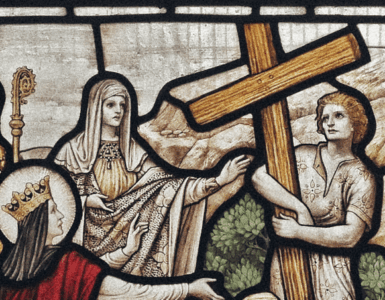
In pondering Jesus and his Holy Cross, the German priest, Thomas à Kempis, wrote:
In the cross is salvation; in the cross is life; in the cross is protection from thy enemies. In the cross is infusion of heavenly sweetness; in the cross is strength of mind; in the cross is joy of spirit. In the cross is the height of virtue; in the cross is the perfection of sanctity. There is no health of the soul nor hope of eternal life but in the cross.
The Imitation of Christ, 2, 12)
Despite that which the world beckons us to gaze upon, we should strive to be a people whose sights are focused upon the high point: Jesus Christ and His Holy Cross! For in doing so, we will always find true meaning in our lives: meaning that comes from placing everything we are and everything we’ve been given at the disposal of others. And also, meaning that comes from believing that the prayers we pray in community and within our hearts are not only heard but that have the capacity to change the world in which we live.
In opening ourselves to God’s endless love, may He transform us into a new reality, one we could never imagine.
Many millennia ago, our Lord invited Abraham to look up. He invites us to do the same.

 Fr Dino Vanin
 Fr Joseph Esper
 Fr Charles Irvin
 Deacon Donald Cox