 Vincent Ryan Ruggiero
The teaching that God wants us to help the poor is so deeply rooted in the Bible that there should be no room for confusion. After all, those who believe in God acknowledge that He is the author of all truth and does not hold diametrically opposing beliefs. So why, when it comes to the details about helping the poor, do Catholics differ with Catholics, Protestants with Protestants, and Jews with Jews?
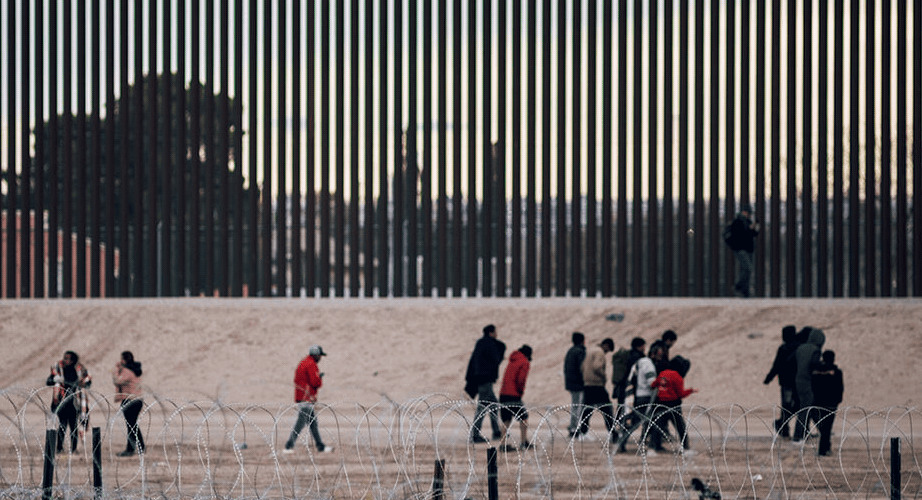
The most obvious example of this disagreement concerns countries opening or not opening their borders to the poor (and the downtrodden who may or may not be poor). The issue exists not only in the U.S. but also in other parts of the world, notably Europe. Here is how it evolved:
Religious believers who support open borders claimed that the Bible commands it. Non-believing supporters agreed because they believed it is the humane thing to do.
Religious believers who reject open borders claimed that though the Bible commands helping the poor, it says nothing about opening borders, and that doing the latter is both unfair and unwise. Non-religious people who reject open borders agreed without mentioning the Bible.
The disagreement intensified when supporters of open borders gained control of government. Illegal migrants flooded the country, and the greater their numbers, the more forcefully the supporters repeated their belief: “These children of God are here, so we must welcome them as Jesus commanded and provide them with food, clothing, and sanctuary.” Religious leaders who had previously been silent about the border issue felt compelled to become active supporters in both words and actions, and to encourage their flocks to do the same. Journalists and educators, who had generally accepted the open border argument, now became bolder in professing it. As the ranks of supporters grew, the angrier and less tolerant they became of those who disagreed with them. And when those “hateful” people won control of the government, supporters’ intolerance turned into protests and in some cases violence.
So much for how the illegal migration issue affected America and many other countries. Now let’s turn to the key question that has been widely ignored. Does the Bible really support open borders? Let’s look closely at what the Bible says:
One of the central biblical commands is to love our neighbors as we love ourselves. This command is reinforced in both testaments. In the Old Testament see Job 31, Deuteronomy 15, Jeremiah 22, Proverbs 19, Psalm 41, Isaiah 10 and 58.
The New Testament includes these directions from Jesus: “But when you give to the needy, do not let your left hand know what your right hand is doing.” (Matthew 6:3) “For I was hungry and you gave me something to eat, I was thirsty and you gave me something to drink, I was a stranger and you welcomed me . . . ‘Truly, I say to you, as you did it to one of the least of these my brothers, you did it to me.’” (Matthew 25:35) Also, these from the Apostles: “If anyone has material possessions and sees a brother or sister in need but has no pity on them, how can the love of God be in that person?” (1 John 3:17) “Do not neglect to do good and to share what you have, for such sacrifices are pleasing to God.” (Hebrews 13:16) “If a brother or sister is poorly clothed and lacking in daily food, and one of you says to them, ‘Go in peace, be warmed and filled,’ without giving them the things needed for the body, what good is that?” (James 2:15-16)
It is important to note that each of these statements in Scripture concerns how “you”—that is, each person—must treat his or her neighbor. If Susan gives to “the least” of Jesus’ “brothers,” it is Susan who “does it to Jesus” and Susan who earns God’s pleasure. Scripture does not say that Susan’s kindness can be credited to her brother or sister. And it certainly does not suggest that forcing Susan to help her neighbor fulfills her obligation or brings credit to her. Yet that is exactly what supporters of open borders are approving—forcing citizens to aid illegal migrants in breaking our country’s laws, pay for their food, housing, education, and healthcare, as well as providing them sanctuary when the laws are carried out. Far from following Scripture, such forcing of citizens violates the commandment “Thou shalt not steal.”
It gets worse: open borders have not only failed to alleviate poverty—they have encouraged millions of poor and downtrodden people to leave their homelands, violate the laws of other countries, put themselves in bondage to cartels during and after their migration, and let their children become slaves and drug carriers. As if that were not enough, open borders have forced an unfair financial burden on millions of American citizens and those of other countries and contributed to disharmony and chaos in their societies. The disharmony and chaos included dividing children from siblings and parents and neighbors from one another. They also caused riots, the destruction of property, physical assault, and even murder.
People unfamiliar with the Bible could understandably make such mistakes about open borders. Religious leaders might make the same mistake at the outset because it seemed an effective way to love their neighbors, as Jesus commanded. But once the results of doing so began producing results, they were morally obligated to apply what Jesus taught for discernment—”By their fruits shall you know them.” Had they done this, they would have realized the harmfulness of open borders to the migrants themselves, its unfairness to citizens, and its threat to the foundation of civilization.
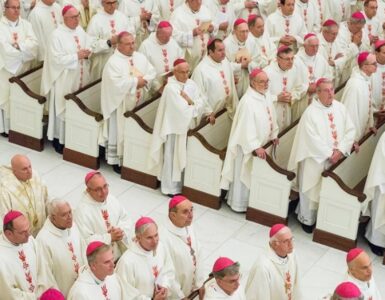
At that point religious leaders would have understood that God could not possibly approve open borders. That understanding would have made them morally obligated to change their view, publicly oppose open borders, and seek a morally sound way of helping the poor. To continue their support for open borders after this realization was not merely wrong but gravely so. Those who did so bear responsibility for the consequences of open borders commensurate with the level of their understanding and their status as “shepherds” of others.
Copyright © 2025 by Vincent Ryan Ruggiero. All rights reserved.


 Mindszenty Report
 Fr Mario Attard OFM Cap