

 Fr Joseph Esper
Several centuries ago in Great Britain, the punishment for public crimes was what we would today consider cruel and unusual. Once, for instance, there was a man who was caught stealing sheep. The local authorities decided that he must be permanently identified as criminal, so the letters S T –standing for “sheep thief”—were branded on his forehead. Naturally, this was not only very painful but also humiliating. The man faced the prospect of spending the rest of his life carrying those shameful letters where everyone could see them, with children likely staring at him in curiosity or fear, and their parents and other adults turning away from him in disapproval and disgust. This thought was very frightening and depressing, so in prayer he repented of his sin and asked Jesus to help him—and the Lord did. The man’s character slowly changed, and he became a good person: humble, accepting, honest, patient, and holy. When he reached old age, the letters S T could still be seen on his forehead, but now when children asked their parents what they stood for, the parents would reverently answer, “The letters stand for the word Saint” (Mark Link, S. J., Illustrated Sunday Homilies,Year A, Series II, p. 4).
Change is always possible with God’s help. Lifeless faith can be revived, hopeless situations can be given meaning, cold and hardened hearts can be warmed by love. We do not have to be imprisoned in our sinfulness; God sent His Son to offer us freedom. We are all invited and challenged to reform our lives—and Jesus makes this possible.
The readings for the Second Sunday of Advent (Cycle A) speak of new beginnings. The prophet Isaiah announces that “a shoot shall sprout from the stump of Jesse, and from his roots a bud shall blossom”—that is, a messiah or savior will come from David’s royal line. His kingdom will be everlasting; it will be marked by justice and peace, and people from all nations will be part of it. As St. Paul says, God is faithful in fulfilling His promises to the Jews, and generous in showing mercy to the Gentiles; all are offered new life in Jesus.
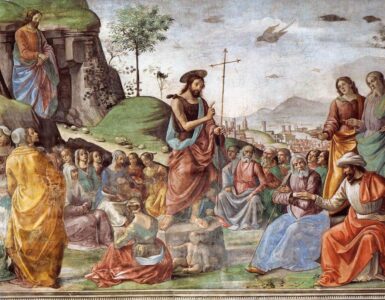
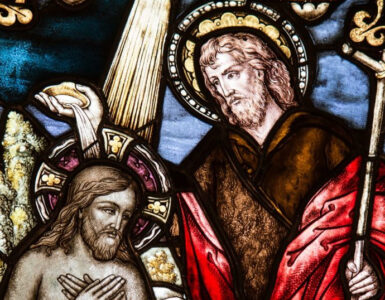
John the Baptist was sent before the Lord to prepare people to accept this new life. Repentance and a change of heart were required, and these were symbolized by baptism and a confession of sins. John’s message was, “Reform your live! The reign of God is at hand.” The word “reform” literally means to form or shape over again. Our souls are twisted and disfigured through sin; they must be cleansed and recreated. Even with the best of intentions, doing this is beyond our ability; John himself, as holy as he was, declared his own unworthiness and inability to save himself. Only God can do this. As John promised. Jesus baptizes His people with the Holy Spirit and fire—a cleansing fire, painful but healing, which burns away our sins and softens our hardened hearts, allowing them to be reformed in God’s image. Once this happens, of course, the Lord desires that we be agents or instruments of His grace, evangelizing others through our words, deeds, and example.
There’s a short, anonymous poem which says:
God said, “Build a better world” and I said, “How? The world is such a cold, dark place and so complicated now! And I so tired and useless, there’s nothing I can do.” But God in all His wisdom said: “Just build a better you!”
James F. Colaianni, Sunday Sermons Treasury of Illustrations, p.213
Becoming better and holier persons is the first step in bringing about a better world. This can be a long and painful process—and it will only happen if we cooperate with God’s grace. Advent gives us the opportunity to look back at our lives and ourselves to see what changes we need to make, what crooked paths we need to straighten, what ways we need to prepare for the Lord’s coming. For instance, do we tend to be selfish? Advent is a time to reflect on how generous God was in sending His Son for our salvation. If we sincerely ask Him to give us generous hearts, He will. Do we find ourselves getting too caught up in material things and earthly concerns? We can adopt John the Baptist as our hero. He lived in a very simple and humble way, without worrying about what other people thought of him—and God’s grace can help us do the same. Do we tend to be critical or judgmental toward others? Isaiah tells us the Messiah will judge not by appearance or hearsay, but with justice. If we ask for God’s guidance, we too will be able to evaluate and decide wisely. Do we find it difficult to get along with certain people? St. Paul says that God is the source of all patience and encouragement—and so, opening our hearts to Him allows us to live in harmony with others. Do we find it difficult to put our faith into practice? John the Baptist’s message of repentance and reform is just as valid and urgent today as it was 2000 years ago. If we’re sorry for our sins, God will certainly forgive us and make us part of His Kingdom.
Change and personal growth usually aren’t easy things, but they are possible—with God’s help. We can all look back at our lives and recall ways we’ve changed, for better or worse, and think of instances in which we’ve pleased God, and others in which we disappointed Him. We’ve all grown in our faith, and we all have much more growing to do. Advent is a time to prepare for Christ’s coming, and the best and most important way to do this is to let His grace be at work within us. We don’t need to have the letters S T branded on our foreheads, but we do need to have God’s love engraved on our hearts. Jesus wants to make a difference in our lives—but only we can decide if this will happen.


 Fr Dino Vanin