
 William Borst
On the return flight from Florida, I had neglected to separate my book for the trip from our luggage. As a result, I was dangling in mid-air without anything interesting to do. I happened to be seated next to a young woman, who was watching Wicked, a film, I had only heard of but had never seen. Every so often I would glance at the screen without poaching or intruding on her enjoyment, to quell my boredom and maybe my curiosity.
The last scene where it appears that the title character, Wicked* and her natural opposite, Goodness acted as if they had a sort of mutual respect for each other, piqued my interest. I started to wonder if Wicked were a morality tale where both good and evil face off in a battle of culture, history, and morals. Whichever the case, I believe Wicked raises one of the key questions in the Christian religion: Are people born evil or wicked or do they have to acquire or develop it while on earth?
Wicked has covered all its bases, as it has appeared as a book, a Broadway show, and a Hollywood fantasy film in two parts. The movie has a varied and diverse parentage, as it is an adaption of the first act of Stephen Schwartz and Winnie Holzman’s play, which was loosely based on the 1995 book. The latter was a reimagining of L. Frank Bauman’s 1900 novel, The Wonderful Wizard of Oz, and its 1939 film adaptation. Some have called this a recreation of the classic, Pilgrim’s Progress by John Bunyan in 1678.
Wicked stars Cynthia Erivo as Elphaba Thropp, who becomes The Wicked Witch of the West and Ariana Gande as Glinda Upland, who becomes Glinda the Good. While it is a story about corrupt governments, discrimination, and propaganda, at its core Wicked is an account that begins long before Dorothy arrives at Oz. Wicked explores the unlikely and ironic friendship between the Wicked Witch of the West and Glinda the Good Witch of the South. It examines their relationship in the context of the nature of wickedness as Glinda reflects on the Witch’s backstory.
It seems that Elphaba was the product of an affair between, the then Governor Thropp’s wife Melena and a mysterious traveling salesman. The Witch was ostracized because of her parentage and unnaturally green skin, the result of the salesman’s green elixir and the impulsive use of magical powers. To make matters worse, Elphaba had always been bullied and ostracized because of the color of her skin.
Both parts, taken as a whole, tell the story of Oz before Dorothy arrived there. The major surprise for those who were weaned on the 1939 film, is that Elphaba and Glinda were college roommates. This was surprising because they came from opposite backgrounds. Glinda was the popular child of privilege while Elphaba was an outcast unloved even by her own father. Their friendship deepens as they transcend their respective backgrounds.
Once they were forced to room together, they quickly realized that to their surprise that they genuinely saw each other in a light no one else ever had before. Elphaba and Glinda undergo a shared arc of seeing each other as forgone rivals before realizing their personalities, fears and aspirations actually complement each other and they will need one another for what is to come.
It was author, Gregory Maguire who seemed keen on focusing on the witches of Oz because of their moral ambiguity, something not seen in characters in a strict binary. As an American living in London in the 1990s, Maguire witnessed the long-running media circus around the killing of a Liverpool toddler, named Jamie Bulger, who had been murdered by two young boys who were labeled as pure evil.
This violent crime and its surrounding media frenzy, which troubled him deeply, led to what he termed the greatest revelation of his life. Everyone was asking how could those boys be so villainous? Were they born evil or were there circumstances that pushed them toward behaving like that?
If what I grasped at the ending was accurate, the powers of the Network were engaging in a very shallow portrayal of the world’s oldest struggle, which to Christianity is the primordial battle of good vs. evil. On its face value, the film fostered a lie that was detrimental to the moral health of western civilization. Their world view has been corrupted by the society’s general adoption of the principle of moral relativity.
This is true because good and evil have been diametrically opposed to each other since the Garden of Eden. As a result, they are forces which can never peacefully coexist with one another. To illustrate this truism, I often refer to a story I heard many years ago about the Scorpion and the Frog.
After a great flood, a Frog, and a Scorpion run into each other on one side. Both needed to get to the other side, especially the Scorpion. He asks the Frog if he could hitch a ride on his back and carry him across. The Frog immediately sensed the danger of this request. No, he says, you will sting me before we reach the other side. And we will both drown. No, says the Scorpion I won’t. So, the Frog agrees to trust the Scorpion.
Halfway across the river, the Frog feels a paralyzing pain in his shoulder. Just before they both start to sink beneath the current, the Frog dolefully looks up at his passenger and asks, Why? The Frog sadly states: It’s in my nature!
I think the same is true of both characters in Wicked. No matter how hard she may try to fight her inner demons, Wicked has to be true to her nature, which is doing wicked things. Since the nature of Goodness is the polar opposite, it could never do even the slightest evil deed. In reality, there is no way they can peacefully inhabit the same territory.
On its surface, the story of Oz seems to be a direct conflict between the Good Witch Glinda, and the Wicked Witch Elphaba. However moral complexities abound and there is no quick-draw application of heroes and villains in this play. Glinda wants to take the low and easy road and accommodate herself to the Wicked Wizard’s authority while the Wicked Witch wants to unmask the deception at the root of that order.
Both women have noble traits and obvious flaws, but their respective natures dictate that the one must be wicked and the other good. Each is the product of her upbringing and personal decisions. The resulting point is clearly made, people are much more complicated than we want them to be.
After spending most of his career within the colorful walls of children’s literature, Maguire decided he wanted to write something about and for adults. He knew from the start that he wanted the subject to be a study of evil. He realized that his pursuit must categorically include its opposite, which is Goodness. He was especially fascinated by the fact that both the Good Witch and the Wicked Witch had been good friends before clashing in the play.
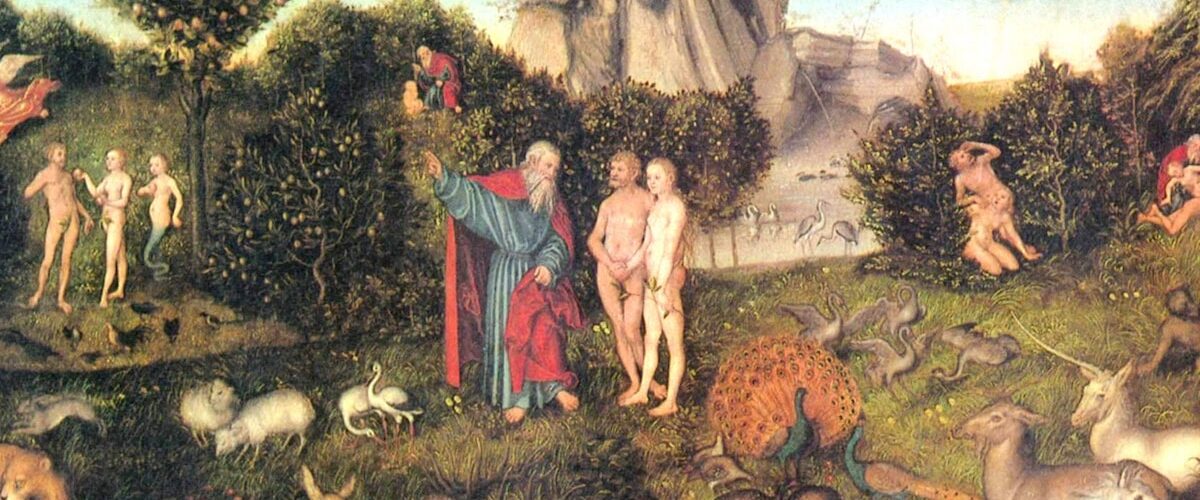
Thus, the core of Maguire’s story is wrapped around a basic human predicament. Mankind has been made of a number of inner clashes, such as body and soul and a leaning toward the good in life, countered by an attraction for many of life’s evils. This human scenario dates back to the Garden of Eden, where Adam and Eve’s sin opened Pandora’s Box to every evil known to mankind.
Unfortunately, mankind can be very weak when confronted with the temptations of the Devil. One need only visit Genesis 3:1-24 where humanity suffered its Great Fall. The serpent, who was more crafty and deceitful than any other beast of the field which the Lord had made, said to the woman, Indeed, as God said: ‘you shall not eat from any tree of the garden’? The woman said to the serpent From the fruit of the trees of the garden we may eat; but from the fruit of the tree which is in the middle of the garden, God has said, ‘You shall not eat from it or touch it, or you will die…’
There are several other Bible verses which confirm this statement. For example, Romans 12:21 states that we should not be overcome by evil but overcome evil with good... and Corinthians 15:33, which states Bad company corrupts good morals. Probably the best advice on evil comes from Psalms 37:27, which says Depart from evil and do good, So you will abide forever.
The National Catholic Register’s review gave high marks to the film Wicked. In its essay, ‘Wicked for Good Proves more Potent than the Strongest Spell, the review underscored the fact that while propaganda triumphs and motives misfire, the new film keeps Oz’s moral questions timeless and lets the art speak for itself. The reviewer also alludes to George Orwell’s dystopian novel, 1984, where war is peace, freedom is slavery and ignorance is strength. InWicked, it appears that truth is lies and lies are truth.
I think the main trouble with Wicked is that many get it wrong as to who is promoting good and accentuating evil. People often see goodness and wickedness in the wrong places because they have been misinformed and manipulated by a warped public discourse. The Wizard’s cynical philosophy about goodness and wickedness is that it is all in which label is able to persist. Fortunately, the reviewer adds, this is the point of view of the show’s villain and not its heroine.
The movie offers several examples of human frailties, such as Glinda’s selfishness and even casual cruelty in youth, which often benefit others and fill them with gratitude, while Ephaba’s best intentions often misfire and create deep resentment.
As for most people, they typically judge others by observing the effects of their actions and surmise their intentions, but they often forget to mind the gap between the two. That is, they assume that others must have intended exactly as they acted, when in truth the result is rarely fully foreseen and the intentions perfectly executed.
I think the salient point Wicked makes is that, even when people mean well, the consequences of their actions may fall far from their intentions. Conversely, even acts undertaken from vicious motives may bring about consequences that may make their actions appear kind to the outside observer.
C. S. Lewis’s devils made brilliant use of what the dictionary calls the cobra effect. In The Screwtape Letters and in Wicked, the audience gets to watch some of the characters learn this for themselves, looking self-critically at the way they have judged others. This is aided by the fact that virtually every song is a meditation on the nature of good and evil, playing on such phrases like for good, make good, thank goodness and goodness knows.
Elphaba had literally been targeted for scorn and derision at birth when she was born with green skin. Even though she appears as a wicked witch, Elphaba’s only character seems to belie her role as a Witch because she seems a gentle, kind character, whose only defects seem to be her bouts of anger.
One could say that these social perceptions actually led her down a path to pure evil. It was the Wizard who calumniated her so much that the rest of Oz thought she was really evil, even though she was fighting the Wizard for justice and the protection of the vulnerable talking animals of Oz who were at risk.
This view is assisted by the public’s natural attraction for Glinda and the feeling that she is virtuous and authentic while the Wizard uses this to slander Ephaba. Yet Glinda treats Boq and Nessarose terribly. Calling her the Good Witch is a parody on how we view goodness. If you look good, and sound good, the material consequences of your actions do not count for anything.
Thanks to the 1939 movie the audience knows that the Wizard is a con artist who rules by fear. His deception is literally one of smoke and mirrors. In the recent movie, the tone swings from awkwardly between an upbeat wonder and dark oppression. This is a world where minorities are hunted, placed in cages, prevented from speaking and where a charismatic leader, a playfully Jeff Goldblum, prosecutes a black woman.
But none of this stops us from applying judgements and labels to what they do or don’t do. This is a message that Christians might want to reflect upon. The Gospel of Jesus is all about redemption for those who might feel written off. So often we can be guilty of pronouncing or reflecting that very same sense of judgement.
For Christians, the lesson seems to be both an endorsement of the Church’s redemptive message and a cautionary tale about how our religious and secular institutions can perpetuate the opposite. Do we place our leaders on too high a pedestal and endow them with too much power? Are we really a people of acceptance and forgiveness? Or do we write off people who do not fit the mold? This is something for all of us to think about.
*I am not sure if what I saw on the plane was Part I or Part II.


 Fr Joseph Esper
 Deacon Steve Greco
 Deacon Donald Cox
 Thomas Addis