

 Fr Joseph Esper
A Chinese-American author named John Wu, who grew up in China but later came to the United States with his family, wrote a book comparing China with the West, in which he described how he came to be married. He wrote: “My wife and I had never seen each other before our wedding. Both of us . . . were brought up in the old Chinese way. It was our parents who engaged us to each other when we were barely six years of age. In my early teens I came to know where her house was. I had an intense desire to have a glimpse of her. In coming back from school, I sometimes took a roundabout way to pass by the door of her house. . .. But I never had the good fortune to see her [until the day we were married].”
Mr. Wu and his wife eventually fell deeply in love, and later emigrated together to the United States, where they made many friends. When these American friends expressed astonishment at how the marriage was arranged, he asked them if they had chosen their parents, brothers, and sisters. When they answered, “No, of course not,” he responded, “But don’t you still love them just the same?” (Mark Link, S. J., Illustrated Sunday Homilies, Year A, Series I, p. 9).
In a situation in which he had no control, Mr. Wu’s only real choice was to trust that everything would work out, and it did: he and his wife came to know and love each other very deeply. Trust and love are meant to go together, especially in our relationship with God. He loves us more than we’ll ever know, and if we place our trust in Him, He’ll do more for us that we can ever imagine or expect.
The most important choice we’ll ever make is whether we’re going to live for ourselves—which will eventually lead us to a life of selfishness, loneliness, and fear—or live for God, in which we will find or become our best selves, and experience true and lasting peace. St. Paul tells us in the Letter to the Romans that Jesus came for our salvation, fulfilling God’s promise—but this means or achieves nothing for us unless we’re prepared to trust in the Lord. The prophet Isaiah (7:10-14) confronted King Ahaz, a weak and sinful descendant of King David. His kingdom of Judah, centered around Jerusalem, was threatened with a foreign invasion, and from a military and political viewpoint, the outlook wasn’t very bright. The king thought he could save the day by making an alliance with the powerful but godless empire of Assyria, but Isaiah warned him this would only lead to a loss of national independence. Isaiah advised him, “Remain neutral and trust in the Lord to save you; if you have doubts, you may even ask for a sign from God as proof.” Ahaz, however, refused to ask for a sign—not out of piety, but out of stubborn pride and hypocrisy; if he accepted a sign, he’d be obligated to follow God’s plan, instead of his own. Disgusted with Ahaz’s lack of trust, Isaiah stated that a sign would be given anyhow: the birth of a child named Emmanuel, or God-with-us, whom we know as Jesus. The Lord’s plan, of course, would have succeeded; He would have saved Judah, but Ahaz chose differently, and ended up a powerless vassal of the Assyrian empire. He did not truly love God enough to trust Him, and by going against the Lord he merely made the situation much worse for himself and his people.
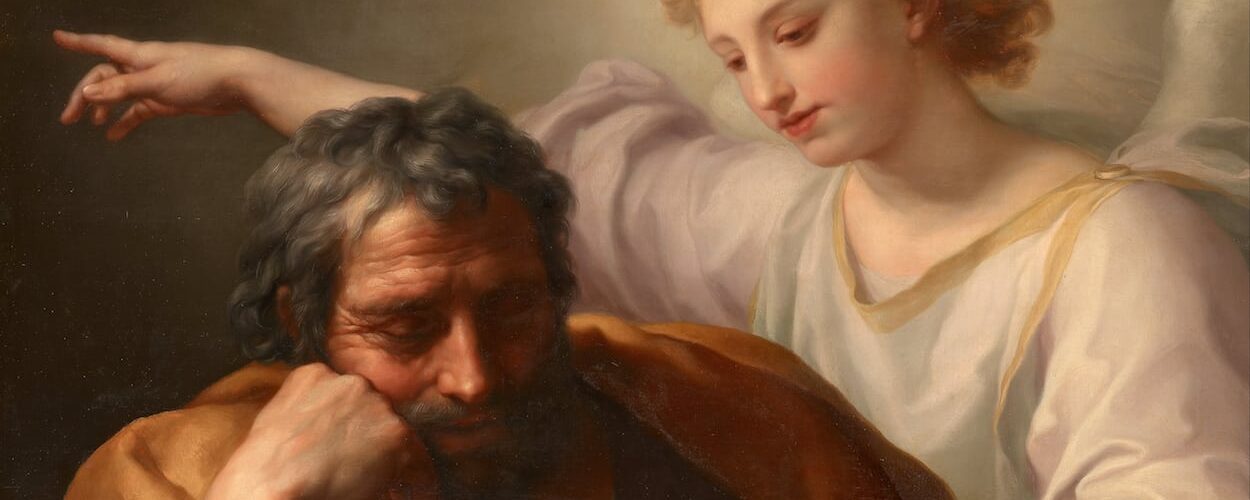
As we see in the Gospel of Matthew (1:18-24), a very different choice was made by St. Joseph. He was betrothed to Mary—a legally and morally-binding step in between engagement and an actual marriage ceremony. When Joseph observed that Mary was pregnant, he could only assume she had been unfaithful to him, thereby violating the marriage agreement. As an upright Jew, he could no longer marry her; the question was how to end these arrangements. He didn’t want to follow the Law strictly, which would result in Mary being condemned and executed for adultery, so he decided to divorce her quietly, even though he himself might become subject to ridicule if the situation became known. It was only after Joseph made this merciful decision that the truth was revealed to him by an angel—and he chose to believe in the incredible revelation that Mary had conceived through the power of the Holy Spirit. Joseph trusted in God, and was thus privileged to become the foster father of the Savior—an honor and blessing far greater than he, as a simple carpenter, could ever have expected.
At a testimonial dinner honoring a famous and much-awarded celebrity, the man was asked, “What is the greatest honor you’ve received in your lifetime?” He responded, “The time when, at a busy street corner, a little boy unknown to me came up, looked carefully into my face, then placed his hand in mine and said, ‘Mister, please take me across the street to the other side’” (Walter Knight, Knight’s Master Book of 4000 Illustrations, p. 707). As followers of Jesus, we are called to live in such a way that people can safely trust us—for in this, we becoming living reminders of the trustworthiness of our Heavenly Father, even as we ourselves learn to trust Him more deeply in all our needs.
When we trust in the Lord, His plan for us will unfold in ways more wondrous than we would have imagined. This sort of trust doesn’t mean, however, that we must let someone else make wedding arrangements for us, as was the custom in ancient Israel and, until recently, in China, nor does it mean neglecting our own plans and preparations for the future. Trusting in God means being willing to set aside our plans at any time if it becomes clear that the Lord is asking something different of us; it means not giving up, even when things get difficult; it means continuing to believe God has something wonderful in store for us, even though we can’t always understand His plan. If we trust in God and try to do His will, we know that one day we’ll experience the joys of Heaven, which are beyond our imagining. Even here on earth, however, God can do great things for us; by trying to live out our faith, we might meet persons who truly love us, we might experience a deep sense of community, and we might find a genuine inner peace—all of which might otherwise remain unknown to us.
We love God; thus, we must also do our best to trust Him. King Ahaz failed in this; St. Joseph succeeded. It is Joseph whom we must imitate, for through a loving and trusting faith we are richly blessed.

 Fr Dino Vanin

 Deacon Kurt Godfryd