
 Gracjan Anthony Kraszewski
According to a popular story from Saint Thomas Aquinas’ formative years he once interrupted a lesson to ask the instructor, who had been discoursing on the attributes of God, ‘Yes, but what is God?’
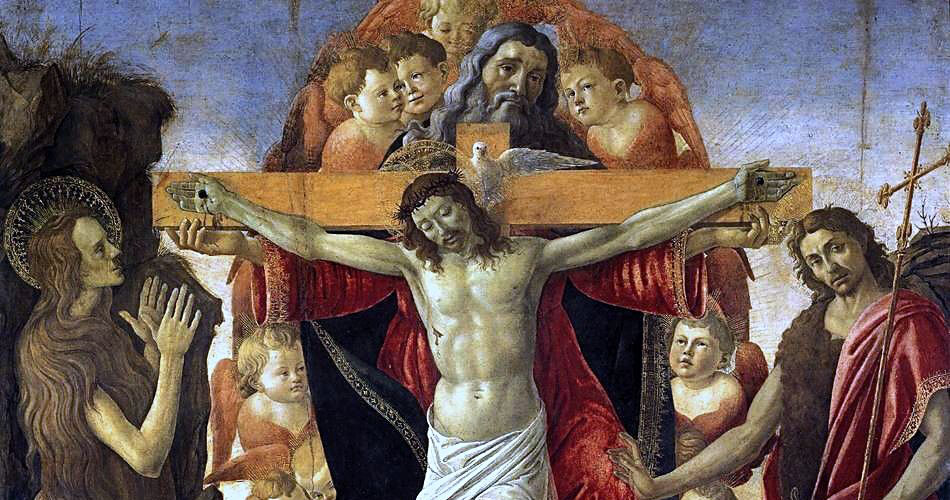
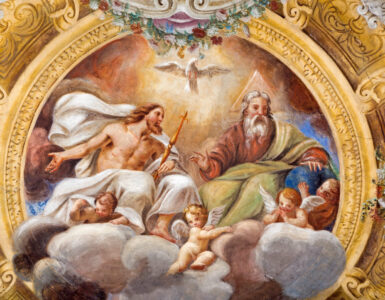
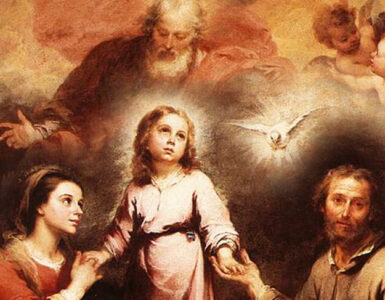
We’ll ourselves take this as a starting point discussing God—the Holy Trinity; Father, Son, and Holy Spirit—and especially how the Church elucidates Trinitarian theology by way of the Creed. Please note: elucidates means to make clear. But the Mystery of the Holy Trinity, the Catechism tells us, is the central Mystery of the Christian Faith.[1] As Saint Augustine said, ‘Si comprehendus, non est Deus.’ If you understand, it is not God. Another story involving Augustine has him walking along a beach and seeing a kid fill and refill a bucket with ocean water. Augustine asks him what he’s doing and the kid, who turns out to be an angel, tells him he’s trying to put the whole ocean into the bucket. ‘You’ll never succeed,’ Augustine says. ‘Right,’ the angel replies, ‘just like you’ll never be able to fully understand the mystery of the Holy Trinity.’
So however feeble our comprehension might be, and it is, let’s get at this topic, with the help of God’s grace, in four primary ways.
First, to the textual frame of the Creed itself. What does it say about God? Second, to the Catechism. Third, to the saints, from whom will take our historical notes on the mentioning, specifically, and within the historical record, of the term Trinity. Please note, while you can search Scripture to exhaustion and not find the literal words ‘Trinity’ anywhere there, the Doctrine of God being One God, Three Divine Persons is a most biblical claim, present not just in the heart of Scripture, the Holy Gospels, but at a moment of incredible importance when, at the close of St Matthew’s Gospel, the Risen Christ puts forth the Great Commission plan for entrance into the Church, and the ultimate hope of eternal salvation, in Trinitarian language:
‘Go, therefore, and make disciples of all nations, baptizing them in the name of the Father and of the Son and of the Holy Spirit, and teaching them to observe all that I have commanded you. And behold, I am with you always, to the end of the world.’[2]
So, following the Creed itself, and then the Catechism, and then the historical record of the saints’ writing we will, fourth and finally, conclude with two brief speculations.
First, to the Creed.
I believe in one God, the Father almighty, maker of heaven and earth, of all things visible and invisible.
I believe in one Lord Jesus Christ, the Only Begotten Son of God, born of the Father before all ages. God from God, Light from Light, true God from true God, begotten, not made, consubstantial with the Father; through him all things were made.
I believe in the Holy Spirit, the Lord, the giver of life, who proceeds from the Father and the Son, who with the Father and the Son is adored and glorified, who has spoken through the prophets…
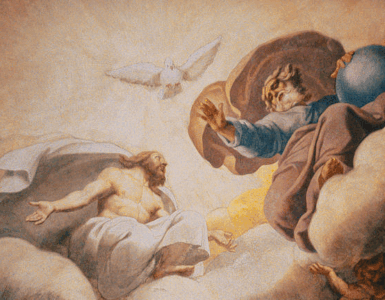
So, we can say, simply from a commonsense reading of the Creed, that God is one, almighty, the maker of all things, whose only begotten Son is consubstantial with He Himself and outside of time and space, prior to all things[3], and in perfect unity with He Who too is the Lord and giver of life, the Holy Spirit, proceeding from the Father and Son and to be adored and glorified for it is to God alone to Whom adoration is due. God is One, One God in Three Divine Persons, all powerful and all knowing; the only good, goodness itself, and from Him, through Him, all that is, all that has being, came to be.
Going to the Catechism for our second investigation we find the answer to Aquinas’ question what is God? God is a pure spirit infinitely perfect and of no beginning. He always was and will be. God is everywhere, seeing us and watching over us and knowing all things, even our most secret thoughts, words, and actions. God can do all things, nothing is hard or impossible for Him, and as He is all just, all merciful, He is, additionally, infinitely perfect.[4]
Having begun to consider what is God we can progress to Who is God. The Catechism explains that there is but one God, and three Persons in God; The Father, the Son, and the Holy Ghost. The three Divine Persons are equal in all things, one and the same God, having one and the same nature and substance. Bringing us back to where we started, we are reminded that we cannot fully understand how the three Divine Persons are one and the same God, because this is a mystery. A mystery being a truth which we cannot fully understand.[5]
Third, we turn to the saints, more precisely a collection of Church Fathers, for their commentary on the Holy Trinity within the historical record.
‘For, in the name of God, the Father and Lord of the universe, and of our Savior, Jesus Christ, and of the Holy Spirit, they then receive the washing with water.’[6]
‘O mystic marvel! The Universal Father is One, and One the universal Word; and the Holy Spirit is One and the same everywhere.’[7]
‘Thus, indeed, we expand the indivisible Unity into a Trinity; and again we contract the Trinity, which cannot be diminished, into a Unity.’[8]
And one more citation, a most expansive quote from Saint Augustine, drawn from his work On the Trinity:
‘All those Catholic expounders of the divine Scriptures, both Old and New, whom I have been able to read, who have written before me concerning the Trinity, Who is God, have purposed to teach, according to the Scriptures, this doctrine, that the Father, and the Son, and the Holy Spirit intimate a divine unity of one and the same substance in an indivisible equality; and therefore that they are not three Gods, but one God: although the Father hath begotten the Son, and so He who is the Father is not the Son; and the Son is begotten by the Father, and so He who is the Son is not the Father; and the Holy Spirit is neither the Father nor the Son, but only the Spirit of the Father and of the Son, Himself also co-equal with the Father and the Son, and pertaining to the unity of the Trinity. Yet not that this Trinity was born of the Virgin Mary, and crucified under Pontius Pilate, and buried, and rose again the third day, and ascended into heaven, but only the Son. Nor, again, that this Trinity descended in the form of a dove upon Jesus when He was baptized; nor that, on the day of Pentecost, after the ascension of the Lord, when “there came a sound from heaven, as of a rushing mighty wind,” the same Trinity “sat upon each of them with cloven tongues like as of fire,” but only the Holy Spirit. Nor yet that this Trinity said from heaven, “Thou art my Son,” whether when He was baptized by John, or when the three disciples were with Him in the mount, or when the voice sounded, saying, “I have both glorified it, and will glorify it again;” but that it was a word of the Father only, spoken to the Son; although the Father, and the Son, and the Holy Spirit, as they are indivisible, so work indivisibly. This is also my faith, since it is the Catholic faith.’[9]
In fourth and final order, the aforementioned two speculative points I will close with are:
(4)1. That God is pure Being and the only non-Contingent Being and
(4)2. Why we should deeply rejoice, even more than we already do, at the doctrine of the Incarnation.
Aquinas answered the question of what is God? definitively by showing how God Himself revealed His fundamental nature as ‘to be,’ to exist, and that He is ultimately the only Being whose beingness is self-referential and explainable. All of us, all of everything, did not have to be. But if God was not, nothing would be. God, therefore, simply, is the One who is. God is the One Who is the only necessary One, the only one whose essence is His existence. He told us this Himself; see Exodus 3:14:
God said to Moses, ‘I am who I am.’ Then he said, ‘You will say to the children of Israel, “I am sent me to you.”’
This leads into point.(4) 2—why we should deeply rejoice, even more than we already do, at the doctrine of the Incarnation—because God, who is full other to us, we nothing at all like Him, His perfect nature not simply millions of miles or leagues above us but infinitely so, spurned not the lowly stable of Bethlehem. The supreme Second Person of the Holy Trinity, world-making Eternal Word of God, while remaining True God, became True Man too. While we may struggle and do fail to comprehend the Holy Trinity intellectually, we can certainly grasp, via the Incarnation, the truth of the words that God so loved the world, that he gave his only begotten Son, that whosoever believes in Him should not perish, but have everlasting life.[10] The Mystery of the Holy Trinity is the central Mystery of the Christian Faith. This does not mean suspend reason. As Pope St. John Paul II said, faith and reason are two wings upon which, in balanced flight, we rise to the contemplation of truth.[11] But here, certainly, reason is not enough. Just know, remember, that when it comes to anything to do with God, si comprehendus, non est Deus.
[1] The Catechism of the Catholic Church (New York: Image/Doubleday, 1996), No. 234, p. 69.
[2] Matthew 28: 19-20.
[3] ‘Jesus said to them, “Amen, amen, I say to you, before Abraham came to be, I AM.” ’ John 8:58.
[4] The Penny Catechism: A Catechism of Christian Doctrine (TAN Books: Charlotte, NC: 1982), Nos. 16-30, p. 3-5.
[5] Penny Catechism, No. 28, p.4.
[6] St. Justin Martyr (AD 110-165), The First Apology, Chp. 61
[7] St. Irenaeus, Against Heresies, Book I, Chp 10.
[8] Dionysius, Bishop of Alexandria (AD 200-265).
[9] St. Augustine, On the Trinity, Book I.
[10] John 3:16.
[11] Encyclical Letter ‘Fides et Ratio,’ of the Supreme Pontiff, John Paul II, to the Bishops of the Catholic Church on the Relationship Between Faith and Reason. September 14, 1998.

 Fr Dino Vanin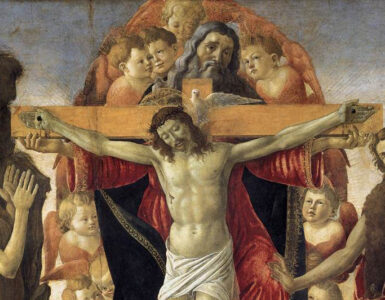
 Fr Joseph Esper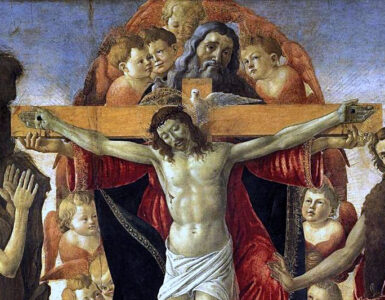
 Anthony Perrone