
 Fr Dino Vanin
One of the worst sinking feelings we do not want to experience in our fast-paced world is pressing the ignition button and failing to hear the vrmmmm sound of our car awakening from its mechanical sleep.The readings (Is 55:1-3; Romans 8:35, 37-39); Mt 14:13-21) for the 18th Sunday in Ordinary Time are all about God’s superpower-packed “battery” designed for our spiritual life with immense benefits for all the other components of our being. May God forgive me for using this prosaic analogy, but the point comes across very clearly.
In the first reading we see God “advertising” this new miracle battery: It is not expensive; it is free. “Come, without paying and without cost.” (Is 55:1) It is also the finest because God produces it himself, and we are encouraged to try it for two reasons: that we may have life and renew the everlasting covenant with him.
The gospel passage shows clearly how miserable life truly is with any other “battery:” His heart was moved with pity for them and he cured their sick. (Mt 14:14) If we look around, we notice that the world has a huge number of “dead batteries” inevitably bound to give a sinking feeling to a lot of people. They are all cheap brands with tag lines like: “pile up as much money as you can,” “you are the only one that counts,” “if it feels good, it is for you,” “do as you please, just don’t get caught,” “you deserve all that—and more,” All these “batteries” and similar ones are flashy, promising, but do not hold a charge for too long…. God’s signature battery can be had at our Eucharistic Celebrations.”
Even in that deserted place, as the disciples urged Jesus to tell the huge crowd to go elsewhere to find sustenance, Jesus said: There is no need for them to go away; give them some food yourselves. (Mt 14:16)
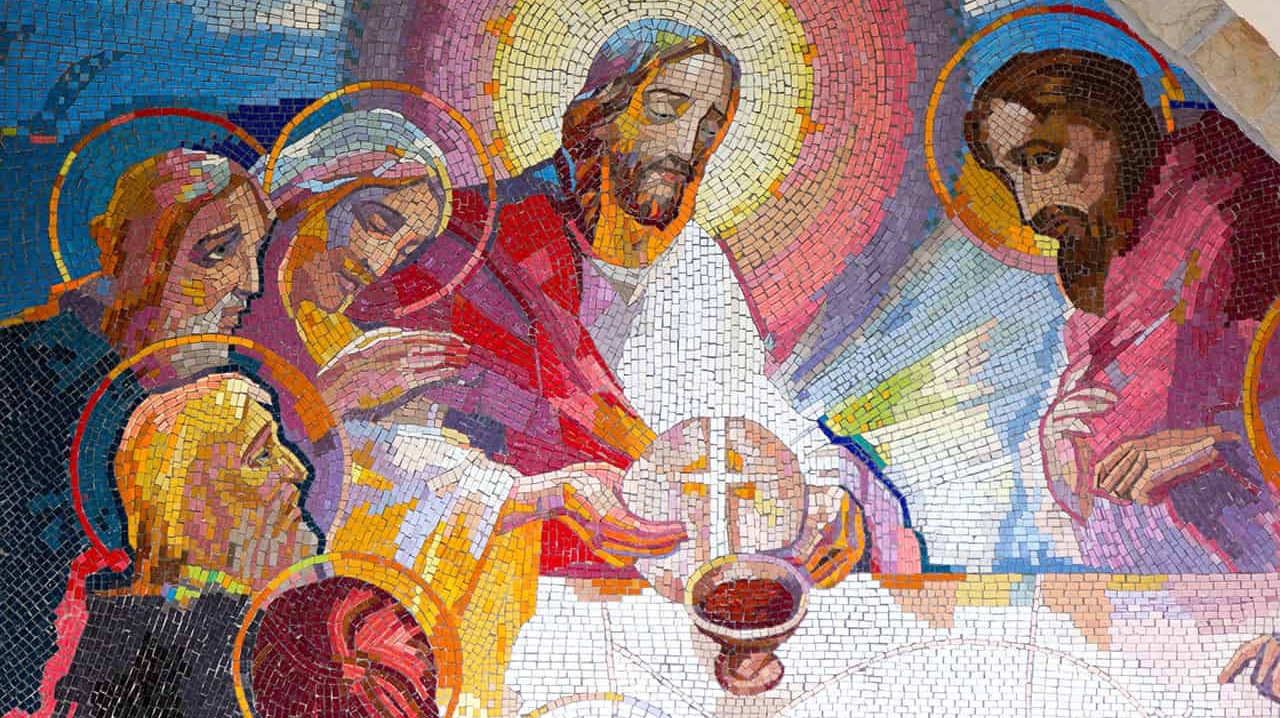
At this Eucharistic Celebration, Jesus gives us the same order. It is a gentle reprimand for having failed to capitalize on the heavenly nourishment the Lord has been providing in each of the many Holy Masses we have attended so far, and it is also a forceful invitation to benefit fully from the Eucharist so that, once properly fed, we can “feed” many other famished people ourselves. At each Eucharistic Celebration, the Lord feeds us his words of life at the Table of the Word. (cf. Amen, amen, I say to you, whoever keeps my word will never see death.” John 8:51) And, in Holy Communion at the Table of the Sacrament, the Lord renews his everlasting covenant with us as he feeds us the Bread of immortality and we share the chalice of the New Covenant.
This is exactly what our tired, confused, repeatedly deceived, disoriented, frustrated and hurting world needs in the desert of life that it has created for itself. The Eucharist is precisely God’s offer to “charge” each one of us with divine energy, with concern, with care, with a healing touch, with willingness to serve, and with credible, reassuring, energizing hope.
Hence, we welcome the Lord’s reprimand and his invitation to “feed” this world ourselves.
There is only one condition for this divine order to work: we must give to Jesus and to each other our personal contribution, our five loaves and two fish. There is a wonderful and most meaningful prayer that the priest says quietly as he prepares the gifts on the altar: “by the mystery of this water and wine may we come to share in the divinity of Christ, who humbled himself to share in our humanity.” Our contribution, represented by the water, will become inseparable from the wine representing the divinity of Christ, i.e., the Lord’s contribution for the salvation of the world. However, we cannot forget that our modest contribution must be always given most generously.
By consuming the Lord’s Body and Blood, we commit ourselves to total self-giving to the vast crowd around us. Our five loaves and two fish must always represent the joyous offer of our whole self, because with every Holy Communion, we become one with Christ in his sacrifice, our contribution inseparable from his, with both offers, his and ours, sealed in the Blood of the new and everlasting covenant.
Here is Our Lord’s order in different words: I give you a new commandment: love one another. As I have loved you, so you also should love one another. (John 13:34)

 Fr Joseph Esper
 Jennifer Borek
 Deacon Gregory Webster
 Deacon Donald Cox