
 Fr Joseph Esper
A compassionate, kind-hearted man named Jack was the activities director at an assisted living facility for the elderly. He and the rest of the staff frequently made a special effort to reach out to the patients suffering from Alzheimer’s or memory loss, hoping to involve them in the nursing home’s social life, but with limited success. Jack was especially concerned about an elderly woman named Vera, who was always isolated, withdrawn, and completely silent. Vera had never married, had no immediate family members, and never had any visitors, let alone any interactions with the other patients. Jack felt very sorry for her, but it seemed there was nothing he could do—until, one year, it was time for the holidays. The nursing home always held a holiday party for those residents who had no family or visitors. In past years, Vera was always included in these celebrations, but remained completely silent and withdrawn. This time, however, the staff decided to do something a little different.
The facility happened to be short-staffed the day of the party, so Jack was asked to take care of Vera’s makeup. Even though he had no experience with such things, he managed to apply blush, eye shadow, and lipstick, while also parting her hair and attaching a pair of large earrings set with rhinestones. The result was astonishing: Vera wasn’t just pretty, she was glamorous, and could have passed for a Hollywood movie star. When a mirror was held so that Vera could see herself, the breakthrough Jack and the other staff members had been hoping for finally occurred: she smiled and laughed, and was radiant with joy. As Jack later wrote, “Vera was the belle of the ball at that evening’s dinner, and although she still didn’t say a word, her entire demeanor changed. Suddenly, she was the most popular of all the residents and she became the acknowledged leader of a group of women who always sat together, not actually talking, but always there for each other. That one glance in the mirror unlocked a vivacious spirit, someone who showed joy with every smile that now lit up her face” (Amy Newmark, Miracles and the Unexplainable, pp. 154-156). This true story makes an important point: sin—especially the sin of pride—is like a spiritual or moral Alzheimer’s disease that cuts us off from other people, and hides or makes us forget our dignity as children of God. Humility and repentance, however, can help us discover, and rejoice in, our true selves.
The Church has traditionally taught that there are seven deadly sins: anger, lust, greed, gluttony, envy, laziness or sloth, and pride. It can be argued that the worst, or most dangerous of these, is pride—for it was pride that caused Lucifer, the greatest and most beautiful of all the angels, to rebel against God and thereby become changed or deformed into Satan. Pride is also dangerous because it distorts our values and makes it hard for us to acknowledge the truth—especially our own sinfulness. People who are guilty of gluttony, greed, lust, or just about any other sin, can usually recognize and admit it, but proud persons tend to see only the sins of others, and not their own. The Pharisee, or religious leader, in the Gospel of Luke (18:9-14) is a classic example of this; he was convinced of his own righteousness, when in fact, the sinful but humble tax collector was much more pleasing to God than he was. Moreover, pride robbed the Pharisee’s good deeds of their spiritual value, meaning that he appeared empty-handed before God. As the Book of Sirach (35:12-14, 16-18) says, “the prayer of the lowly pierces the clouds” and receives a favorable hearing from the Lord. That’s why St. Paul (2 Timothy 4:6-8, 16-18) could be so confident of receiving a crown of righteousness: he freely acknowledged that he was a sinner and unworthy to be an apostle, but had completely opened himself to divine grace and had placed all his trust in a loving and merciful Savior. St. Paul learned to boast not in himself or in his many achievements, but in the power of Christ’s grace working within him, thereby glorifying God, not himself.
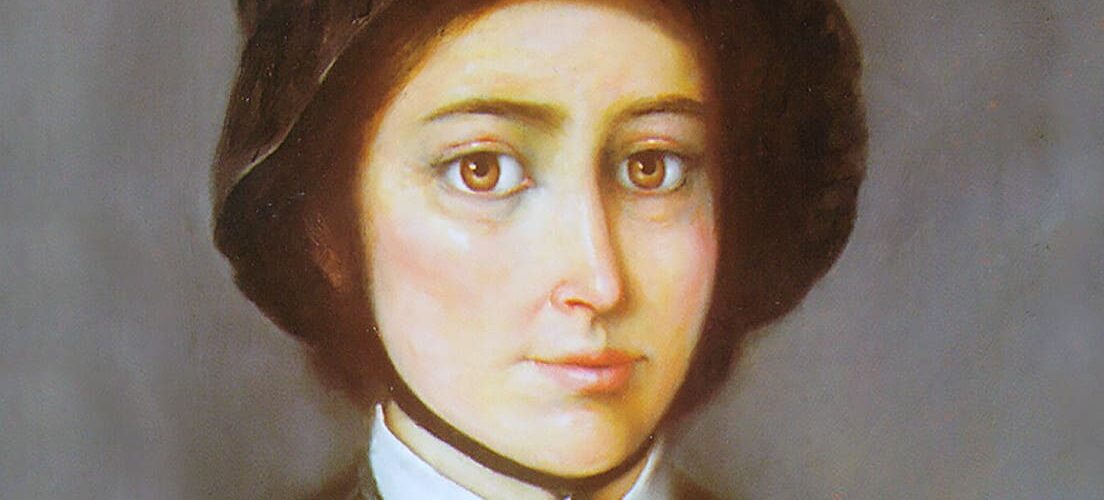
Many great saints and spiritual writers have spoken of the necessity and importance of humility. For instance, St. Augustine wrote, “It was pride that changed angels into devils; it is humility that makes men as angels.” St. Elizabeth Ann Seton, the first American-born canonized saint, advises us that…
The gate of Heaven is low; only the humble can enter it.
According to St. Vincent de Paul, “The most powerful weapon to conquer the devil is humility. For, as he does not know at all how to employ it, neither does he know how to defend himself from it.” This saint also teaches us, “If we possessed every virtue, but lacked humility, those virtues would be without root and would not last.” This idea is echoed by the great 20th century Christian author C. S. Lewis, who wrote, “A proud man is always looking down on things and people—and, of course, as long as you are looking down, you cannot see something that is above you.” Lewis also gives some practical advice, saying, “Humility is not thinking less of yourself; it’s thinking of yourself less.” In other words, we don’t have to deny our virtues and achievements, but instead of boasting about them, we should focus on God’s goodness and on the needs and feelings of those around us; this is how we’ll stay on the straight and narrow path leading to holiness and everlasting happiness.
We might say that humility is the richly-fertilized field in our souls that allows every other virtue to take root and grow, whereas pride is a noxious and intrusive weed, or a poisonous chemical that contaminates our character and perverts our good deeds. Just as Vera was, in effect, restored to emotional life by seeing her own hidden but renewed beauty in a mirror, so humility helps us discover, achieve, and accept the wonderful destiny that God has always intended and desired for us. As Jesus teaches, “whoever exalts himself will be humbled, [but] whoever humbles himself will be exalted.” Let us strive for humility in this life, so that we may share in Christ’s glory for all eternity.

 Fr Dino Vanin

 David Seitz