
 James S. Anderson
An insightful rabbinic metaphor views the Torah or the teaching that came down from God at Sinai as a giant light that passed into a prism atop the mountain. The light then refracted into several lights, each light representative of multiple meanings or interpretations of the Torah or the biblical text. Thus, I would like to offer a few refractions of the light arising out of the battle between David and Goliath in the Valley of Elah (1 Sam 17), one perhaps rather novel and another that should bring comfort and peace, especially during personal valley experiences in life.
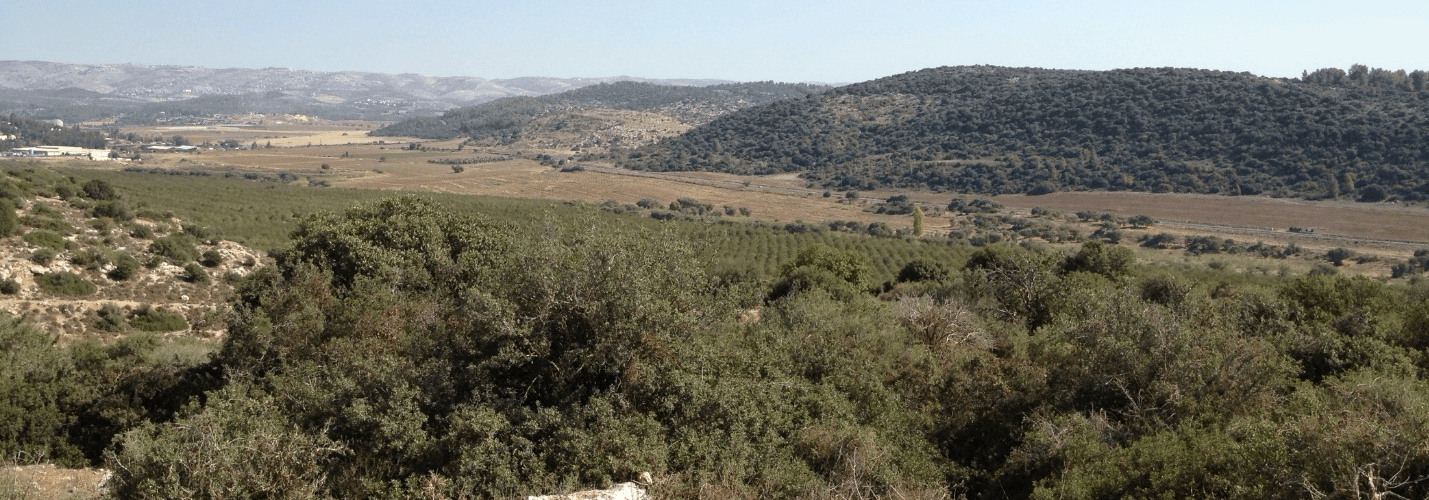
First Samuel 17 begins by explaining the Israelites are in the Valley of Elah forming ranks due to the Philistine threat. The chapter goes on to read: “The Philistines stood on the mountain on the one side, and Israel stood on the mountain on the other side, with a valley between them” (v. 3). It is not a coincidence that both groups proceeded to opposite mountaintops. There is more than meets the eye here, as both groups did so for more than just their safety. It is well-known amongst scholars that in ancient times deities were believed to reside on top of mountains; thus, the text is likely hinting at something: each group was running to their own respective god. In the case of the Philistines, it is “gods” plural, as is made apparent in verse 43 of the chapter.
There is, in fact, ample evidence for the understanding that to the ancient mind, deities resided on top of mountains. Recall that Moses encountered the Lord previously on Mt. Sinai/Horeb and later the Transfiguration of Jesus occurs atop Mt. Tabor in northern Galilee. It is possible each group would have had atop their opposite hilltops a means to venerate and consult their god(s), namely, in some type of portable sanctuary. For the Israelites, it would have been the tent of meeting described in the Pentateuch. Ancient cultures, especially prior to battle, often consulted their respective god(s) and implored their help.
Divination also occurred to ascertain the divine will and ask whether or not the king should go to war. Texts from Mari and elsewhere in the ancient Near East have revealed these common practices. Texts on how to read omens, such as the livers of animals or cloud formations, have been found, as ancients thought the divine will could be found in such ways. Some scholars think the Urim and Thummin worn on the breastplate of the High Priest was used for such in Israel (Exod 28:30). Again, though the text does not go into detail that such might have occurred in the Valley of Elah, it is likely that it did at this juncture because of the practices of that time, at least on the part of the Philistines.
It is interesting to note the Bible tells us that for 40 days Goliath taunted the Israelites (v. 16). Forty is a highly symbolic number in the Bible, suggesting a hardship, for just as the Israelites were in the wilderness 40 years, so was Jesus portrayed as the new Moses in the Gospel of Matthew and tempted for 40 days in the desert. Goliath’s haughtiness is made evident in verse 10: “And the Philistine said, ‘Today I defy the ranks of Israel!’” We then learn in verse 11 that all of Israel was greatly afraid, which is reiterated again in verse 24. The words of Pope John Paul II need to be remembered and mentioned here. His pontificate was one that rightly emphasized the most frequent passage of all of Scripture: “Do not be afraid.” This is especially pertinent for us today during such times as when we face our own giants.
The battle between David and Goliath really can be reframed as one between the God of the Israelites verses the gods of the Philistines to some extent. Though this point is perhaps more of a subtext; nonetheless, there is a strong argument for it, especially considering the later comment by David following his encounter with Goliath: “…for the battle is the LORD’s…” (v. 47). Thus, one refracted light or meaning from this text revolves around the issue of who is the true God? Is it the Lord, the god of the Israelites, or the Philistine gods? As noted above, that the story makes a point to describe how the people ascended their respective mountaintops, the locale where divinities are encountered in antiquity, strongly suggests this much.
Therefore, one of many readings of this classic text is a contest between Yahweh verses the Philistine gods and most likely their head god, Dagon. Indeed, Dagon does not seem to have been very enticing to the Israelites at any time, so one might wonder why scribes would create such a subtext. However, we know from the finds at Ugarit (modern-day Syria) that Baal in Canaanite mythology was Dagon’s son (their temples existed aside one another at the site), and we know from textual and artefactual finds that Baal was widely and shamefully venerated in Israel and Judah, as the Bible confirms. Another way to attack Baal, as much of the Hebrew Bible does, would be to go after his father, which I would suggest this text does. Notice what David, the man of faith, says during the ordeal: “For who is this uncircumcised Philistine that he should defy the armies of the living God?” (v. 25). The reference to “living God” might be a subtle clue intended for ancient readers/listeners of this text to recall the mythology of Baal who was thought to die each year and come back to life based on the Baal Cycle found at Ugarit. Thus, the text is implicitly saying the Israelite God is not like Baal – the Lord never dies. Hence, a criticism or attack on Baal is likely intended, suggesting a polemical subtext in the story. Such would have been most appropriate for the Israelites in light of how they often venerated Baal. Later in the text, notice another reference to the living God in the context of revealing the great faith of David:
Saul said to David, “You are not able to go against this Philistine to fight with him; for you are just a boy, and he has been a warrior from his youth.” But David said to Saul, “Your servant used to keep sheep for his father; and whenever a lion or a bear came, and took a lamb from the flock, I went after it and struck it down, rescuing the lamb from its mouth; and if it turned against me, I would catch it by the jaw, strike it down, and kill it. Your servant has killed both lions and bears; and this uncircumcised Philistine shall be like one of them, since he has defied the armies of the living God.” David said, “The LORD, who saved me from the paw of the lion and from the paw of the bear, will save me from the hand of this Philistine” (1 Sam 17: 33-37).
It seems most likely there is a polemic against the Philistine gods in the background of the David and Goliath story.
Another refraction of light arises for us in this chapter’s important theological message, one that is immediately helpful for all of us today: the fights or our Valley of Elah experiences as well as our Goliaths are ultimately fought and won not by us but by the Lord! They are not our fights, but God’s. What a relief. I would suggest 1 Samuel 17:47 contains a timeless message most relevant for today. Namely, that regarding our battles and struggles, “…the battle is the LORD’s.” One learns in this text it is God who fights for us, and often in ways we least expect or cannot understand at the time. The appropriate response, as David’s is in this text, is to have faith. We are to have faith prior to when God goes to battle for us. David demonstrates this par excellence.
Therefore, faith and God fighting for us stand at the core of this text along with an attack against anything standing in the place of God; in this case, what was thought to be a very real threat to the authors of the text, Dagon and Baal. These deities symbolize for us today anything we put our faith in that is not God (such would be idolatry, a violation of the first commandment); thus, Dagon and Baal are very much still something we struggle against today, perhaps even more so than the ancients, for we have many more distractions than they did. We must not fool ourselves into thinking we cannot get caught up in the same type of snares as the Israelites and their neighbors did. Faith such as David’s is required, one in which he chose to fight without any body armor (v. 39). His faith in his god was his armor.
I sometimes refer to this story when counseling individuals today to discover their particular Valley of Elah or Goliaths. It is the human condition that at some time we will all find ourselves in a Valley of Elah or meet a Goliath. Unfortunately, there are times we face multiple valleys at once, to be fair. Again, the good news is that this story reminds us it is the Lord who fights for us! Hence, this interpretation of the story is perhaps the best and most comforting refraction of light for us today, albeit only one amongst many. It reveals one of God’s truths – God fights for us! This wonderfully presupposes and demonstrates that God is with us when we are in our own personal Valley of Elah. Recall the text in 1 Samuel 17:43b-48 reads:
…the Philistine cursed David by his gods. The Philistine said to David, "Come to me, and I will give your flesh to the birds of the air and to the wild animals of the field." But David said to the Philistine, "You come to me with sword and spear and javelin; but I come to you in the name of the LORD of hosts, the God of the armies of Israel, whom you have defied. This very day the LORD will deliver you into my hand, and I will strike you down and cut off your head; and I will give the dead bodies of the Philistine army this very day to the birds of the air and to the wild animals of the earth, so that all the earth may know that there is a God in Israel, and that all this assembly may know that the LORD does not save by sword and spear; for the battle is the LORD's and he will give you into our hand."
We all know what happens next; David conquered Goliath with a slingshot. He hit the giant in the head with a rock and he died. God certainly does work in mysterious and sometimes counterintuitive ways and often uses those we would least expect to enact God’s purpose. One should recall David is the youngest of his brothers in a society that valued the first-born male the most (v.12-15). He is later shown to be a very fallible human being, though one of great faith. After David’s success with the giant, the Israelites then go on to rout the Philistines. The chapter concludes with a discussion between Saul and David. Verse 58 reads, “Saul said to him, ‘Whose son are you, young man?’ And David answered, ‘I am the son of your servant Jesse the Bethlehemite.’” One learns later in the story of salvation history that Jesus the Christ is descended from David’s lineage, and it is in Him that we are to put our faith, knowing our battles are already conquered and won, no matter the Goliath or Valley of Elah we face.
+++
Image: The Valley of Elah where the encounter between David and Goliath recorded in 1 Samuel 17 took place. This photograph was taken by the author atop Khirbet Qeiyafa, where the oldest Hebrew inscription to date has been found.

 Fr Dino Vanin
 Fr Joseph Esper
 Msgr John Kasza