
 Vincent Ryan Ruggiero
A 2025 Pew survey revealed that though Protestants have increased their numbers, Catholics have not. Forty-three percent of those raised as Catholics are no longer members of the Church. And for every new convert to Catholicism, 8.4 members leave.
The Catholic hierarchy are understandably striving to determine what has caused the decline. However, the hierarchy’s greatest mistake would be to assume that the fault lies with those who have left the Church rather than with the hierarchy themselves. Every human is tempted to blame others before blaming oneself. But that temptation is understandably greater among those in positions of authority and greatest where their authority is believed to come directly from God. To say this is not to suggest that the hierarchy are necessarily at fault, but only that they might be, and fairness demands that the possibility be examined.
One way to conduct that examination is to consider how Catholic Bishops responded to one of the most significant controversies of our time—Illegal Immigration. Here is a sampling of the stated views of the U.S. Catholic Bishops on that subject.
Los Angeles Archbishop José Gomez said Trump has “no immigration policy beyond the stated goal of deporting thousands of people each day.” He added, “This is not policy, it is punishment, and it can only result in cruel and arbitrary outcomes. . . Already we are hearing stories of innocent fathers and mothers being wrongly deported, with no recourse to appeal.” This reference can be found at: https://www.independent.co.uk/news/world/americas/us-politics/la-archbishop-jose-gomez-trump-immigration-b2772808.html. [Comment: Bishop Gomez’ was unfair and rash in asserting that Trump’s purpose is evil.]
Bishop Mark Seitz of El Paso, Texas, chairman of the U.S. bishops’ committee on migration condemned “sweeping generalizations to denigrate any group, such as describing all undocumented immigrants as ‘criminals’ or ‘invaders’ to deprive them of protection under the law.” This he termed “an affront to God, who has created each of us in his own image.” [Comment: Bishop Seitz ignored the fact that illegal immigrants are by definition criminals because they violated legitimate laws and are therefore not entitled to legal protection.]
Bishop Michael Burbidge, speaking of Trump’s deportation program, called for “preservation of human dignity while also affirming the right of every country to secure its borders.“ He then referred to the Catechism of the Catholic Church, noting that “Catholic teaching does not support an open border policy but rather emphasizes a commonsense approach where the duty to care for the stranger is practiced in harmony with the duty to care for the nation. We are a Church that stands for justice, not against the enforcement of law but for its application with mercy and understanding for the good of all persons and our country.” [Comment: Bishop Burbrige’s statement implies that the biblical command to “care for the stranger” requires that illegal immigrants be forgiven for violating the law. In logic, this is known as a non-sequitur; in other words, his conclusion does not follow his premise.]
The bishops of New Mexico, as a group, said that mass deportation of unauthorized immigrants “will not fix the broken immigration system but, rather, create chaos, family separation, and the traumatization of children.” They then called for Trump to “return to bipartisan negotiations to repair the U.S. immigration system.” [Comment: This statement ignores the facts. Trump’s deportation of illegals is not breaking the system or creating chaos, separation and traumatization—It is restoring the system and overcoming the chaos, separation and traumatization created by Biden.]
Archbishop John Wester of Santa Fe, stated “overly simplistic solutions” (like Trump’s) don’t work, adding that as Catholics “we firmly believe that all human beings are children of God, brothers and sisters created in God’s image.” And for this reason, “We must not treat [migrants] as mere pawns in a game of chess nor politicize them. Instead, we must place their needs and concerns at the forefront of our debates, considering both the citizens of our nation and those seeking refuge at our borders. Our Christian faith urges us to care for the resident and the stranger.” [Archbishop Wester accuses Trump of being “simplistic” by deporting people who came to our country illegally. He believes a more sophisticated approach would be to ignore the distinction between legality and illegality and treat everyone the same. Catholic scholarship over the centuries would reject that idea.]
Bishop James V. Johnston of Kansas City-St. Joseph called for parishioners in his diocese to “embody the Gospel values of love, mercy, and justice” in light of the recent executive orders. He also called on people to “understand the teachings of the Church on migration and the rights of individuals, articulated in the Catechism of the Catholic Church, No. 2241, and as outlined by the USCCB’s Migration and Refugee Services.” Note: the Previous five references may be found at: https://www.catholicnewsagency.com/news/261923/here-s-how-us-bishops-have-responded-to-trump-s-immigration-orders. [Bishop Johnston did not mention that No. 2241 also specifies that “Political authorities can set conditions on immigration to ensure the common good,” which challenges the Bishop’s view of migrants’ rights.]
It would be significant enough if only U.S. Catholic Bishops spoke against the Trump administration’s position on illegal immigration. But what makes it much more significant is that Pope Leo seems to share those views, as the following statements suggest. [The following Pope Leo statements may be found at: https://www.dw.com/en/pope-leo-backs-us-bishops-message-rejecting-trumps-immigration-policies/a-74800862. ]
The Pope has said that many immigrants in the US were being treated in a way “that is extremely disrespectful.” This supports a recent statement by U S Bishops expressing concern about immigration raids and urging the US government to “treat people humanely.” [Comment: These statements speak only of “immigrants,” implying that there is no meaningful distinction between legal and illegal.]
The Pope has also supported the US Conference of Catholic Bishops’ statement on US immigration that criticized Trump’s “vilification” of immigrants, rejected the denial of care to migrants in detention centers, and urged the US government to “treat people humanely.” The Pope then added, “I would just invite all people in the United States to listen to them.” [Comment: The last sentence removes any doubt that the Pope disagrees with the Bishops on immigration.]
The Pope also told reporters that “every country has a right to determine who and how and when people enter,” but he noted that there were people who were “living good lives, and many of them for 10, 15, 20 years” who were being treated in a way “that is extremely disrespectful.” [Comment: this statement implies that living good lives for a period of time is sufficient to absolve migrants from responsibility for illegal entry.]
The Pope said to journalists, “We have to look for ways of treating people humanely,” and “If people are in the United States illegally, there are ways to treat that. There are courts, there’s a system of justice.” [Comment: This phrasing suggests that the existence of courts and a justice system are sufficient to handle illegal immigration. It ignores the enormous difficulty of dealing with millions of unvetted people spread across the nation with no records of their presence, not to mention the obstacles created by those, including many clerics intent on providing them sanctuary.]
Some readers may still be thinking, “The author is not being fair to the Pontiff and Bishops. Are they not guiding their ‘flocks’ as good ‘shepherds’ by explaining Catholic teaching?” My answer is that though they are providing such information, much of it is slanted, if not false. In such cases, they are actually failing their followers. Here are two examples:
1) As shown above, the Catholic hierarchy say over and over that a country has the right and obligation to protect and control its borders. Then, often in the next breath, they accuse those who apply that principle of failing to love their neighbors and welcome strangers. Worse, they supported a president who opened borders to anyone and everyone, thereby sending millions of illegals—many of them rapists, child molesters, thieves, and drug pushers—throughout the country without warning the citizens, let alone seeking their approval. Ironically, the victims of those criminals include members of the bishops’ flocks!
In addition to contradicting themselves, when the next president tried to correct his predecessor’s irresponsibility and follow the law, the bishops accused him of not caring for those in need and praised the officials who created sanctuary cities that prevented border restoration and opposed the deportation of the criminals who victimized their flocks.
2) The Catholic hierarchy has historically been rooted in Scripture, steeped in logical reasoning, and committed to the pursuit of truth. Over the centuries they have learned that the best way to overcome error is to examine all sides of difficult issues before reaching conclusions. Yet many members of today’s hierarchy ignore that heritage and, from all indications, consider only one side of every issue, and that side the least defensible one. The issue of illegal immigration is perhaps the best example of the hierarchy’s rush to conclusion.
Religious leaders of all denominations have always considered helping the poor a special concern of theirs, and rightly so because the Bible demands it of everyone, notably in the parable of the Good Shepherd. Leaders therefore preached that demand to their constituents.
Some time ago, governments believed they should also help the poor, not only in their own countries but in others as well. One way to do this was to send aid to needy countries; another was to allow a certain number of individuals to migrate into their countries. More recently, “progressive” politicians decided that it would be even better to open the borders completely. Catholic leaders supported the idea without carefully considering the arguments against it. That decision violated the Church’s traditionally careful thinking. If the hierarchy had honored that tradition, they would have considered the possibility that open borders might hurt both the migrants and the host citizens, as well as further destabilizing the migrants’ countries. That line of thought would lead to searching for effective ways of improving the poor countries so that staying there was as rewarding as migrating.
Since the Catholic hierarchy embraced the “progressive” notion about open borders, there has been abundant evidence that they made a serious mistake. We now know that drug cartels have been involved in transporting people for money, enslaving those who couldn’t pay, raping young women, and making young children work long hours in unhealthy conditions. Also, that migrants who could not speak English were given driver’s licenses and caused accidents on highways, and that thieves, shoplifters, sex offenders, and other criminals caused havoc in many cities. Yet despite this evidence bishops and the Pontiff have persisted in supporting their decision and maligning those who rightly reject it.
This essay began with the suggestion that “the hierarchy’s greatest mistake would be to assume that the fault lies with those who have left the Church rather than with the hierarchy themselves.” That statement will not surprise anyone who has left the Church. They have read the hierarchy’s biased statements on important issues and have observed their refusal to give the benefit of the doubt to conservative Catholics. They also grasp that such statements and behaviors about illegal immigration are at odds with sound thinking and Catholic teaching, and thus cannot have been inspired by the Holy Spirit. As a result, they have become disillusioned and greatly saddened. That, I believe, is the most likely reason they are no longer Catholic. They don’t feel they have left the Church but that the Church has left them.
The question is what will it take to bring these Catholics back to the Church. The answer, I believe, is quite simple. The hierarchy must acknowledge their fault and ask to be forgiven as Matthew 5:23-24 explained: “If you are offering your gift at the altar and there remember that your brother has something against you, leave your gift there before the altar. First be reconciled to your brother; then come and offer your gift.”
Copyright © 2026 by Vincent Ryan Ruggiero. All rights reserved.

 Deacon Gregory Webster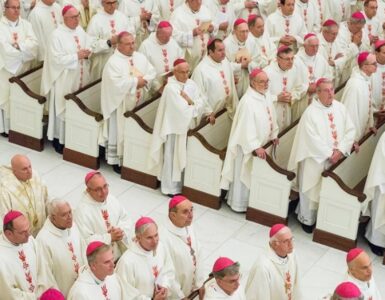

 Deacon Kurt Godfryd
 Mary F. Werbaneth