 Frank Jastrzembski
If you are fortunate enough, you will find a priest unlike any other. When that priest dies, you realize you will never find another like them.
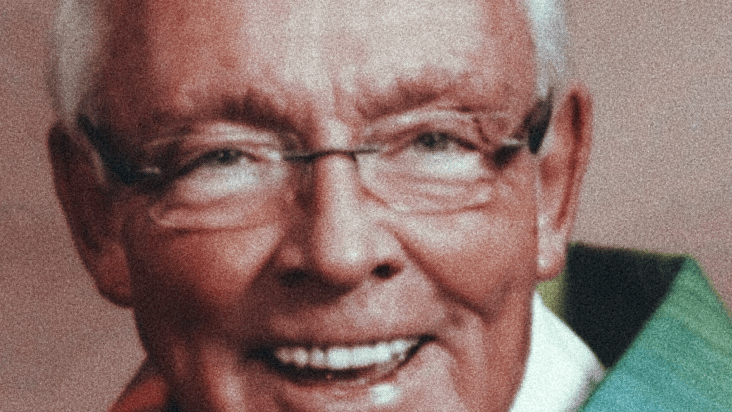
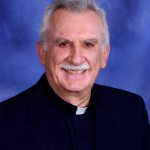
That was Rev. Michael Strachota for me.
Exactly one year ago today, Father Mike went home after a series of health complications that forced him into retirement and ultimately cost him part of his leg, leaving him wheelchair-bound.
Only a few months before we moved to Ohio, my wife and I paid the Capuchin priest a final visit to his assisted living home. We hardly had time for the trip, but my wife prodded me, saying we needed to see him before we left Wisconsin. I am grateful that she did, because it was the last time we saw him.
A Legacy of Love
Father Mike knew from the age of 7 that he wanted to be a priest. He would gather family members and friends to “say Mass” and deliver homilies.
The flame of faith burned incessantly in Father Mike’s heart for seven more decades, stoked by his love of Jesus and his parishioners. Even in old age, poor health, and retirement, it continued to smolder.
In the final year of his life, Father Mike celebrated 45 years of ordination. He continued to hold weekly Masses at the assisted living home, and my wife and I cherished the chance to be there the day he received his annual vase of roses from a parishioner who started the tradition more than four decades earlier. She presented him with a single rose in his first year as a priest and added one each year, uninterrupted, for 45 years. I don’t think I have ever seen so many roses in one vase.
That gesture is a testament to how many lives Father Mike touched.
In 2021, he received the Archdiocese of Milwaukee’s Vatican II Award. A priest friend who delivered the homily at his funeral joked, “I’ll never forget when a priest said to me, ‘I really like Mike Strachota, but you know, he’s already celebrated Vatican V.’”
Father Mike welcomed everyone, like Jesus, regardless of status, race, or faith. To him, those lines blurred, leaving only a precious soul. Jesus received anyone who opened their heart to God, and so did Father Mike. Rejection was out of the question.
And I loved him for all of these reasons, not least of all his homilies.
Words You Won’t Easily Forget
One of Father Mike’s strongest attributes, which he began to cultivate as a boy, was his gift for delivering powerful homilies.
Today, I believe the homily is more vital to the Catholic Mass than it has ever been before. It is the primary opportunity for the priest or deacon to drive home why listeners should strive to emulate Jesus in their actions, how to apply these teachings in daily life, and why any of it matters. Father Mike was a master at weaving the day’s Scriptures, his own life experiences, and what was happening in our troubled world into his homilies.
Father Mike’s brother, Tim, acknowledged this unique gift at his funeral.
“He preached God’s words that would touch us emotionally,” he recalled. “He would make us laugh. He would make us cry. He talked words of the past, and challenges of the present. He spoke our language, and we understood. But most importantly, he made us think.”
His homilies strengthened and deepened my faith, as they did for countless others. They made me question how I might apply them to my daily life.
Visiting numerous churches in search of a home parish since leaving Wisconsin has allowed me to hear a lot of homilies — some good, others OK, and a few not-so-good. Some priests interpret the daily readings for parishioners through a scholarly lens, with little, if any, commentary about how the message applies to ordinary life. No connection to the struggles and heartbreak those priests have experienced in their own lives — things that make them human. No association with modern events in the way Father Mike so often did.
I am not scolding priests for doing it this way, nor am I insinuating that I could do any better. Delivering an impactful homily does not come naturally. It takes years of practice and hours, and even days, of preparation to craft a powerful message tied to the Scripture readings within a 20-minute window. It is both a gift and a chore.
And before any priest reading this thinks that I am letting parishioners off the hook, think again. Churchgoers need to have open hearts to receive God. Not every homily is going to be equally impactful. One Sunday’s message might be more insightful than last Sunday’s, or maybe the last three Sundays have not really connected with you. Sometimes a priest is still learning the craft. Or maybe he simply will not ever be a Father Mike, and that is OK. All I am asking is that you give your priest a chance and be patient.
Rev. Richard C. Madden, a Discalced Carmelite of Holy Hill, Wisconsin, dedicated a chapter to the subject in his 1954 book Men in Sandals, humorously titled “The Plague of the Pulpit.” He wrote about the challenges of preparing and delivering sermons while keeping people interested.
“All [priests] ask of our people is that they be tolerant of us and charitable with their attention,” he wrote. “If through our sermons we cannot make them love God more, then we have failed. For which we are deeply grieved. But no one should ever forget that God can use blunt chisels to carve beauty into a soul.”
Priests, I ask you to strive to make each homily better than the last. The editorial staff for the magazine I work for lives by this mantra: “Make every issue better than the last one.”
Rev. William O’Brien Pardow, a successful Jesuit preacher, kept a record of the criticisms he received after giving a sermon so that he could perfect it the next time. “Voice was loud, harsh and husky,” “His preaching was monotonous,” “Should have been more conversational,” and so on. A biographer noted that “He collected them as carefully as another man might have collected compliments; the opinion of an altar boy was set down beside that of the provincial.” This habit included his own self-criticism.
“A priest who is going to preach even a five minutes’ sermon, is a lawyer going to plead the cause of our Lord and Saviour,” Pardow explained. “It may be a case of life and death … To have reached one soul is enough reward.”
“[T]here was never a moment, even in the height of his success and popularity, when he relaxed in his effort to improve,” Pardow’s biographer wrote.
I encourage priests to do the same with their homilies. Make them more impactful. Relevant. Emotional. Personal. Ultimately, doing so will lead to greater appreciation and respect for God within your parish — and, more importantly, it will lead people to think and reflect, even if it is only a single soul.
I am living proof, thanks to Father Mike.
An Ongoing Impact
On our last visit with Father Mike, my wife and I brought a case of Coke, his favorite drink, and chatted about our move and how we hoped to find a church like St. Catherine of Alexandria. We had dinner with his tablemates that evening and joked about how the kitchen staff could never get the grilled cheese just right. Father Mike told us that we were always welcome back. We hugged and parted ways for the last time.
I couldn’t help but feel sad for him. Here was a man who spent his life caring for and helping so many others, and yet he was waiting for the end as other residents of the assisted living home passed away around him, one tablemate after the next. Sure, he had a core of dedicated followers who stayed with him to the end, as well as a loving family, but it made me think of the countless priests who give their lives for others and, ultimately, die alone and virtually forgotten. Visit those priests after retirement to let them know they are still appreciated, respected, and loved after decades of selfless service. They are human, too, after all.
You find a priest like Father Mike once in a lifetime. His words, energy, passion, and love will remain with me for as long as I live.
Sadly, as we begin the first full year without him, his impact will live on through the countless people he inspired to think more deeply about their faith.
Alleluia.
If you’d like to hear him for yourself, you can listen to Father Mike’s homilies on YouTube.

 Paul Suski
 Vincent Ryan Ruggiero
 Fr Dino Vanin