


 Paul Suski
As we are now in the Feast of Divine Mercy, I recommend focusing on the beautiful words of Pope St. John Paul II at the Divine Mercy Sanctuary in Łagiewniki in 2002:
How greatly today’s world needs the mercy of God! In every continent, from the depth of human suffering, a cry for mercy seems to rise up. Where hatred and the thirst for revenge dominate, where war brings suffering and death to the innocent, there the grace of mercy is needed in order to settle human minds and hearts and to bring about peace. Wherever respect for life and human dignity are lacking, there is need of God’s merciful love, in whose light we see the inexpressible value of every human being. Mercy is needed in order to ensure that every injustice in the world will come to an end in the splendour of truth. (…) In the mercy of God the world will find peace and mankind will find happiness!
The inspiration for the establishment of the Feast of Divine Mercy came from the revelations of Jesus recorded by Saint Faustina Kowalska. It offers an excellent opportunity for a Western audience to become acquainted with little-known or entirely unknown episodes from the life of the Apostle of Divine Mercy. Her virtues and supernatural gifts may still astonish many and prompt reflection.
Suffering
Some may assume that the childhood of Helena Kowalska, the future Sister Faustina, was a life of ease and comfort. Nothing could be further from the truth; from the very beginning, the Heavenly Father was shaping this noble stone, destined for the construction of an eternal edifice.
In the Kowalski household, life moved with a quiet rhythm, cantered on work and prayer. God was given primacy—not merely on Sundays or during the solemnities of the Church; He was at the heart of the unfolding of every hour. It is said that Helena’s father began each morning by chanting religious hymns, often drawing a gentle reprimand from his wife for fear he might wake the sleeping children. Upon the walls hung the Sacred Heart of Jesus and the Immaculate Heart of Mary, images that were popular in the rural Polish landscape of the era. Stanisław Kowalski managed a modest, five-hectare farm—half of which was meadowland—and earned more for his livelihood by working as a carpenter and joiner.
The father of the future saint was a strict man who expected a lot from his children. He demanded total obedience and was known to punish even the smallest mistakes. On one occasion, he told three-year-old Helena—as a joke—that she should go live with the neighbours, since she did not look much like her siblings. Without a word of protest, the child submissively grabbed a small bundle of her things and walked outside. It was only after some time had passed that her mother, realizing the weight of what had happened, hurried out to catch up with the girl just as she was crossing the ditch and reaching the road.
A difficult childhood and her parents’ strong opposition to her entering the convent meant that, even as a young religious sister before her perpetual vows, she already had a remarkably mature understanding of suffering. She believed that everything the soul encounters—whether health or sickness—is a grace.
In a letter to Sister Ludwina, she wrote:
“Dear Sister, do not fear suffering too much; one must love it, for there is nothing sweeter than suffering. In my view, it is good to suffer much without any help, if it so pleases the Lord; to do so in quiet and silence is my greatest delight. Then, suffering itself will cease, and it can no longer be called suffering, but rather a delight.” On another occasion, Sister Kajetana noticed—about a year before her death—how emaciated Sister Faustina had become, with her bones clearly protruding. By then, her tuberculosis was already very advanced, yet she remained remarkably cheerful and kind to everyone around her. She never showed impatience or complained, even amid great hardship.
When Sister Felicja once asked whether it was truly good for her to work in the garden in such a condition, she replied:
“Sister, I am fulfilling God’s will, so I am doing very well; adversities will be found everywhere—one must only remember that it is God who sends them.”
As a reminder, Sister Faustina, due to her lack of formal education, belonged to the so-called Second Choir, made up of sisters who performed manual labour. In her case, this primarily involved work in the kitchen and the garden. By contrast, the First Choir sisters were responsible for managerial and administrative duties.
As postulant in the Congregation of the Sisters of Our Lady of Mercy, Sr. Faustina was assigned to assist in the kitchen.
Sister Szymona recounts an episode in the kitchen:
We were grinding meat in a machine; I was turning the crank, and Sister Faustina was feeding and pushing the meat in. Suddenly, while turning, I felt resistance, and Sister Faustina, completely calm, said: “Sister, please reverse the crank.” When I did so, she withdrew her hand; the finger was completely stripped of skin and bleeding. She did not even wince. She went to dress the finger and returned to work.
Obedience
If among the readers there are those who have, even for a short time, experienced life in a religious community, or who have a loved one who is a nun or a religious priest, they know well that the hardest of the religious vows is not the vow of chastity, as one might think, but precisely the vow of obedience.
By this time, our protagonist had made her perpetual vows. Where other sisters struggled to grow anything, she, in her role as gardener, achieved remarkable results. Sister Klemensa gave specific figures: “From a relatively small plot, we harvested 150 kg of strawberries a day—an amount that was difficult even to imagine.”
Sister Kajetana Bartkowiak also recalled a remarkable episode involving cabbage. It was a time of drought, and the sun was scorching. The head gardener had instructed the sisters not to break up the clods of earth, as they might help retain moisture. Some sisters, however, disregarded religious obedience; they broke up the clods and watered the seedlings by hand, carrying water from a nearby stream. Sister Faustina did exactly as Sister Klemensa had directed, placing the seedlings directly between those hard clods of earth.
Sister Kajetana, who was then in charge of the farm in Krakow, watched this and tapped her forehead in disbelief. “Where is your common sense?” she asked. “Nothing will ever grow if you plant like that.” To this, the mystic replied that great heads of cabbage would indeed grow from those very spots. And so, they did!
She did nothing on her own initiative. Yet her obedience was neither blind nor mechanical; it was thoughtful and deeply considered. This is beautifully illustrated by one incident.
The convent sold surplus fruit and vegetables from its garden at the Monday market, the only market day of the week. Sister Faustina could not agree to packing the produce on Sunday evening, believing that it violated the sanctity of the Lord’s Day. Sister Damiana later sought guidance from a priest, who explained that “such work is for the good of the Congregation and is justified even on a Sunday.” Even so, Sister Faustina objected, maintaining that the commandments of God and of the Church apply equally to everyone. She brought the matter to the Mother Superior, and with her permission, the sisters began rising at 3 a.m. to prepare the goods for sale.
Let us turn back the clock by a few years.
The garden was always kept in impeccable order; the grounds were clean and the paths neat. “Once,” Mother Michaela recalled of Sister Faustina’s time in the Vilnius convent, “we were showing around guests from high government circles.” One of the visitors remarked, “My, the sisters certainly have a specialist gardener here!”
Charity
Sister Faustina was given a difficult resident to help in the kitchen—a girl with a very unpleasant disposition whom no one else wanted to work with. (The sisters ran a home for troubled girls and women, some of whom had had minor brushes with the law.) “At every turn she caused Sister Faustina trouble,” Sister Alojza recalled, “and yet Sister Faustina never complained about her.” During her time with Sister Faustina, the girl’s heart changed beyond recognition. “She had such a quiet but godly influence on souls,” Mother Serafina, superior of the convent in Walendów, wrote in her memoirs.
She was also keenly sensitive to even the smallest slights and sufferings her fellow sisters sometimes endured. Once, when a sister who had waited too long for a meal helped herself to food from a pot and received a harsh rebuke from the cook, Sister Faustina spoke in her defence: “How can you speak to a sister that way and cause her such distress? After all, every sister is the apple of the Lord Jesus’ eye.”
Sister Faustina suffered from tuberculosis at a time when no effective medications were available in Poland; the usual treatment consisted of long hours in the fresh air and a high-calorie diet.
“Silence is the doorkeeper of the interior life.” – St. Josemaria Escriva
After returning from nearly four months of convalescence and feeling somewhat stronger —this was during the final months of her life— Sister Faustina resumed work in the garden at Kraków-Lagiewniki. Sister Zefiryna, who was then a young, professed sister, recalled that Faustina “was deeply recollected and never broke the silence. She showed an unwavering love for her neighbour and had a gift for noticing the good in every sister, which was very encouraging.”
Another sister, also newly professed at the time, Sister Eufemia Tarczyńska, remembered her as someone who was “always composed, cheerful, and smiling. I never heard her speak ill of anyone. She longed for holiness and wanted the entire world to be holy.”
Prophetic Insight
The nun possessed the rare gift of foreseeing future events. Once, while talking with her fellow sisters about what might happen after her death, she predicted a terrible war. Doubting her words, Sr. Klemensa replied, “If there is a war, it will be short—people will poison one another with gas, and that will be the end of it.”
“Oh no,” Faustina answered. “The war will last a long, long, long time. There will be terrible misfortune, and immense suffering will fall upon the people.”
“And will Poland still exist?” someone asked. “Oh, Poland will exist, but there will be few people, for many will perish, and they will long to see one another.’ “At these words, Sr. Klemensa laughed and seemed entirely unconcerned.
The mystic assured Sr. Anna — “the sisters will remain here in ‘Jozefow,’ but we will need to pray fervently for this.”
Soon after, World War II broke out and the German occupation began. “We were constantly threatened with expulsion from the convent,” recalled Sr. Felicja, “just like other religious orders.” Three times the threat seemed imminent; but each time all the sisters went to Faustina’s grave to implore Divine Mercy. Each time, the danger passed and throughout the entire war they were never forced to leave their premises.
Her words were also fulfilled: “The time will soon come when this gate will be open, and people will come to pray to Divine Mercy.” After the outbreak of World Conflict in 1939, the sisters opened their gates to refugees and the poor, preparing several hundred meals a day. Her resting place began to attract a large number of visitors; initially, pilgrims came only from Poland, but after the war, they began arriving from abroad as well.
Between 1952 and 1965, the sisters’ recollections were formally recorded and confirmed under oath. After Faustina’s death, Natalia Grzelak, Helena Kowalska’s younger sister, frequently and eagerly shared her memories with the nuns of the Congregation. She recounted a remarkable story of how Faustina appeared to her supernaturally to say goodbye at the moment of her passing. Insisting that it was neither a dream nor a hallucination, Natalia recalled hearing these words: “Father will die first, even though he is in good health, and Mother, despite being gravely ill, will live a long life.” This is exactly what happened!
Summary
Although the Heavenly Father tested Sister Faustina like gold in a furnace, He spared her the traumatic experiences of World War II, which were particularly painful for the people of Central and Eastern Europe. Conflict in the Middle East has been escalating. According to reports, Russia is helping Iran identify potential strike targets. A devastating pattern of warfare is eroding the very foundations of civilian life in the region. All in all, the Earth appears to be in serious turmoil, and predictions about World War III are abundant. Some even say that God is about to turn our Globe to shake out the lice.
Whether these words are true or not, we ought to turn to Him continually and with confidence, not paying too much attention to politics. Just be on God’s side, and you will be on the winning “party.” Therefore, one should call upon Divine Mercy with even greater trust.
Saint Faustina, ora pro nobis!

 Fr Joseph Esper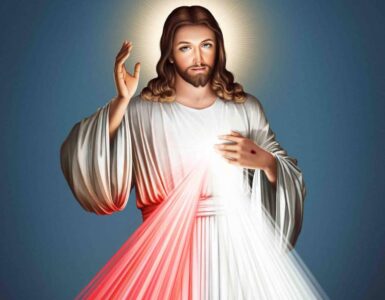


 Fr Dino Vanin