
 Carolyn Humphreys, O.C.D.S.
Matt Talbot was born in Dublin, on May 2, 1856 to a family that was large and poor. His father worked on the docks and had a hard time supporting the family. After only a few years of school, Matt went to work as a messenger for a few liquor merchants. He soon began “sampling their wares.” By age fifteen, his drinking was excessive; he was an active alcoholic for fifteen years. He frequented pubs in the city with his brothers and friends, spent most or all of his wages on liquor, acquired debts, and borrowed or begged for money. He even pawned his clothes and boots to get cash for alcohol. One time, he stole a violin from a street entertainer and sold it to buy drink.
One day he decided to take “the pledge” (renounce drink) for three months, made a general confession, and began to attend daily Mass. At the end of the three months, he took the pledge for six months, and then for life. Evidence supports the fact that Matt’s first seven years after taking the pledge were very difficult. It was hard to avoid his favorite pubs and drinking friends. However, he changed from being an indifferent to being a strong Catholic, and for the rest of his life atoned for his irresponsible behavior. Most of his life Matt worked as a builder’s laborer. His job did not make him rich; however, he contributed generously to the missions. He joined the Secular Franciscan Order, lived a life of unyielding reparation; abstained from meat nine months a year, and said the rosary, and read Scriptures and the lives of the saints each day. He also tried to pay back people from whom he had borrowed or stolen money and participated in activities that made up for the hurt and disruption he caused during his drinking days. After 1923, Matt’s health failed, and he was forced to quit work. He collapsed and died of heart failure on June 7, 1925 while on his way to church. He is considered to be the patron for those struggling with alcoholism. Alcoholic people who have stopped drinking can understand and fully appreciate how difficult the early years of sobriety were for Matt. During his sober years he lived by taking one day at a time. This is good advice for all of us. Books have been written, retreat centers founded, and programs established through the influence of Matt Talbot. His journey in life has encouraged innumerable people to live in hope and trust in God.
Although uncontrolled addictions are not as intense as slavery, it can destroy lives. Alcohol is the most common substance addiction. Addiction can be viewed as a lesser form of enslavement, where a person’s behavior is controlled by a substance, circumstance or activity, despite its negative consequences. That individual is negatively circumscribed by a strong physical or mental need or urge that causes physical, psychological or social harm. Addiction holds a person captive and diminishes his or her life.
What to do?
We are all sons or daughters of God even though we may be personally enslaved by lack of freedom through an addiction that has a powerful hold on us. Are there ways to break the shackles of addiction? The following suggestions may be considered for those of us who are addicts or have other serious problems.
Awareness occurs when we admit that we are an addict. An addict is a person who cannot stop doing or using something, particularly something harmful. Our addiction becomes an idol when we cannot live without it. Addictions take the place of God. What are the gods that hold me captive in my life? We wake up when we admit we are powerless over our addiction and we can no longer manage our lives. We acknowledge there is a personal God and we need his help.
Acceptance means understanding ourselves as we are at the present time without judgment, recrimination or other self accusatory labels. We list the positive and negative aspects of ourselves, our current situation, and beneficial changes such as new habits, better routines, and realistic goals. To help us with the changes we consult a professional therapist and pray for Divine assistance. Time will help us to be patient, trust in the sometimes slow work of God, and be open to grace. We begin to walk the straight line on our path to God and do not look back at our immobile times of self pity, despair or self absorption. Jesus is with us as we walk forward. When we bond with him, we learn to see life beyond ourselves.
Action means to change from one state to another. Passively sitting still and feeding our problem is replaced by proactively doing something to find a solution. We take purposeful steps to implement the changes we listed that support our desired outcome. We move ahead with the support of daily prayer and an assurance that God is with us. Action does not let us mope if we relapse. We remember, and act upon, the wise words of a venerable old monk: “Life is this: I fall down and I rise up, I fall down, and I rise up, I fall down and I rise up.”
If we look beyond our mistakes, we see that everyone makes them. We are not alone. We all fall short. This helps us move out of our own pain into a universal reality. As Paul the apostle said, we do things we do not want to do and do not do things we should do. When this happens we turn to the God’s loving forgiveness. We embrace God’s merciful grace and allow that grace to embrace us. God’s mercies never fail, and they are new every morning. The Bible reassures us that in spite of our mistakes and self indulgence, we are worthwhile, treasured, loved, and made in the image of God. We are God’s masterpiece of creation even when we blunder.
Jesus is the commanding reminder of God’s steadfast love and faithfulness, even in the midst of suffering and adversity. He encourages us to rest in the promise of God’s mercy, to find hope in the midst of desolation, and the importance of expiation. Like Matt Talbot, we also must make amends to the people we harmed, or things we destroyed, during our addictive binges.
Alcohol Use Disorder, often called alcoholism, is a familiar medical condition. In this disorder, people cannot stop drinking, even when it affects their health, risks their, or others, safety or damages their personal relationships. Alcohol use disorder is not a choice or a moral failing, but rather a chronic disease that is progressive. This means it tends to worsen over time if left untreated. Treatments vary according to individual needs. They can involve counseling such as behavioral therapy, medication, medical detoxification, mutual support groups that offer encouragement, confidence, and belief in the power of God, individual therapy, a residential inpatient stay or programs that offer necessary lifestyle changes. Alcoholics Anonymous is an international fellowship organization that has been in existence for over eighty years. They welcome anyone who has a desire to stop drinking. Members admit to their group that they have a drinking problem, share their personal stories, strength, and hope, and try to get sober and stay sober. There are no dues, fees, or payment needed to attend meetings.
Dominated Persons
Self chosen addictions are modern day slaveries but they should not be equated with slaveries such as forcible kidnapping or modern day human trafficking that are world wide. In the United States, slavery was the premier atrocity. Man’s inhumanity to man knew no bound and lasted approximately 246 years. Since that period has the incidence of slavery decreased? It may be not as well known, but it is still present in people who are in domestic servitude, sexual exploitation, forced labor, debt bondage or migrant farm workers. Other forms operate seemingly as legitimate activities. They look inviting from the outside but are corrupt on the inside. Regrettably, concentration camps did not end with the Nazis. Although they are known by different names, today there are places that resemble concentration camps dedicated to the torment or dehumanization of civilians.
Today individuals formerly called slaves are now often referred to as “enslaved people” or “enslaved individuals”. This change in terms emphasizes that the individuals are people, and not merely objects, and separates their identity from the circumstances of being enslaved. People can end up in slavery because they live in harsh poverty, are tricked, believe fabrications, arevulnerable, trapped or exploited. Fulton Sheen wrote, “Our Blessed Lord said nothing about slavery, because he knew that slavery would never be eradicated until men saw themselves related to one another on the basis of equality as children of God.” Viktor Frankl, in his classic book ‘Man’s Search for Meaning,’ which was based on his experience in Nazi concentration camps, shows how most people who hold on to the hope of achieving something positive can survive the worst of human conditions.
Bakhita’s Story
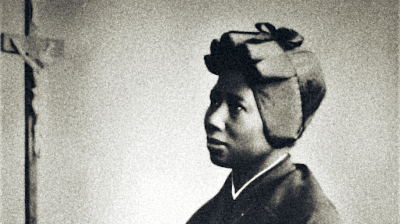
Josephine was born in the Darfur region of southern Sudan. At the age of seven, she was kidnapped, sold into slavery and given the name Bakhita. She was sold several times; her body mutilated by those who were cruel to her. In 1883 she was sold to Callisto Legnani, the Italian consul in Khartoum, Sudan. Two years later, Callisto took Bakhita to Italy and gave her to his friend Augusto Michieli. Bakhita became Mimmina Michieli’s babysitter and accompanied her to Venice’s Institute of the Catechumens, run by the Canossian Sisters. While Mimmina was being instructed, Josephine felt attracted to the Catholic Church. She was baptized and confirmed in 1890. Since slavery was illegal in Italy, her baptism set her on a path to freedom, and to serve God’s people as a Canossian Sister. Josephine entered the Institute of St. Magdalene of Canossa in 1893 and made her profession of vows three years later. In 1902, she was transferred to the city of Schio (northeast of Verona), where she served her religious community by cooking, sewing, embroidery, and welcoming visitors at the door. She was well loved by the children attending the sisters’ school and the local citizens. She once said, “Be good, love the Lord, pray for those who do not know him. What a great grace it is to know God!”
Bakhita means fortunate. She was beatified in 1992 and canonized eight years later.
She also said, “The suffering caused by illness is more meritorious than any self inflicted mortification.” Serious illness, short or long term, can leave us confined, at the mercy of others, doing things we would rather not do and feeling dehumanized. John Henry Newman was thirty-three years old when he was on a boat going from the Sicilian city of Palermo to Marseille, France. He was headed home but dangerously ill with a frightening fever. While he was recovering on the last boat returning to his native England, he penned the lyrics to “Lead, Kindly Light.” This beloved hymn emphasizes that God’s light can illuminate even the darkest paths and encourages us to trust in God’s wisdom and timing.
Lead, Kindly Light, amid the encircling gloom, Lead Thou me on. The night is dark, and I am far from home, Lead Thou me on. Keep Thou my feet; I do not ask to see the distant scene; one step enough for me. I was not ever thus, nor prayed that Thou shouldst lead me on. I loved to choose and see my path; but now Lead Thou me on. I loved the garish day, and, spite of fears, Pride ruled my will; remember not past years. So long Thy power hath blessed me, sure it still Will lead me on. O’er moor and fen, o’er crag and torrent, till The night is gone. And with the morn those angel faces smile, Which I have loved long since, and lost awhile.

 Fr Joseph Esper
 William Borst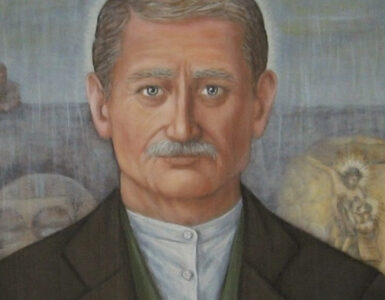

 Vincent Ryan Ruggiero
 Fr Dino Vanin