
 William Borst
In my Georgia parish, during the past few months, we have witnessed at least four First Communions and sundry Baptisms. This policy of incorporating sacraments within the body of the Mass has been interesting to say the least and very uplifting for our parish.
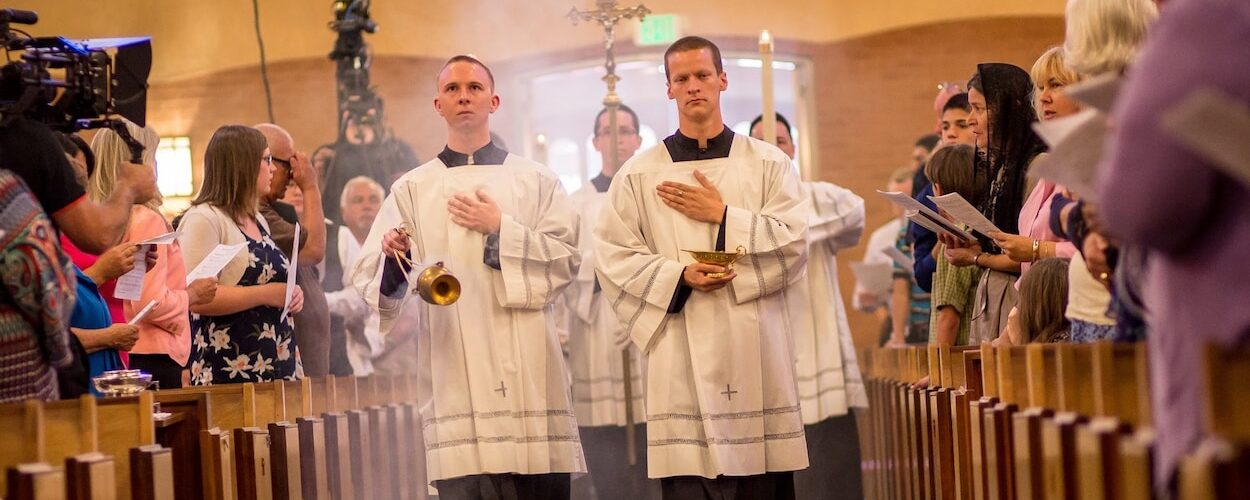
There has been nothing new lately. So, last Saturday at the Vigil Mass, I focused on the altar servers, mostly prepubescent boys with a few girls mixed in. I was impressed by how much their service and presence added to the solemnity of the Mass.
I was surprised to learn that the history of the altar server dated back to the Middle Ages. Some of the Church’s ministries were formalized under the term minor orders and along with the diaconate were considered steps to the priesthood. Altar servers are a substitute for an instituted acolyte, or an assistant to the celebrant in a religious service.
St. Tarcisius was a holy man from the 3rd century, who is alleged to have helped the priests with Mass in the catacombs. He was known for his great love of the Eucharist. For his devotion, he is also regarded as the Patron of Altar Servers.
Altar boys were a unique brand of young men who historically served Mass at the altar. This ministry started as a means to attract them into the priesthood. Though more than 70% of priests ordained in 2020 started their religious journeys as altar boys, it evolved into a broader spectrum for involving young people in the Mass.
I immediately fell into one of my reveries and started thinking back to when I was their age. Though I never had the calling to be either a priest or a server, my best friend then was an altar boy. Gerry and I were part of a triumvirate of three young boys who lived a block and a half from each other.
We were like staircase kids, born a year apart. I was the middle one. We all went to Our Lady Queen of Martyrs in Queens where we attended Mass. Both of us followed Doug, the oldest to Xavier High School in Manhattan, a Jesuit military school, which is redundant. While I continued the streak by following Doug to the College of the Holy Cross, Gerry broke the model by going to Notre Dame.
During Lent one year Gerry and I made the Stations of the Cross together. He used to show off by reciting all the prayers in Latin, a language we both would later endure at Xavier. I cannot forget how devout he was. No wonder, he was an altar boy.
I cannot fathom why I never was attracted to any service at the Mass. Perhaps, the story I have recounted here about the priest on our pilgrimage to Italy many years ago, who threatened to punch me in the nose if I said I felt unworthy to be a Lector, explains it.
Not being a server did make me unique during and after college because it seemed that any man who still practiced the faith had been one. I have never really done anything to directly be involved with the actual Mass, not counting my 18 months as a Lector. (See The Parish Lector, September 17, 2017) There is something about being in the sanctuary that overcomes me with awe and maybe a little apprehension.
I do have three Masses in my personal vita that I served in Wiggins, Mississippi during Easter Week in 1966. I was there to visit Barbara, a fellow Extension Volunteer, for whom I had some deep feelings for at that time. While visiting, I spent the three nights sleeping on the rectory couch.
Each morning the pastor celebrated Mass so I was elected by default to serve on the altar since females were not allowed then. Since I was an absolute beginner who had little idea what I should do, the priest had to walk me through my duties during the Masses. By the very grace of God, I was able to function without sacrilege or any serious mishap.
Later when I married, (not the aforementioned girl above) and had two sons out of our three children, both became servers for 4-5 years. As their father, I had to drive them to their first two straight weeks for the daily seven o’clock Mass. Though I was not 100% conscious during Mass, my heart welled up with a parental pride that sent waves of joy through my soul. They looked so angelic in their uniforms. From then on, anytime one of them served, my regular job was to drive them to the church. I still relish every minute of it.
The only problem with my watching them serve the Lord was my deep fear that in their lighting the candles. Their long, floppy sleeves were like a fire just waiting to happen. I had serious visions of their being immolated before my eyes. I remember one occasion when the elder son had serious trouble in lighting the candles. They just would not ignite right away. It took him more than a few minutes before the flame appeared.
Though it was probably not this occasion, after Mark had finished lighting the candles before one Mass, this heavy set young man with obvious mental trouble stormed through the church doors. Then he angrily marched up to the altar and blew out my son’s candles. With the candles smoking and devoid of illumination, he made an about-face and marched out the way he had entered. He left the few people in the church shaking their heads. I kept thinking, did he not like the way my son lit the church’s candles?
I have also cited my experience as a Talk Show host for many years on WGNU radio, in St. Louis. One of my favorite stories was about my dealings with one of my most irritating callers on the air, a black man, who called himself, The Prisoner of Love.
As I recounted several weeks ago in The Unbroken Seal and countless essays before that, he always began his call with the hostile words: When you gonna talk about priests and dem little boys? He was obsessed with the brewing scandal in the Catholic priesthood concerning the sexual abuse of several young boys, many of whom had been altar servers, a primary source for their victims.
In retrospect when one understands just how long the Church has sat on this issue, and did little more than kick its repulsive can down the years, it is disconcerting and can shake one’s faith in the Church. I always thought he was exaggerating but he obviously had been better informed than I was. I am not certain I used it on the air but I think I answered his claim with my quip that the priests’ scandal was the reason the Church decided to open the altar service to girls. Though I seriously doubt that was the real reason, my answer does make perfect sense.
The Church had a long-standing rule that no woman may enter the sanctuary at all. Pope Benedict XIV and encyclicals over the centuries even called their presence an evil practice. When females started showing up on the altar at first, I did not like the idea. I had always thought that the Mass and the altar was always a sanctuary (no pun intended) for men and boys.
Many Church leaders feared this would lead to women in the priesthood, which is an idea I doubt I could ever support. Like gay marriage, it would permanently alter the nomenclature of another sacrament. What would we call them? Mother? That is what the head of a convent is called. Homosexual men call their male spouses wives. Are we to call our female priests, father? Mother would really sound out of the ordinary thought at least it is the correct gender. Others feared that scandal might arise from a priest and a woman, alone on the altar.
It took the Second Vatican Council in 1963 to discuss the issue though without settling on a clear policy. St. John Paul II was up to the task and changed these archaic rules so that girls could be altar servers, though subject to the scrutiny of the priest and his pastor.
Despite Vatican II, and the late pope, there are still many diehards who oppose girls on the altar because traditionally the altar server was a step toward the priesthood. If girls were allowed to perform as servers, it might provide a strong impetus to allow women in the priesthood.
In 1983 the Code of Canon Law said that Lay persons can fulfill the function of lector in liturgical actions by temporary designation without distinguishing between men and women. This led to many dioceses allowing female altar servers, as well. The Church began accepting girls as servers in 1995. The Church’s semantic police say we do not say altar girls or boys anymore, only altar servers.
Others correctly say few boys at that age want to do things that girls are allowed to. They fear most boys will be chased away from the altar. Many Catholics believe God intended for men and women to have different roles in the Church, family and society. Unfortunately, the modern world has shred serious holes in this belief, making it virtually untenable. This could add fuel to the fear that a modern world wants to destroy the Catholic Church as we know it.
While it took the hierarchy over 30 years to bend on altar girls, it has no intention of accepting women to the Catholic priesthood. This is a long-standing tradition that I hope they never will alter. The Church does not want to lose the general impression that Rome has always recognized the connection between boys serving at the altar and priestly vocations. It was not forced on all dioceses but left to the discretion of each bishop with the caveat that no individual priest could be forced to accept altar girls.
Though it has taken me a while, I think I am finally willing to accept the fact that girls on the altar are here to stay. However virtually all I have encountered are prepubescent, on the dawn of full maturity. I can only imagine what would be the reaction to a fully developed teen appearing in the altar boy cassock. One thing I do know whenever a woman breaks some kind of male barrier, things will never go back to the way they were. Women have to change the culture, wherever they go. It is in their nature.
I think this essay should also treat the question as to how many famous Catholic men were altar boys during their youth. The list was not as long as I had anticipated. A few athletes came to mind. The first was Vince Lombardi, a graduate of Fordham University and a member of the most famous football line, in college history, the Seven Blocks of Granite. Leo Paquin, my Latin teacher at Xavier and the school’s football coach was also a member.
Lombardi earned his Hall of Fame notoriety while the coach of the Green Bay Packers during their glory days in the sixties when they won the first two Super Bowls. Not only was he an altar boy but he had been a devout Catholic until his death from cancer in 1970 at the age of 57.
Another devout Catholic, who also served on the altar was Harrison Butker, the place kicker of the Kansas City Chiefs, whose field goal in 2023 won the Super Bowl in overtime. He didn’t stop serving when he became a football player. Having just turned 30, he can still be seen regularly on the altar at St. Mary’s Catholic Church in Independence, Missouri.
Several famous and well known Church figures, such as St Francis Xavier, Cardinal Newman, Paschal Baylon, Martin de Porres, Pope Pius X and Bishop Fulton J. Sheen were all altar servers. Even actor George Clooney and TV host Jimmy Fallon also served God on the altar.
Devout religious faith often makes me think of actor, Mel Gibson. He was still serving at a Latin Rite Mass, as late as 2021. During the making of his faith-based film, The Passion of the Christ, a Latin Mass was offered every day during its production. Many people who were involved in the film proclaimed that it was this practice that made it such a successful movie.
Bill Strub was considered a marvel to have been the oldest altar boy when he died at the age of 98 in St. Paul, Minnesota, in 2018. He had served Mass continually for 88 years at Assumption parish at the 9:30. Many admired him for his great reverence for the Host. Strub also served as a mentor for countless younger altar servers.
After 75 years of attending Mass, I could not fathom one without a server. I think it would be incomplete. But this streak ended recently when our celebrant said Mass without any server at all, not even an adult, summoned from the congregation. I could easily feel the difference. I have also observed that it seems as if we have the same servers almost every week. I hope this is not an indication that like the priesthood, the Church is having difficulties in attracting young people to serve Holy Mass.
I seriously doubt that anyone will disagree that the altar servers are the unsung heroes of our faith and have often acted as its lifeblood. Perhaps this may explain why the Hierarchy is struggling to fill their congregations’ need for more priests. I think we should all thank the altar servers for their vital contributions to our faith. As the saying should say, Take an altar server to lunch.


 Donald Wittmer
 Fr Joseph Esper
 Jennifer Borek
 Thomas Addis